The True Cost of RFID Quality: Why Testing Pays for Itself
For many RFID manufacturers, quality assurance is often viewed through the lens of cost. Testing equipment, quality management systems, and process controls require investment, making it tempting to minimize testing in pursuit of lower production costs.
However, this perspective only captures part of the picture.
The real question is not how much quality costs, but how much poor quality costs. Once all direct and indirect consequences are considered, quality becomes one of the strongest drivers of profitability, operational efficiency, and customer retention.
The most successful RFID manufacturers understand that quality is not simply a production requirement—it is a business strategy.
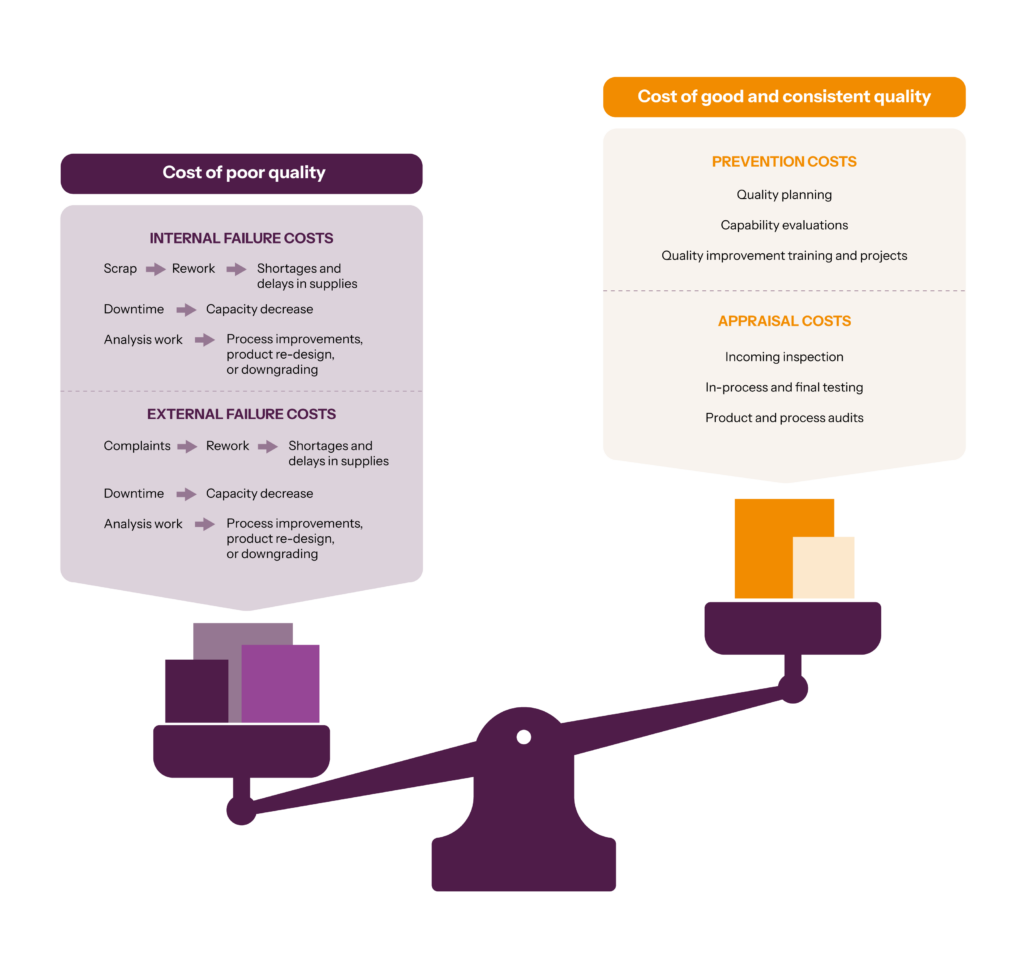
Every manufacturing operation carries two types of quality-related costs.
The first is the cost of good quality. These are planned investments that help prevent defects before products leave the production line. They include RFID testing equipment, process monitoring, quality assurance procedures, operator training, and production verification.
The second is the cost of poor quality. These costs only appear when something goes wrong. Scrap, rework, production downtime, engineering investigations, delayed deliveries, customer complaints, replacements, warranty cases, and damaged reputation all belong to this category.
While investments in prevention are easy to identify in a budget, the costs created by defects are often spread across multiple departments and business processes. As a result, they are frequently underestimated.
Every defect has a price—even inside the factory
The impact of poor quality starts long before a customer notices a problem.
When defects appear during production, manufacturing efficiency immediately begins to decline. Engineers investigate root causes, operators stop production lines, affected batches require additional inspection, and production schedules need to be adjusted.
For RFID manufacturers operating high-speed production lines, even a relatively short interruption can represent thousands—or tens of thousands—of labels that are no longer being produced.
The consequences quickly accumulate:
Production downtime
Material waste
Additional inspections
Rework
Lost production capacity
Delivery delays
Although these costs remain internal, they directly reduce profitability. The earlier quality issues are detected, the easier—and less expensive—they are to resolve.
The economics of quality become clearer at scale
As production volumes increase, even small defect rates begin to carry significant financial consequences.
Consider a simplified example.
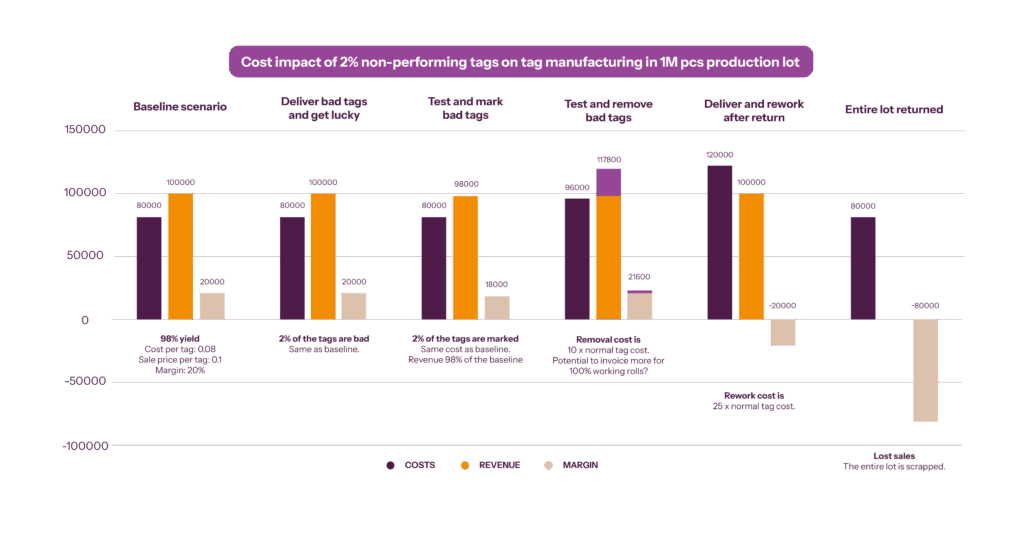
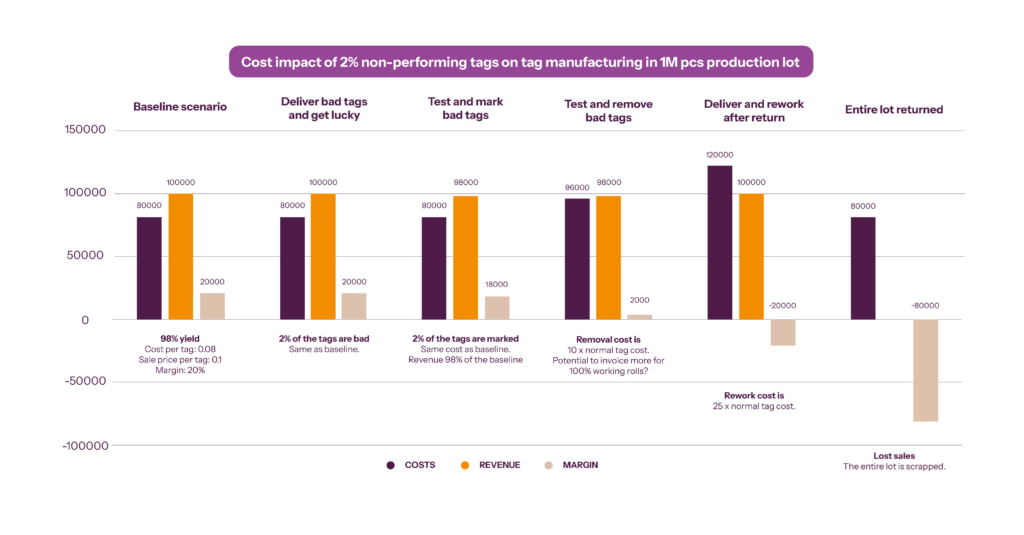
A converter manufactures one million RFID labels with a production yield of 98%. Two percent of the tags do not meet performance requirements.
At this point, there are two possible approaches.
The first is to ship every label without testing and hope the defects go unnoticed. On paper, this appears to maximize margins because no additional quality costs are incurred.
The second is to verify product quality during production, identify defective tags, and either mark or replace them before shipment.
Testing naturally introduces additional cost. Yet it also prevents defective products from reaching customers, keeping margins positive while significantly reducing business risk. This illustrates an important principle of manufacturing economics: The cost of preventing failures is typically far lower than the cost of correcting them later.
Everything changes once defects reach the customer
The financial impact increases dramatically when poor-quality RFID labels leave the factory. What was previously an internal production issue quickly becomes a customer issue.
Instead of simply replacing defective tags during manufacturing, suppliers now face a much longer chain of consequences:
Customer complaints
Technical investigations
Product returns
Replacement production
Additional logistics
Customer support
Production rescheduling
The original production costs have already been incurred.
Now the same order generates new costs through investigation, reproduction, shipping, and customer management.
An order that initially appeared profitable can quickly become unprofitable.
More importantly, production resources that could have been used for new business are instead consumed by correcting previous mistakes.
The biggest cost rarely appears in financial reports
While scrap and rework are measurable, the largest consequence of poor quality is often invisible.
Customer trust.
RFID labels are critical components in increasingly automated supply chains. Customers rely on consistent read performance and predictable quality because failures can disrupt their own production, logistics, and operations.
If quality problems occur repeatedly, customers begin asking difficult questions: Can this supplier consistently deliver? Will future shipments perform as expected? And finally, should another supplier be considered?
A rejected shipment may be expensive, but losing a long-term customer relationship is far more costly. The value of repeat business, future projects, and referrals often exceeds the financial impact of a single defective production batch.
Quality is becoming a competitive advantage
In today’s RFID market, manufacturers compete on far more than price. Customers increasingly expect suppliers to demonstrate—not simply claim—the quality of their products.
Manufacturers that can consistently verify performance, monitor production quality, and provide objective quality data strengthen customer confidence throughout the purchasing process.
This transforms quality from a manufacturing function into a commercial advantage.
Consistent quality leads to:
Greater customer confidence
Fewer complaints
Stronger customer retention
Improved operational efficiency
Better long-term profitability
Rather than viewing testing as an expense, leading manufacturers increasingly see it as an investment in customer relationships.
The objective is optimization—not maximum testing
Investing in quality does not mean testing everything imaginable or adding unnecessary process steps.
The goal is to find the optimal balance between prevention costs and failure costs.
Initially, investments in testing and process control produce substantial reductions in scrap, rework, downtime, and customer issues. Eventually, however, the additional benefits begin to diminish.
The objective is therefore not to maximize quality spending, but to minimize the total cost of quality.
Finding that balance allows manufacturers to improve profitability while maintaining the level of quality customers expect.
Quality decisions should never be evaluated solely against the cost of testing equipment or inspection processes. The more important comparison is between the visible investment in quality and the hidden costs created by poor quality throughout the entire business.
For RFID converters and inlay manufacturers, those hidden costs extend far beyond production. They influence manufacturing efficiency, delivery performance, customer satisfaction, reputation, and future revenue.
Companies that consistently invest in measuring, controlling, and proving quality are not simply producing better RFID products. They are building more resilient operations, stronger customer relationships, and a more profitable business over the long term.
RFID Label Production for Label Converters
Did you get a customer request for RFID labels? Is your company preparing to start to convert RFID smart labels, and now you need all the information on how to produce RFID smart labels? You are at the right place!
Smart labels are one of the most common RFID tag types, especially in retail business, but also in numerous applications in other industries. Increasing acceptance of RFID technology and the double-digit growth rate of inlay and tag volumes in the past years have made smart labels an attractive business segment not only for the established RFID companies, but also for the traditional label manufacturers.
The barrier for a label company to enter the RFID smart label business is very low as their core business comprises of printing and converting anyways – adding inlay insertion or inlay lamination to the converting process will increase the label manufacturer’s value-add and enable meeting the customers’ RFID and IoT requirements.
We gathered all you need to know when starting RFID label converting in one handy resource. In this page, we give you an introduction to basic concepts and how RFID works, walk you through the RFID label production processes, and give you insights on what you need to take into consideration when you prepare for the RFID label converting operation. Among the information you can find also useful links to explore.
First, let´s look briefly at how RFID actually works.
RFID (Radio Frequency Identification) system consists of RFID tag, RFID reader and software to collect and manage data. The technology enables automatic identification of items and data transfer between RFID tag and reader. When the RFID tag is read with a reader, the reader emits a radio signal, which wakes up the tag to send its ID to the reader.
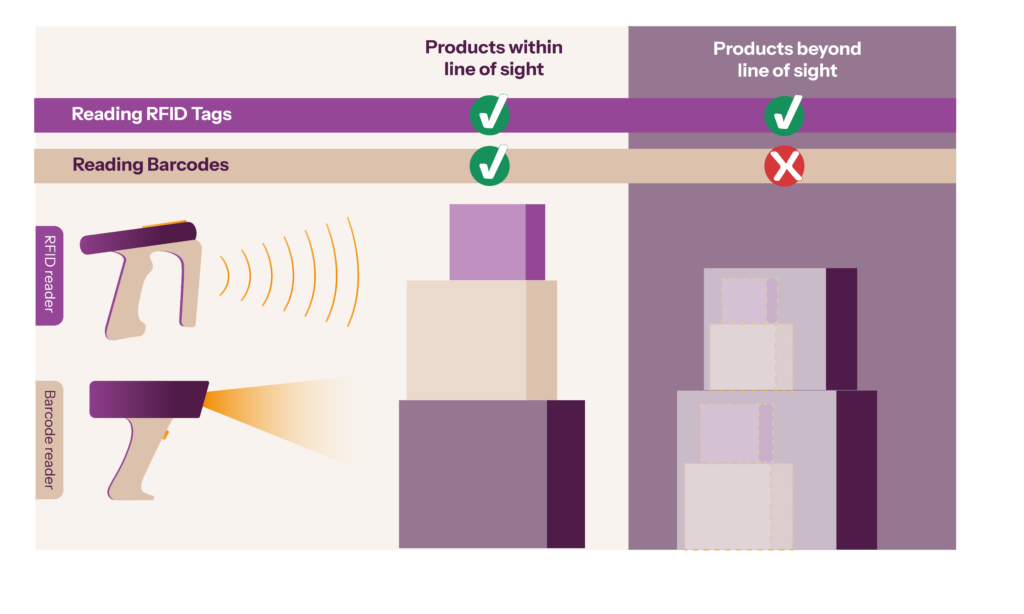
Unlike, for example, barcodes, with RFID many item tags can be read at once, without line of sight. It is also possible to read the tags inside a box or packaging. These are the reasons the technology is leveraged in, for example, retail and logistics or apparel, as RFID technology brings cost- and time-saving solutions which in turn make the whole operations more efficient.
Different types of RFID systems
RFID systems can be categorized based on operating frequency, power source, and application requirements. For label converters, understanding these distinctions is essential for providing the customer the most suitable product for their specific application and needs.
Ultra High Frequency (UHF) aka RAIN RFID
Label converters most often work with Ultra High Frequency (UHF) RFID, which operates in the 860–960 MHz band. UHF provides significantly longer read ranges than other RFID technologies—typically several meters and, in optimized systems, more than ten meters depending on antenna design, tag orientation, and regional regulatory limits. It also supports high data rates and strong anti-collision performance, enabling hundreds of tags to be read simultaneously.
RAIN RFID refers specifically to the global, standards-based ecosystem of passive UHF RFID technology. RAIN is based on the EPC Gen2 / ISO/IEC 18000-63 standard, which ensures compatibility between tags, readers, antennas, and software across different vendors and regions. The RAIN Alliance promotes this interoperability, making RAIN RFID a reliable choice for high-volume, multi-supplier deployments as it is optimized for high-volume, item-level identification at scale
In other words:
UHF RFID describes the radio frequency band
RAIN RFID describes the interoperable system built on that band
For label converters, this distinction matters because virtually all UHF RFID smart labels used in retail and logistics today are RAIN RFID–compliant. These features—long read range, fast multi-tag reading, and global standardization—make RAIN RFID the dominant technology for:
Retail inventory management
Logistics and supply chain tracking
Item-level identification
Industrial automation
High Frequency (HF) RFID and NFC
High Frequency (HF) RFID operates at 13.56 MHz and typically supports read ranges of up to one meter, though most applications operate at much shorter distances. HF offers moderate data rates and is commonly used in smart cards, ticketing systems, library tagging, and secure identification applications.
Near Field Communication (NFC)—used in smartphones for contactless payments, access control, and consumer engagement—is a subset of HF RFID. Compared to UHF / RAIN RFID, HF and NFC are better suited for intentional, close-proximity interactions rather than wide-area or bulk reading.
Low Frequency (LF) RFID
Low Frequency (LF) RFID operates in the 125–134 kHz range. These systems have very short read ranges, typically from a few centimeters up to around 30 cm, and low data transfer rates. LF RFID is mainly used for simple identification tasks where proximity reading is required, such as animal identification, basic access control, and specialized industrial applications
LF RFID plays only a minor role in smart label production due to its limited range and data capacity.
Passive and active RFID systems
In addition to frequency-based classification, RFID systems are divided into passive and active systems based on how the tag is powered.
Passive RFID tags do not contain a battery. Instead, they harvest energy from the electromagnetic field generated by the reader to power the chip and transmit data back.
Because passive tags are low cost, thin, maintenance-free, and suitable for mass production, they dominate applications such as retail, logistics, and high-volume industrial use. RAIN RFID is a passive RFID system, which is why it is ideally suited to smart labels and high-speed converting processes.
Active RFID tags, by contrast, contain an internal battery that powers the chip and enables much longer read ranges—sometimes tens or even hundreds of meters. Active systems are typically used for high-value asset tracking, real-time location systems (RTLS), and industrial monitoring and sensing applications. Due to their higher cost, thickness, and maintenance requirements, active RFID tags are rarely used in label converting applications.
RFID Tag Structure
Now, let´s look closer at the RFID tag, it’s components and how it works.
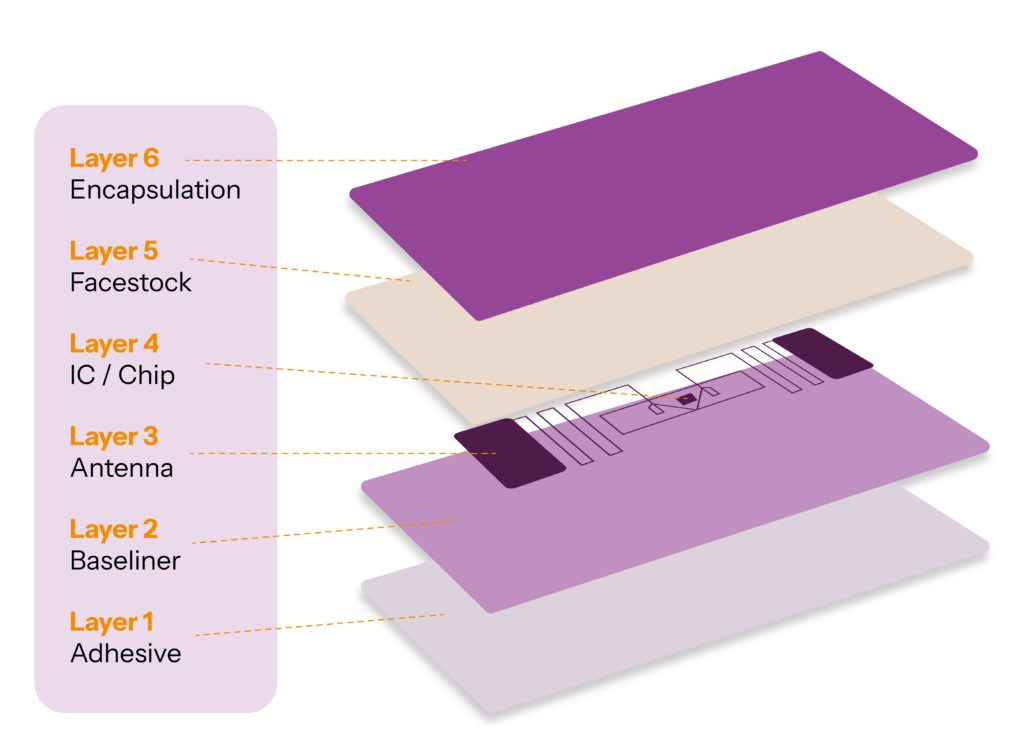
The basic elements of a single RFID tag is a chip and an antenna.
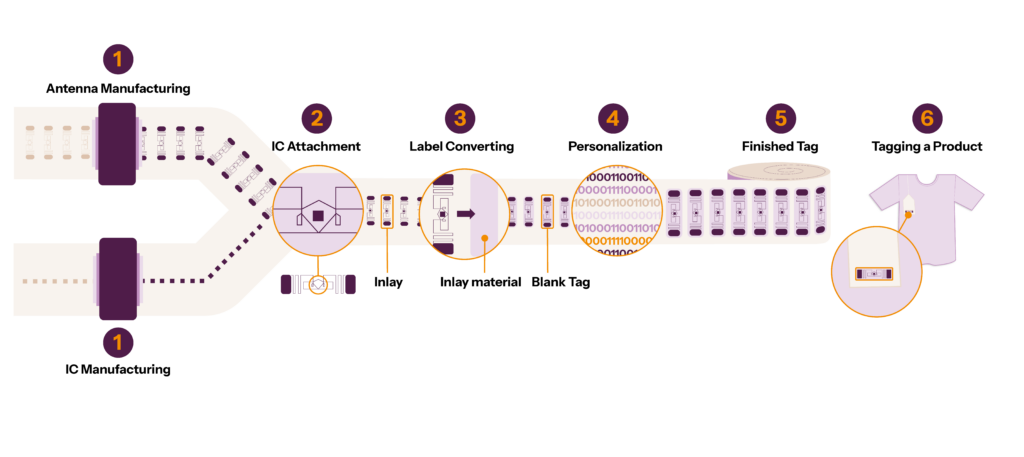
ICs, or chips, are mostly manufactured from silicon. The RFID chip stores the tag ID (such as EPC, electronic product code), manages communication, and controls memory and security. It’s a semiconductor device, just like any other microchip. In that sense IC is the core of the RFID tag, as it contains the data of the tagged item, stored in the tiny computer memory.
The data is stored in the RFID chip memory in binary format, bits – ones and zeroes. For human use, the data is typically written in hexadecimal format, where 4 bits are turned into one character from 0 to 9 and A to F.
Antenna gathers the energy from the reader to wake the tag and send the data formulated by the chip back to the reader. If the antenna doesn’t work, or if the chip is not properly connected to the antenna, the inlay will not work.
The inlay surface material is usually plastic or paper. Baseliner refers to the material to transport the labels.
Protocol Standards: the basis for interoperability
RAIN RFID technology relies on EPC Gen2 (Electronic Product Code Generation 2) communication defined by EPCglobal and formalized in ISO/IEC 18000-63 standards. These standards define how tags and readers communicate: how data is encoded, how anti-collision works, how memory is structured, and how commands such as read, write, and lock are executed.
For label converters, this ensures that tags produced will work seamlessly with standard RAIN RFID readers across different applications and geographies.
In addition to the core standard, related specifications also impact the interoperability and customer requirements. EPC memory structure guidelines, such as GS1 EPC Tag Data Standard, define how data is organized in the tag (for example EPC, TID, and User memory banks), while encoding schemes such as SGTIN-96 or other EPC formats define how serialized data is written to the tag.
Regional regulations, such as ETSI in Europe or FCC in the US, also influence how RFID systems operate by defining frequency ranges and transmission limits. These standards ensure that tags can communicate with standard RAIN RFID readers, that basic interoperability is guaranteed, and that communication behavior is predictable.
However, protocol compliance alone does not guarantee good RF (Radio Frequency) performance, which is discussed in the next chapter.
RF Performance
RF performance describes how reliably and efficiently an RFID system can read, write, and track tags under real‑world conditions such as distance, orientation, materials, and interference.
In practice, RF performance translates into readability and read range of the tag in the environment it was designed for – from how far the tag can be read, and from which angles, what type of items is it a good fit for?
RFID tags are designed for different use cases and applications. Good quality design means that the tag has the required performance and durability for the intended use case, taking form factor and unit cost into consideration as well.
Variation in tag sensitivity causes the readability to vary. Differences in tags’ read ranges lead to missed readings, and ultimately, decreased reliability of the whole RFID system. High variation in tag sensitivity also indicates variation in durability – some tags may last longer than others.
RFID inlays
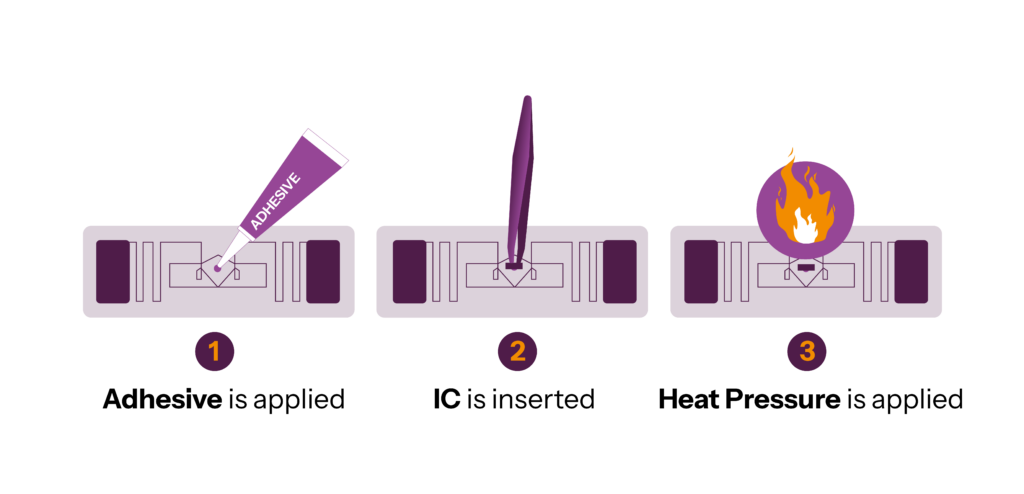
IC attachment, also called chip bonding, is a process where the IC is connected to the antenna, and the outcome of this process is called inlay, which is further converted to different end products like labels, smart cards, hangtags, wristbands and so on.
Inlays are the raw material for smart label converting, as they are the core component of any RAIN RFID tag or label. Inlays can also be embedded into other products as such or after being converted to a suitable format.
Different types of inlays
Understanding the different types of inlays is crucial for a label converter as their construction, materials, and form factor affect how they behave in production and how the finished RFID tag performs in real-world use. When you have a thorough understanding of different types of inlays and how different inlay products fit into various applications, you are better able to deliver the customer exactly what they need for their RFID system.
Here are some key inlay concepts:
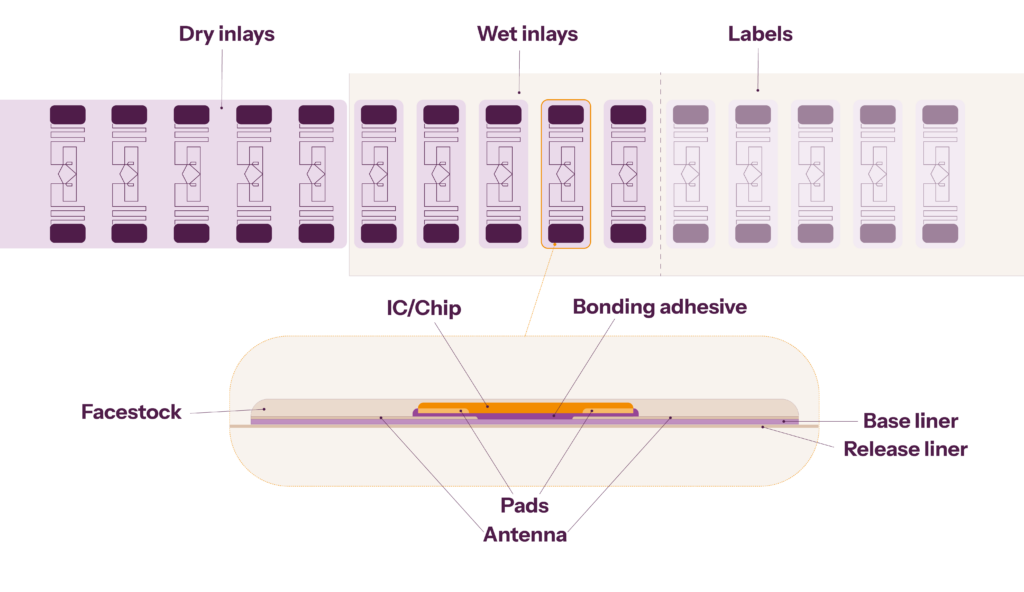
Dry inlays Dry inlays are inlays where there is no adhesive, only chip plus antenna on a carrier. Dry inlays are used in cases where the inlay needs to be embedded into a product, such as access cards.
Wet inlays Wet inlays have an adhesive film, and they can be attached to varied surfaces. They are usually laminated to provide more durability.
Paper inlays For sustainability reasons, inlays can also be built on paper substrate. They are not as durable as plastic inlays, and are mostly used in packaging and disposable labels.
Plastic / PET inlays Pet inlays are mostly used in retail and logistics, as they are durable and have a stable RF performance. These are the ones label converter most often used as the raw material for finalized smart labels.
Textile inlay Inlays can also be integrated into, for example, apparel care labels or sewn-in tags.
Inlay specifications
A critical element in defining quality within RFID solutions is the establishment of clear specifications. These specifications are typically derived from end‑customer expectations, retailer mandates, or established industry frameworks such as ARC and ISO standards.
RF performance specifications outline the required behavior of an RFID tag – covering parameters such as read sensitivity, operating frequency range, and encoding accuracy. This defines what type of inlays to use in the final solution.
Compliance cannot be presumed; usually it must be demonstrated through systematic and repeatable testing, and by providing testing logs. This requires measuring RF performance against defined benchmarks and verifying that every tag meets the prescribed thresholds prior to shipment.
Inlays are specified in various ways:
Some RFID users have listed approved inlays, manufacturer and model
The retail industry, mainly in the USA, widely uses the ARC specifications developed by Auburn University RFID Lab. ARC specifications classify and approve RFID tags into performance categories based on real-world retail use cases, helping brands and retailers select tags that meet minimum performance requirements.
GS1 Tagged Item Performance Protocol (TIPP) is an open performance standard. Anyone can test RAIN RFID tagged Items and define which TIPP grades the tagged items meets.
When performance criteria are clearly defined and validated, converters can ensure that each delivered tag performs exactly as intended—eliminating variability, preventing field failures, and safeguarding customer satisfaction.
Label Converting Process
In RFID label converting inlays are transformed into a physically finalized tag. A layer of protective material and possibly a separate layer of printable material is added on top of the inlay, and glue and the removable liner are added on the bottom. When the inlay is converted to a hard tag, it is mounted inside a hard, protective case.
Beside labels and hard tags, inlays can be converted into several different other formats by adding materials around the inlay. Other common formats include, for example, hang tags, care labels, smart cards, travel tickets, and wrist bands.
How RFID Label Converting is Different from Traditional Label Converting
The biggest difference between RFID label converting and traditional label converting is the adding of the inlay into the label. RFID labels contain electronic components that can be damaged in the converting process, if handled improperly. Die cutting should be arranged to not damage the inlay’s antenna inside the label.
Excess nip force should be avoided to prevent cracking the IC, especially when handling inlays without any material on top of the IC. To protect against damaging the IC, there are special rollers available with IC protection (avoidance slot) or special rollers with very soft materials to protect the IC from pressure can be used. The machine rollers should be checked to be suitable for RFID labels.
Another important aspect to consider is ESD (electrostatic discharge) protection. ESD control systems are vital, especially when exposed antennas are involved; ESD can potentially damage the tag IC. An RFID quality control system in the machine would reveal any issues in the smart label converting.
Personalization
If the converting finalises the tag physically, the personalization process finalises the digital data side of an RFID tag. In this phase the unique product data is inserted into the chip, making it readable and functioning in a specific RFID system.
Personalization of RAIN RFID labels includes encoding the unique EPC (electronic product code) or serial number, setting the memory structure, and possibly locking memory fields. An important part of the process is also verifying the readability and the correctness of the data. At this point data can also be registered into a database, such as ERP.
RAIN RFID Memory
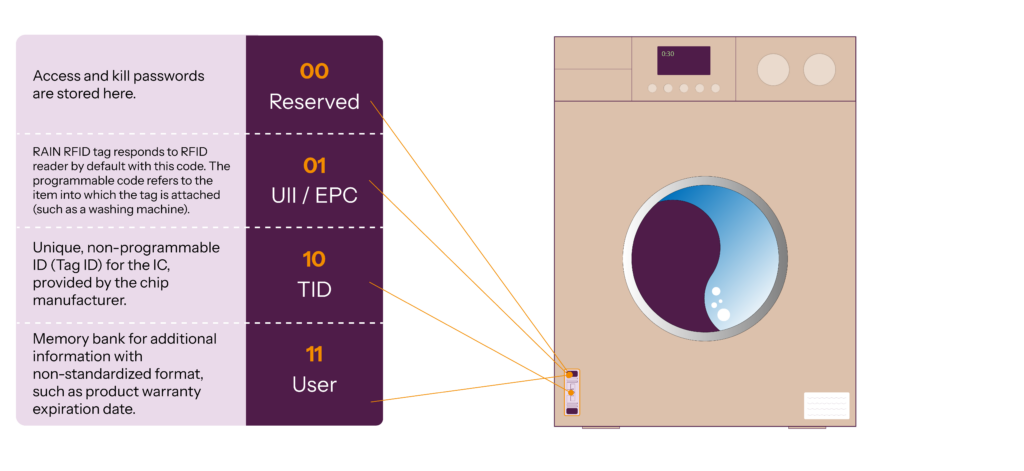
There are four different memory types in a RAIN RFID chip. The reserved memory stores possible passwords, like protection against rewrite or the access and kill passwords. The UII / EPC memory is the one answering when the tag is inventoried, and it contains item identification data.
TID refers to tag identification data, and that is the unique ID for the chip, which the manufacturer has encoded, and which is fixed and can not be changed. User memory size depends on the IC model. It is a kind of extra area of the chip memory, which contains application or end user specific data.
In theory, encoding can be done in any of the phases in the tag production process, but in reality the encoding data is usually ready to be encoded only in later stages of the process.
Encoding can be done with an RFID reader, RFID printer or inline encoding system. Voyantic Tagsurance® 3 enables the encoding of RAIN RFID labels on high-speed machines, eliminating the need for external encoding solutions and streamlining production processes.
The method of the encoding is defined by volume – reader based encoding is handy with single tag encoding but with larger volumes it is not a practical solution. Smaller RFID tag patches can be encoded with printers, but if the volumes grow and there is a need to scale in the future, then inline encoding becomes the most efficient option.
When your customer is asking for RAIN RFID labels for item identification, in terms of data, you will need to convert the products’ UPC / EAN / GTIN barcode number to an RFID encoding and add a serial number.
There are three different kinds of data standards concerning the data structure in RAIN RFID tags. GS1 EPC tag data standard is widely used in retail and apparel, logistics and supply chain, healthcare and in manufacturing. ISO has multiple standards for particular use cases, such as airline package data encoding. RAIN Alliance has a standardized numbering system based on ISO-standards.
Sometimes converters or customers wish to use their own encoding system. In that case it is recommended to anyway follow the standardized data structures when defining the unique numbering.
Ensuring Quality in RFID Tag Production
As RFID volumes continue to surge across industries—from retail and logistics to healthcare and automotive—the importance of consistent, reliable RFID tag quality has never been greater. When a customer invests in RFID-based systems, they expect every tag to perform according to specification. Even small variations in tag read range or sensitivity can undermine system performance, cause process failures, and increase operational costs. Ensuring RFID label quality is therefore not optional; it is mission‑critical.
Unlike visual inspection tasks common in traditional label converting, RFID tag quality cannot be seen, as RFID performance issues do not reveal themselves through appearance, alignment, or surface defects. The only accurate and reliable way to assess RFID tag quality is through RF measurement, conducted at the inlay or finished label level.
This is because quality fundamentally boils down to how consistently each tag meets its designed RF performance parameters—such as activation sensitivity, tuning, and read range across frequencies. These elements determine whether an RFID system will work in real deployments.
A single underperforming RFID tag can cause a breakdown in traceability, delays in logistics, or inaccurate inventory counts. In sectors such as healthcare or automotive, poor reliability can cause safety risks or failed compliance processes. In high-volume retail environments, inconsistent tags reduce the accuracy of inventory systems and undermine the ROI of RFID rollouts.
According to quality control experts, one incorrect machine setting, incorrect IC bonding temperature, or minor material variation can affect thousands of labels in a production batch. That is why 100% inline RFID tag testing has become the gold standard in modern converting operations.
Reliable evaluation of RFID quality requires measuring the parameters that directly predict real‑world performance. The most important of these is sensitivity, since changes in sensitivity reflect changes in read range, orientation patterns, and backscatter response. If two tags have identical sensitivities, they will behave the same way in the field; if their sensitivities differ, their performance will diverge.
Assessing whether sensitivity is within the design‑specified variation limits is the clearest indicator of manufacturing quality. To detect RAIN RFID quality, manufacturers rely on sample testing, inline testing, or both. In practice, testing can be integrated directly into production equipment for 100% inspection or it can be conducted offline as sample based testing.
In processes such as label converting, where daily output may reach hundreds of thousands of tags, statistically valid sampling may require thousands of tags—making automated measurement systems essential. In high-volume production, inline testing provides the most comprehensive visibility, as statistical sampling may overlook short‑term deviations.
Each strategy is chosen based on throughput requirements, product type, and quality objectives, but the underlying principle remains the same: testing must be rigorous, repeatable, and aligned with design specifications.
To avoid distorted results, testing must use proper far‑field or far‑field‑equivalent coupling ensuring that measurements reflect how tags perform in real environments. Quality evaluation also includes reading EPC/TID to confirm data integrity and maintain full traceability.
Log files provide proof of quality and support transparent communication with customers regarding production performance. Taken together, these measurements allow converters and manufacturers to determine reliably whether their RFID tags will perform consistently in large‑scale operational systems.
Yield: Why RFID Requires a Much Higher Bar Than Traditional Label Converting
In traditional label converting, yield has typically been treated as a measure of production efficiency. Some variation or waste could be tolerated because labels were visually inspected and applied within processes that allowed human intervention. Yield losses were visible and, in many cases, recoverable.
RFID changes this fundamentally.
Unlike conventional labels, RFID tags must perform invisibly and autonomously once deployed. They are not verified one by one by operators; instead, they are trusted to function correctly as part of an automated system. As a result, yield in RFID production is no longer just a manufacturing statistic—it becomes a requirement for system‑level trust.
A 99% yield may appear excellent when viewed as an average. However, in RFID systems, the remaining 1% does not behave like traditional scrap or cosmetic defects.
Underperforming or unreadable tags often cause silent failures: the system continues to operate as if everything worked, even when it did not. These failures may not be immediately visible, but they directly affect downstream processes.
At scale, this effect becomes unavoidable. RFID deployments routinely involve millions of tags read repeatedly over time. In such environments, small yield gaps translate into guaranteed operational events—missed items in self‑checkout, undetected movement in loss prevention, delays in logistics, or breaks in traceability. Unlike traditional labeling processes, there is often no human fallback to correct errors as they occur.
This is why the acceptable yield for RFID must be significantly higher than in traditional label converting. The tolerance for errors is no longer defined by production norms, but by the tolerance of the automated systems that depend on the tags. When RFID triggers decisions—payments, alarms, routing, or compliance checks—even occasional failures become unacceptable.
Compounding this challenge, RFID yield loss is rarely random. Minor variations in materials, IC bonding, antenna alignment, or machine settings can affect thousands of consecutive tags. Without rigorous testing, such deviations may pass unnoticed into deployment.
Ultimately, the question is not whether 99% yield is impressive—it often is. The question is whether 99% yield is compatible with systems that must operate reliably without human oversight. As RFID moves from visibility to automation, yield becomes less about efficiency and more about predictability, confidence, and trust at scale.
Machinery for RFID label converting
RFID does not require replacing the entire production environment. Instead, it calls for a purposeful combination of existing converting capability, added RFID‑specific modules, and robust quality assurance.
For converters stepping into RFID, understanding the machinery landscape is essential. RFID labels must not only be physically produced—they must also be encoded, tested, and verified for functionality at every stage. Converting forms the physical label, encoding writes the data, and quality assurance ensures each tag performs as expected. Without fully integrated QA, RFID production becomes increasingly risky as volumes scale.
This chapter introduces the key machine types involved when launching RFID label converting: the converting machine, the offline rewinder, and the press with inlay insertion.
Converting Machines: The Foundation of RFID Label Production
Most converters begin by adapting or upgrading their converting lines to safely handle RFID inlays. While some invest in new RFID‑ready converting equipment, many can continue using their existing machines, gradually adding RFID functionality.
The essential stages of RFID label converting includes:
Inlay placement: Dry inlays are cut from an inlay roll and precisely positioned within the label structure. Consistency is critical to ensure that RF testing yields reliable results.
Lamination and adhesive application: Adhesive layers, release liners, and face stocks are added to complete the label structure. These layers must be uniform to avoid negatively affecting tag performance.
Die‑cutting and waste removal: Labels are cut into shape while avoiding damage to antennas or chips. Slitting accuracy is especially important to prevent cutting through an inlay.
Tension control: Incorrect web tension can break ICs, loosen inlays, or cause antenna joint failure. Converters must ensure precise tension management throughout the process.
ESD protection: Dry inlays often require electrostatic discharge protection to avoid chip damage during processing.
A critical addition to a converting machine is a quality assurance system, such as Voyantic Tagsurance® 3, which provides inline electrical and RF performance monitoring. It verifies that every label meets performance requirements and logs results for full traceability.
Modern converting lines may also feature bad tag handling systems. If a tag fails RF testing, it can be marked, crushed, punched, or removed directly within the line, depending on customer requirements.
Offline Rewinder: Roll Doctoring & Post‑Process Verification
A central tool for early‑stage RFID adopters is the offline rewinder, also known as a roll‑doctoring machine. This equipment is especially important when customers require 100% good‑tag rolls.
When out‑of‑spec RFID labels are detected, they may need to be removed and replaced with good ones, a process best performed in an offline rewinder.
Offline rewinders enable:
Post‑process bad tag removal
Tag replacement to create fully compliant rolls
Verification of unwind/rewind tension, preventing mechanical stress that could damage inlays
Integration data quality system and data
For converters scaling up, rewinders provide a valuable secondary checkpoint, ensuring final rolls sent to customers contain only fully functional tags.
Press with Inlay Insertion: Embedding RFID at the Print Stage
Some converters choose a production model where RFID inlays are inserted directly within a printing or finishing press. In this setup, the press performs both printing and RFID functionality by integrating an inlay insertion module.
Critical functions include:
Accurate inlay application: Dry inlays are precisely cut and inserted into the label structure during the printing or finishing stage. This accuracy is essential for both mechanical alignment and predictable RF performance.
Controlled adhesive coating and lamination to maintain reliable inlay bonding and structural durability.
Stable web handling and tension control to prevent cracking, slipping, or misalignment of inlays.
Voyantic Tagsurance® 3 is commonly integrated inline in these press configurations, enabling real‑time RF performance verification, immediate detection of faulty inlays, encoding and read‑back verification, and automated logging for full production traceability.
With inline QA and splicing stations, defective labels can be removed without stopping the press, significantly improving efficiency.
Getting started with RFID does not require a complete overhaul. Instead, it requires the strategic addition of RFID‑capable components to existing equipment and a strong focus on performance verification. Thus a scalable and future-proof roadmap for building the machinery is needed:
Converting Machine
The core of the production line, enhanced with RFID‑specific modules
Requires precise inlay handling, tension control, and QA integration
Offline Rewinder
Ideal for roll doctoring, final inspection, and producing 100% good‑tag rolls
Supports Voyantic’s QA systems for full roll‑level verification
Press with Inlay Insertion
Enables embedding of inlays directly in the printing workflow
Paired with inline Tagsurance® 3 for immediate performance validation
The safest way to invest in RFID machinery is to treat it as a step-by-step capability build, combined with a material purchasing strategy. This modular approach lets converters adopt RFID production gradually, supporting growth in demand while maintaining reliability and quality—ensuring every tag works as intended.
Used equipment can sometimes be an option, especially for mechanical converting parts, but RFID quality requirements are strict. Any setup must support reliable encoding, accurate QA, and data traceability. In RFID, quality failures scale fast, so investing early in proper verification is often more important than maximizing speed.
How to Start with RFID – Insights
Entering RFID can feel like a big leap for a label converter. Compared to traditional label production, RFID introduces new variables: electronics, radio frequency performance, data encoding, and stricter quality expectations. The good news is that you don’t need to master everything at once. Successful RFID converters follow a phased, structured approach that builds capability step by step while keeping risks under control. This chapter outlines how to get started with RFID in a way that is technically sound, commercially realistic, and scalable.
Start with the right mindset: RFID is functional, not visual
The most important shift when moving into RFID is understanding that RFID labels are functional components, not just printed products. RFID labels contain electronic components that can be easily damaged in the converting process.
Unlike traditional labels, RFID performance cannot be verified by visual inspection. A label may look perfect but still fail in real use due to weak RF performance, damaged chips, or encoding errors.
For a label converter, this means RFID quality is no longer only about print accuracy, die-cutting, or adhesion. It is about measurable performance and reliable functionality. The key takeaway at this stage is simple: If you produce RFID labels, you are responsible for how well they work.
Learn the basics of RFID performance
Before investing in equipment or offering RFID commercially, converters should build a basic understanding of RFID performance fundamentals. This does not require becoming RF engineers, but it does mean learning what affects tag readability in real-world environments.
Key concepts to understand include:
Read range and sensitivity
Antenna design and its interaction with materials
Variability between inlays
How production tolerances impact performance
Many early RFID problems stem from assumptions; for example, that all inlays perform similarly, or that supplier specifications always match real use cases. Testing and measurement early on helps avoid these pitfalls and gives your team confidence when discussing RFID with customers.
Choose validated inlays and limit early variables
When starting out, simplicity is an advantage. Rather than experimenting with many inlay types or custom designs, successful converters typically begin with pre-validated, widely used inlays suited to their main customer applications.
This approach reduces risk by:
Limiting RF variability
Making troubleshooting easier
Allowing teams to focus on process learning rather than product complexity
Make RFID quality assurance part of the process
RFID requires 100% quality assurance. Sampling methods common in traditional label production are not sufficient, because RFID failures are often invisible and random.
Practical starting points for RFID QA include:
Verifying that every tag responds
Detecting damaged or non-functional chips
Identifying weak or inconsistent RF performance
Inline quality control is especially important as volumes grow. It ensures that defective tags are caught immediately, rather than after delivery to the customer — where the cost and reputational impact are much higher.
Encoding is often seen as a downstream or external process. However, many converters discover that encoding can be integrated earlier and more efficiently into the converting stage.
When deciding how to approach encoding, consider:
What data is available at different production stages
Required throughput and line speed
Error handling and verification needs
Total cost per encoded label
Regardless of where encoding happens, one rule is universal: encoding must be verified. Assuming successful encoding without verification introduces unacceptable risk, especially at scale.
Use data as a competitive advantage
RFID production generates valuable data: performance metrics, pass/fail rates, encoding logs, and trend information over time. Capturing and using this data transforms RFID into a strategic advantage.
Production data can be used to:
Detect process drift early
Improve yields and reduce scrap
Support customer audits and requirements
Demonstrate quality and reliability objectively
Converters who can provide data-backed proof of quality stand out in an increasingly competitive RFID market.
By starting with the basics, validating performance, building quality assurance into the process, and scaling step by step, RFID becomes a natural extension of label converting — not a disruptive leap. And for converters who get it right early, RFID is not just a new capability, but a long-term growth opportunity.
RAIN RFID Quality: What Defines Reliable Tag Performance and Why It Matters
High‑quality RAIN RFID tags form the backbone of modern automated processes. Ensuring that every tag work as expected is essential to technical reliability, and long‑term customer relationships. But what quality means in RAIN RFID? And how quality translates in the actual use of RFID tags?
RFID technology has become an integral part of large‑scale logistics, retail, manufacturing, and supply‑chain operations. As adoption accelerates and production volumes rise into the hundreds of millions, the definition and assurance of RFID quality have become essential to business continuity and customer confidence.
Quality in RAIN RFID tags is not defined by whether a tag responds once in a controlled environment. Instead, it is the engineered consistency, durability, and reliability of performance across real‑world operating conditions. If quality is not managed systematically, failures propagate rapidly and invisibly, affecting operational efficiency and eroding customer trust.
What Quality Means in RFID Systems
RAIN RFID quality reflects how reliably a tag performs its intended function under defined environmental and operational conditions. While the concept may appear straightforward, RFID quality is multidimensional. Tag performance depends on both the design of the inlay and the consistency of the production process.
A high‑quality RFID tag responds predictably in all relevant orientations, across required distances, and on all intended materials. In modern RAIN RFID manufacturing environments, quality is evaluated through the lens of sensitivity, performance variation, and the ability of each tag to meet its design specifications.
In practice, quality means that the measured performance of every tag remains within the defined limits of the original design. A tag that can merely “be read” cannot be considered high quality; reliable tags must exhibit controlled and stable sensitivity that correlates with consistent read ranges, orientation behavior, and backscatter performance.
RFID tag performance is shaped long before a tag reaches a reader. True quality is the combined result of engineering decisions, material and process control, and accurate data handling throughout manufacturing. Each stage of the tag’s lifecycle—from initial design to physical construction, production execution, and data management—contributes to how reliably it performs in real‑world applications.
Understanding these elements is essential for ensuring that tags behave consistently across environments, withstand the mechanical stresses of converting and use, and deliver trustworthy data throughout their operational life.
Design Quality
Design quality defines the theoretical performance potential of a tag. It includes antenna geometry, IC selection, memory configuration, mechanical layout, and all characteristics that determine sensitivity, read range, and overall RF behavior before production begins.
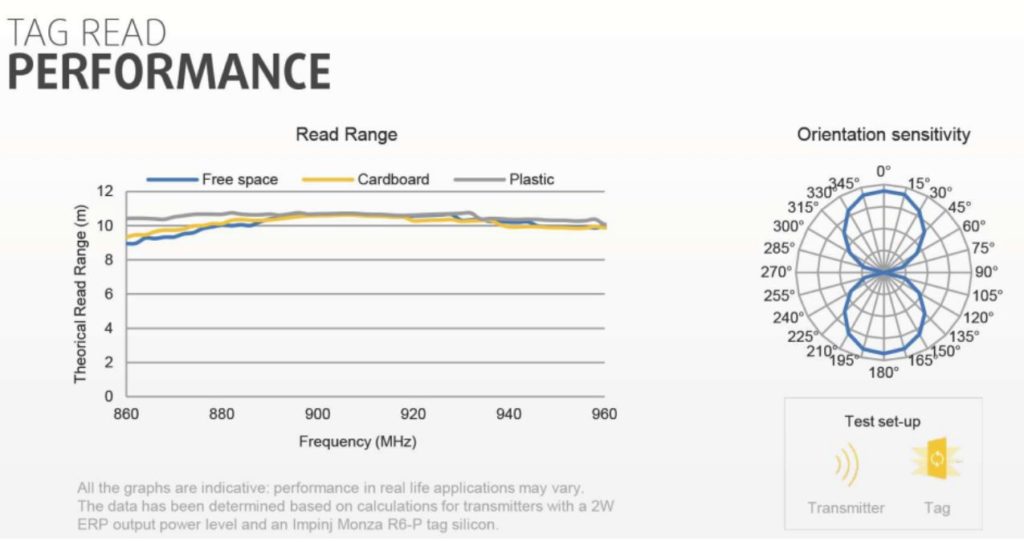
Differences in tag models inherently produce different sensitivities and performance profiles; however, within a given model, the design specification sets the exact performance targets that manufacturing must achieve. Typical design parameters include read range across frequency, orientation patterns, and sensitivity thresholds.
When design quality is properly defined, every manufactured tag can be evaluated against clear and measurable criteria. In practice this means that the target sensitivity, read‑range behavior, orientation pattern, and other defined performance parameters become measurable benchmarks against which each production batch can be validated, ensuring that manufacturing variation is detected and controlled before tags enter real‑world use.
Durability
Durability relates to the physical robustness of the tag. Although the provided materials address durability implicitly rather than directly, they highlight contributing factors such as mechanical stresses from tension control, adhesive distribution, and chip attachment integrity. Poor tension management can break ICs or fracture antenna joints, while improper adhesive coating or unsuitable materials can compromise long‑term reliability.
Durability ensures that tags maintain performance not only at the production line but throughout handling, conversion, application, and their operational lifetime.
Production Quality
Production quality refers to how consistently manufactured tags match the design specification. Where design quality defines the target, production quality determines how closely and reliably each tag adheres to that target.
Manufacturing variation—whether due to tension fluctuations, misaligned inlays, material variation, or process drift—directly affects tag sensitivity. High production quality is characterized by low performance variation, predictable output, and stable yields. Production quality can be defined as the degree to which the tags’ sensitivity stays within the design’s allowed variation margins.
Reliable production quality is achieved through sample testing, inline testing, or a combination of both, with inline testing offering immediate detection of deviations.
Data Reliability
Data reliability ensures that the digital identifiers encoded into RFID tags are correct, readable, and traceable. In practice, this means reading EPC/TID and verifying encoding accuracy is a part of quality control. Ensuring correct EPC and TID data supports track‑and‑trace processes, prevents assignment errors, and provides logs that verify the quality of delivered rolls.
Data reliability, when combined with reliable RF performance, creates confidence that tags function correctly within larger systems, from inventory management to item‑level tracking.
Reliable evaluation of RFID quality requires measuring the parameters that directly predict real‑world performance. The most important of these is sensitivity, since changes in sensitivity reflect changes in read range, orientation patterns, and backscatter response. If two tags have identical sensitivities, they will behave the same way in the field; if their sensitivities differ, their performance will diverge.
Assessing whether sensitivity is within the design‑specified variation limits is the clearest indicator of manufacturing quality. As mentioned in the previous chapter, to detect RAIN RFID quality, manufacturers rely on sample testing, inline testing, or both. In practice, testing can be integrated directly into production equipment for 100% inspection or it can be conducted offline as sample based testing.
In processes such as label converting, where daily output may reach hundreds of thousands of tags, statistically valid sampling may require thousands of tags—making automated measurement systems essential. In high-volume production, inline testing provides the most comprehensive visibility, as statistical sampling may overlook short‑term deviations.
Each strategy is chosen based on throughput requirements, product type, and quality objectives, but the underlying principle remains the same: testing must be rigorous, repeatable, and aligned with design specifications.
To avoid distorted results, testing must use proper far‑field or far‑field‑equivalent coupling ensuring that measurements reflect how tags perform in real environments. Quality evaluation also includes reading EPC/TID to confirm data integrity and maintain full traceability.
Log files provide proof of quality and support transparent communication with customers regarding production performance. Taken together, these measurements allow converters and manufacturers to determine reliably whether their RFID tags will perform consistently in large‑scale operational systems.
Quality failures can be costly – and affect customer satisfaction
RFID systems rely on predictable and consistent tag behavior. Even small sensitivity deviations can alter read range, cause intermittent scanning, or create orientation‑specific blind spots. Sensitivity shifts directly map to changes in how much power is required to activate tags, and this influences all practical aspects of performance. If sensitivity falls outside acceptable limits, tags may perform adequately in test environments but fail in real applications.
Quality failures at scale can have severe system‑level consequences. In conveyor or portal‑based environments, poor sensitivity or excessive performance variation can lead to undetected items, stray reads, or system errors. Fluctuations in tag behavior reduce the reliability of automated processes, which undermines the value RFID aims to provide.
In addition, certain production issues—such as insufficient isolation during testing or testing with near‑field methods only—produce misleading results, undermining the accuracy of quality assessments. The material stresses that real‑world performance requires far‑field‑aligned measurements and adequate isolation to avoid distorted results.
Financially, poor RFID quality imposes significant direct and indirect costs. Production downtime, rework, wasted materials, and labor hours accumulate quickly when quality problems go unnoticed. One hour of downtime in chip attachment alone can eliminate production of 10,000 tags, and in label converting lines, the losses may be substantially larger.
Subtle failures that are not detected during manufacturing become exponentially more expensive once tags reach the customer. Undetected non‑performing tags translate into delays, operational disruptions, and customer dissatisfaction. Reworking entire batches, issuing replacements, or managing field complaints consumes time and erodes margins. Worse still, damaged customer trust is difficult to recover.
An analysis of RFID quality costs demonstrates that failing to address non‑performing tags not only threatens immediate profitability but risks long‑term relationships, as repeat issues reduce confidence in the supplier’s capabilities. High quality is, therefore, not a premium add‑on; it is an essential component of maintaining competitiveness, ensuring customer loyalty, and preventing systemic operational disruptions.
RFID Smart Labels – A Strategic Growth Path for Traditional Label Converters
The label industry has always evolved alongside technology. From offset to digital printing, from manual finishing to highly automated converting lines, successful label companies have consistently adapted to changing market needs. Today, the next evolution has been well underway for some time already: smart labels powered by RFID.
While conventional label volumes continue to grow steadily, their annual growth rate remains modest. In contrast, RFID and smart labels represent one of the most dynamic segments in the broader packaging and identification market.
According to recent industry analyses, the global RFID technology market was valued at over USD 20 billion in 2024 and is projected to more than double by 2030, growing at a compound annual rate of roughly 15–16 percent. This expansion is not theoretical; it is already visible in accelerating tag volumes, broader retailer mandates, and the rapid digitalization of supply chains worldwide.
For traditional label converters, this growth is not happening somewhere “else” in the value chain. It is happening directly adjacent to their core business.
RFID the dominating technology today in smart labels
Smart labels, especially RAIN RFID and NFC labels, are increasingly becoming a standard requirement in retail, logistics, healthcare, and industrial applications. Major retailers have moved beyond pilot projects and are scaling item-level tagging programs globally.
Inventory accuracy improvements, shrink reduction, automated replenishment, and seamless omnichannel fulfillment have proven their return on investment. As a result, more brands are required to deliver products already tagged. That requirement flows directly to the label supplier.
Beyond retail, RFID adoption is expanding into pharmaceuticals, food logistics, manufacturing, and even regulatory-driven traceability initiatives. Sustainability reporting, digital product passports, and anti-counterfeiting measures all depend on reliable product identification.
Not a giant leap but a small step forward
RFID enables automated data capture without line-of-sight scanning and integrates seamlessly into enterprise systems. In many use cases, barcodes alone simply cannot deliver the required efficiency or visibility anymore.
For a traditional label converter, this is strategically important. These companies already understand substrates, adhesives, high-speed web handling, die-cutting, inspection, and quality control. Adding RFID capability builds on these strengths rather than replacing them.
The step from traditional converting to RFID converting is an evolution of the process: integrating inlay lamination or insertion into the process and ensuring that the final product meets both print and RF performance requirements.
The perceived barrier to entry is often higher than the real one. RFID inlays are standardized components supplied by specialized manufacturers. Converting technology for inlay lamination has matured significantly over the past decade. Just as importantly, testing and encoding technologies have become modular and scalable. This means a converter can start at a suitable level of investment and expand as volumes grow.
From RFID pilots to an operational infrastructure – and new opportunities in value streams
What makes today’s opportunity different from the early days of RFID is the maturity of the ecosystem. Back then many RFID programs were still pilots or limited deployments, whereas today, RFID is operational infrastructure in many global organizations. That changes the commercial dynamics. Customers no longer ask whether RFID works; they ask how quickly they can scale and how reliably suppliers can deliver.
This reliability requirement creates additional value streams for converters. In RFID, it is not enough that a label looks good and passes visual inspection. Every tag must function in the field, often within automated and business-critical processes. A non-performing tag can disrupt inventory systems, delay shipments, or compromise traceability. Therefore, end users increasingly demand documented quality assurance and performance measurement.
This is where the opportunity expands beyond simple inlay lamination. Performance testing and encoding are no longer optional add-ons; they are integral parts of delivering a professional RFID product.
Measuring tag sensitivity across frequencies and power levels provides real data on performance consistency. Encoding enables serialization, customer-specific data structures, and compliance with retailer or regulatory requirements. Together, these capabilities allow a label converter to move from being a print supplier to becoming a smart label solution provider.
RFID adoption grows and expands to IoT
The financial logic is compelling. Traditional label markets are competitive and margin-sensitive. Smart labels, by contrast, combine physical product value with embedded digital functionality. They enable converters to increase average selling prices, offer differentiated services, and participate in higher-growth market segments. Moreover, smart label production often strengthens long-term customer relationships, because once integrated into a customer’s operational workflow, switching suppliers becomes more complex.
There is also a timing element. Existing RFID inlay and tag manufacturers will continue expanding capacity, but demand growth is strong enough to create room for new entrants, especially regionally focused or specialized players. Converters with established customer bases in retail, food, healthcare, or industrial segments are in a unique position to extend their offering directly to current clients. Instead of watching RFID requirements move upstream or downstream in the supply chain, they can capture that value themselves.
Looking forward, the smart label landscape will likely become even more integrated with broader IoT systems. Falling chip costs, improved antenna designs, more sustainable materials, and tighter software integration will further reduce adoption barriers. RFID will increasingly be seen not as a premium feature but as standard digital infrastructure embedded into everyday products.
RFID a pathway to future-proof business
For traditional label converters, the question is therefore not whether RFID will grow. Market data and customer mandates already confirm that it will. The real question is strategic positioning: will the company participate in that growth or remain confined to lower-growth conventional segments?
Entering RFID does require investment in knowledge, process adaptation, and equipment. However, the foundations are already present in most modern converting operations. With the right partners and a phased approach, the transition can be managed confidently and profitably.
Smart labels are not just an additional product category. They represent a pathway to future-proofing the business, deepening customer relationships, and moving higher in the value chain. For traditional label companies willing to evolve, the opportunity is not only real — it is accelerating.
How Tagsurance coupling elements upgrade: Snoop Pro™ Mini 3.0 & Snoop Pro™ Tiny 2.0
Voyantic Snoop Pro™ Mini and Snoop Pro™ Tiny have shiny new looks and upgraded features. Read this blog post by our Senior Hardware Designer Sami Rautanen to deep dive into the development work of the upgraded components.
There has been quite a bit of detailed design work and testing to get these released. To see what’s new with them, keep scrolling to the longer article!
If you are too busy at the moment, here is a short summary of the article:
Snoop Pro™ Mini 3.0 with integrated strobe
Mechanically almost backwards compatible (shielding plates, attachment holes, geometry) but the strobe connector and cable take additional space
RF performance backwards compatible with v2 with a couple of exceptions:
Narrow tag near shielding plate opening edge when the opening is ≥ 50 mm long
Any kind of extensions
Snoop Pro™ Tiny 2.0 with integrated strobe
Mechanically almost backwards compatible (shielding plates, attachment holes, geometry) but the strobe connector and cable take additional space and one attachment hole was removed
RF performance not backwards compatible (although usually close)
New looks & integrated strobe feature
Okay, maybe the new look isn’t that new after the Snoop Pro™ 2.0 but it’s still new for Mini & Tiny. Their looks didn’t change too dramatically, some new colours, texts and switches.
Figure 1. Mini 3.0 & Tiny 2.0 appearance. 0603 SMD resistor for scale and confusion.
The new versions of Mini & Tiny feature a built-in strobe light, making it easy to use whenever the functionality is needed. The strobe light illuminates the tag from below, making the tag antenna visible in most cases and helping ensure accurate setup of the test start location. The white colour is actually no coincidence; it is used to make the strobe effect better. With the light coming from below the material the illumination effect is strong.
Both Mini & Tiny have a switch to turn the strobe ON/OFF but only the Mini has the switch for the Fail indicator. There was simply no room for it in the Tiny so the Fail indicator in Tiny is always ON (well, at least as long as the strobe cable is connected to the Snoop). Mini & Tiny can also be used without connecting the strobe cable.
About the RF performance variance and backwards compatibility of the Mini v3.0
This is pretty awesome; with a careful design we were able to squeeze the unit-to-unit variance to better levels. This will allow a better tag production quality since the Snoop will have less impact on the result variance between different lanes.
Here’s an example measured with a bunch of different Mini 3.0 with some tag:
Figure 2. Example of a typical unit-to-unit result variation of Mini 3.0.
You know what? Let’s look at a different one also:
Figure 3. Another example of a typical unit-to-unit result variation of Mini 3.0.
That’s not much variation, with this the Mini 3.0 should not be a limiting factor for result variation in tag production.
The backwards compatibility is divided in two parts: mechanical and RF. Mechanically the new version is pretty much backwards compatible:
Old shielding plates fit (different magnets to make the change easier)
No changes in the attachment hole sizes or positions
Adding the connector for the strobe took some space that breaks the borders of the previous version outlines and of course connecting the strobe cable takes space that was previously unused
So, we needed to break the mechanical backwards compatibility here to enable the strobe functionality.
With the RF performance it was way trickier to achieve backwards compatibility and actually it was not fully achieved. Let’s dig into that a bit more. We have defined the backwards compatibility as follows:
The results are within the envelope of the previous version
OR
The results are within ±1.0 dB from the center of the previous version envelope (need to allow some kind of unit-to-unit variance, unfortunately nothing is ideal in the world we’re living in)
Let’s take a look at some examples of how this looks like with real measurements. I took a small batch of both v2 and v3.0 Minis and some random tag that just happened to be close enough to my desk so I didn’t have to get up. The results with the that tag:
Figure 4. Illustrated example of the Mini 3.0 RF backwards performance with one tag type.
As you can see, with this tag the Mini v3.0 results are not within the v2 envelope across the frequency range, but the results are still within ±1.0 dB from the center of the envelope in those cases.
To find another tag I actually had to move from my desk, luckily my chair has wheels. Here are the results:
Figure 5. Illustrated example of the Mini 3.0 RF backwards performance with some other tag type.
Both results are similar. Again, there’s an area where the Mini v3.0 results are not within the v2 envelope but still very close, most of the time the results are within the envelope.But! Then there’s the situation where the Mini v3.0 results are not backwards compatible: a narrow tag near the shielding plate opening edge when the opening is ≥50 mm. Let’s take a look at an example:
Figure 6. An illustrated example of a narrow tag near shielding plate opening edge.
The narrow tag is relatively close to the shielding plate opening edge and with the Mini v3.0 it requires less power to wake up (yellow curves for v2, blue curves for v3.0):
Figure 7. Narrow tag near 60 mm (largest) shielding plate opening edge, Mini v2 vs Mini v3.0.
Even though the difference is not much it still breaks our definition of the backwards compatibility in some cases. Usually, such tags have a small pitch between consecutive tags at the inlay manufacturing stage and this problem gets smaller as the shielding plate opening gets smaller -> such a situation is unusual at the inlay stage. However, in label converting stage a larger pitch could be more common.
During the development a much larger set of different tag types was tested but of course it’s impossible to test every single tag type that exists so it’s important to keep in mind that the difference in results between Mini v2 and v3.0 is tag size, antenna geometry, chip and tag orientation dependent.
There are a few different extensions for Snoops such as the Swan and the situation can get very complex when any kind of extensions are used, no RF backwards compatibility can be promised with any of them. However, they do still fit the Mini and can be used but should only be used when really needed.
About the RF performance variance and backwards compatibility of the Tiny v2.0
Again, lets start with the mechanics.
Old shielding plates fit (different magnets to make the change easier)
Removed one of the attachment holes to make room for the Strobe connector, but the rest remain unharmed
Adding the connector for the strobe took some space that breaks the borders of the previous version outlines and of course connecting the strobe cable takes space that was previously unused
RF-wise Tiny is a real tricky one to develop due to the small geometry, mainly because the distance between the coupling element and the tag is very small and therefore even small changes might cause surprisingly large differences. During the development we decided to make changes that break the RF backwards compatibility, so keep that in mind when mixing Tiny v1 with v2.0.
As with Mini v3.0, Tiny v2.0 has a very good unit-to-unit variation. Here are examples of a batch of 9 Tiny v2.0 with a couple of different tags.
Figure 8.Example of a typical unit-to-unit result variation of Tiny 2.0.
Figure 9. Another example of a typical unit-to-unit result variation of Tiny 2.0.
The result variation is at pretty much the same level as with Mini v3.0. As said before, this is nice because the Snoops don’t cause much variations between lanes.
Combining QA and Encoding: The Next Efficiency Breakthrough in RAIN RFID Production
RAIN RFID encoding has traditionally taken place late in the production process, often across multiple parties and disconnected systems. This blog looks at why encoding workflows may be shifting, how integrating encoding with quality control can streamline production, and what new business opportunities this creates for converters, manufacturers, and other players in the value chain.
In most RAIN RFID production environments, tag personalization is done at a late stage in the production process — just before the label is attached to the item. This is partly due to legacy processes, but at the center lies one key issue: data for encoding, such as unique item-level information, is often only finalized late in the process. Many times, the personalization part of the process is also outsourced to a separate party.
Streamlining the production chain can open up new business opportunities. Label converters can take on a larger role by handling encoding during the converting process, or partial data can be encoded already at the chip attachment stage when the process and data flows support it.
Encoding can thus shift from being a costly bottleneck to becoming a competitive advantage. RAIN RFID tag volumes will continue to grow, and the need for encoding—one way or another—will grow with them. With efficient, scalable processes, the margin per encoded tag can increase, and with large volumes, this margin improvement becomes significant.
In our previous blog, we looked at the most common encoding methods, compared desktop printers with inline systems, and broke down how their ROI differs as production volumes grow. While printers work well for small batches, inline encoding with integrated quality assurance provides clearly lower per-tag costs and better scalability at higher volumes.
Combining Steps in the Process
For converters or manufacturers already using an integrated quality control system in their inline machines, combining two steps into one is already possible today.
It is possible to handle both quality control and high-speed encoding within a single system — no handoff or secondary systems required. Unlike desktop printer setups, these integrated solutions scale: production can start with a single line and expand by adding more lanes or stations as demand increases, lowering per-unit costs while improving speed, quality, and traceability.
Quality control is already implemented in most bonding machines producing RAIN RFID. By including encoding capabilities, these machines can integrate encoding and verification directly into the production line, simplifying the process and enabling concrete opportunities for optimization.
These changes demand a lot from both processes and people, and optimization is always case-specific. However, the technology is already available. Moving beyond how things are done today and recognizing the future opportunities strengthens the position of the organizations that act early as the market continues to grow and tag volumes increase.
Things to Consider When Scaling Up
As the demand for RAIN RFID tags continues to grow, companies in the value chain needs a clear plan for scaling up. Encoding solutions must be able to grow with rising tag volumes, so that doubling volumes does not double the cost or complexity.
Manual and fragmented encoding processes tend to limit scalability and squeeze margins, especially when desktop printers are pushed beyond the small-batch use cases where they work best. In contrast, inline encoding solutions with integrated quality control help keep per-tag costs low and support high-volume production.
Encoding is no longer just a technical step; it can become a strategic business lever. Companies that treat encoding as part of their value proposition — for example by combining encoding and quality testing into a single, streamlined process — improve efficiency, strengthen their role in the value chain, and position themselves for profitable growth as RAIN RFID adoption expands.
Get insights on Tagsurance 3 system with encoding feature in action.
In this on-demand demo webinar, we will walk you through the new system in practice.
Choosing the Right Encoding Method in Large-Scale RAIN RFID Tag Production
Encoding influences the total cost, speed, and efficiency across the entire RAIN RFID tag value chain, from manufacturing to the end customer. In this post, we look at the most common encoding methods, compare desktop printers with inline systems, and break down how their ROI differs as production volumes grow.
Encoding, or personalization, is a crucial step in the RAIN RFID value chain, as it provides the tag with the meaningful data required for its intended use. It allows the tagged item to be synchronized with systems like inventory management, unlocking countless use cases where users can identify, locate, authenticate, and interact with each item. Therefore, the majority of the tags are encoded before they are shipped out, or the label is applied.
Although personalization is essential for the end use, encoding can often be an inefficient or costly step in the workflow.
The Costs of Label Encoding
There are some finishing lines for the personalization, and for many, desktop RAIN RFID printers have served — and continue to serve — well for encoding. The printers offer low initial investment costs, ease of use, and are sufficient for small batches.
However, these systems don’t scale. Their limitations become apparent as production volumes grow or complexity increases. Many of the finishing line systems are self-made or one-off (few off) systems from miscellaneous suppliers. Less-than-perfect systems and processes introduce delays, raise per-label costs, and increase the risk of errors.
Ultimately, you’re paying not just for the hardware, but also for operator time — and, in the worst case, for material waste and quality issues.
Real cost of encoding:
Hardware
Operator time
Unplanned downtime
Waste
Errors
Personalization can take place at several different stages of the value chain
Traditionally, personalization occurs in the final stages of RAIN RFID tag production, just before the tag is applied to its end-use item. In some cases, the inlay manufacturer handles encoding, selling inlays with customer-specific data already embedded. Label converters may encode and sell labels that already contain customer data.
RAIN RFID labels can also be encoded by service bureaus specializing in data management and encoding. End users may choose to purchase blank labels and perform encoding in-house. In addition, various intermediaries — such as system integrators or other service providers — may also handle encoding.
Regardless of who performs the encoding, the key question remains: how to encode in a cost-efficient way.
The comparison: when inline encoding is the better option
Larger machines are needed to address the scalability limitations of desktop printers. Industrial-grade RAIN RFID machines today can produce and encode tags at speeds ranging from 1,000 to over 1,000,000 units per hour.
But speed alone isn’t the breakthrough. The question is at which point the investment becomes viable. For example, frequently starting and stopping a high-speed machine makes little sense if only small batches are being produced.
We have worked on some comparisons to evaluate the benefits and ROI of the industrial-scale encoding solution. The comparison and the key parameters are shown in the table below.
Metric
10 pcs printers
Inline encoding
Initial Setup Cost
10’000 USD
Contact Voyantic
Monthly Throughput
1’500’000 pcs
50’000’000 pcs
Operators per Shift
1
1
Quality Control
N/A
100% Quality Assurance
Scalability
Limited due to the required floor space and the number of operators
Scales easily to large volumes
For short runs and smaller operations, printers still earn their place. Yet when volumes grow, the economics shift: inline encoding outperforms by delivering higher throughput, dramatically lower per-tag costs, and built-in quality assurance. In other words, if you’re preparing for mid to high-volume RFID adoption that meets the quality standards, inline encoding is the strategy that keeps your production efficient — and your business competitive.
Get insights on Tagsurance 3 system with encoding feature in action.
In this on-demand demo webinar, we will walk you through the new system in practice.
Best Practices for RAIN RFID Label Quality Testing
RAIN RFID is now widely used in logistics, retail, and supply chain operations. As RFID deployments grow, businesses depend on reliable and consistent tag performance more than ever. This raises an important question: how can manufacturers verify that tags work as intended, and what level of testing is enough?
Modern RFID production environments operate at high volumes and high speeds. Millions of tags may be produced in a single production run, often using multilane converting machines designed for maximum throughput. In these environments, quality is no longer simply about ensuring that tags function. The real challenge is ensuring stable, predictable performance in the field, across every tag delivered to the customer.
As RFID systems increasingly support automated business processes, quality issues can no longer be viewed as isolated product defects. Small variations in tag performance can result in missed reads, reduced process efficiency, and costly troubleshooting after deployment. Quality testing therefore plays a central role in ensuring that RFID systems perform reliably from the first tag to the millionth.
At a basic level, manufacturing quality is often described as whether RFID tags are defective or not. While intuitive, this definition is not sufficient for describing RFID quality and functionality.
RFID tags rarely fail all at once. Performance usually declines over time. Read range gets shorter, sensitivity changes, and behavior becomes less predictable before the tag stops responding completely.
A more meaningful definition of manufacturing quality is therefore: Manufactured RFID tags’ sensitivities are within defined variation limits.
This definition shifts the focus from simple functionality to measurable performance and controlled variation.
Tag sensitivity measures how much RF power is needed to activate a tag. Although it sounds like a technical detail, it directly affects how the tag performs in real-world applications.
Read range, readability at different orientations, and overall system reliability are all directly influenced by sensitivity. When a tag becomes less sensitive, it requires more energy from the reader, reducing its ability to operate consistently in real-world environments.
This is why sensitivity measurement has become the preferred method for evaluating manufacturing quality. Instead of simply asking whether a tag works, manufacturers can determine how well it works and how consistently it performs compared to other tags from the same production run.
When sensitivity changes, everything else changes with it. A shift in read range, orientation behavior, or response strength can all be traced back to a change in sensitivity. Conversely, if two tags have the same sensitivity, they will perform similarly in every practical sense. For this reason, sensitivity provides a single, comprehensive metric for evaluating RFID tag performance.
Understanding RF Performance in Practice
In manufacturing, the goal is not only to achieve good performance but also to maintain consistency. Different tag designs may have different performance characteristics, but within a single design, users expect all tags to behave in a similar manner.
Variation describes how much individual tags differ from each other, and controlling this variation is essential for ensuring reliable system performance. The acceptable level of variation depends on the application, but in all cases performance should remain within predefined limits.
A single underperforming tag may go unnoticed. The real problems appear when performance differences exist across thousands or millions of tags. Even small variations can reduce the reliability of an RFID system.
Even when every tag passes a basic functionality test, excessive variation can reduce the overall reliability of the RFID system.
From a practical perspective, RF performance defines how the tag behaves in real use. It determines how far the tag can be read, how it performs at different angles, and how it behaves when attached to different materials or products.
These characteristics are typically presented in datasheets using graphs. Orientation patterns show how readability varies with angle, while threshold curves describe sensitivity by showing how much power is required to activate the tag across different frequencies. In some cases, threshold curves are presented as read range instead of power.
Picture: Threshold sweep and orientation graphs from Tageos EOS-500 datasheet
Good manufacturing quality results in tags with consistently similar orientation patterns and threshold curves, ensuring predictable behavior in the field. Importantly, production environments do not require full laboratory characterization of every tag. Similarity between tags can be verified using simpler and faster production test methods that correlate with overall RF performance.
Defining a Repeatable Testing Approach
Quality testing must be repeatable. If you test a tag today and repeat the test tomorrow under the same conditions, the result should be the same.
This is why manufacturers define specific test recipes or test configurations that determine exactly how each tag will be evaluated. The test configuration specifies measurement frequencies, pass/fail criteria, acceptable variation limits, and inventory requirements. Consistent application of these rules ensures that quality decisions are based on objective data rather than operator judgement.
Although there is no single testing method suitable for every RFID application, the industry has gradually converged on a set of best practices that balance performance verification with production realities.
Testing Far-Field Performance in Production Conditions
A key requirement of RFID quality testing is that it reflects how tags behave in real-world deployments. RFID performance is fundamentally a far-field phenomenon, meaning that the most relevant performance characteristics emerge at normal operating distances rather than in close proximity.
Production environments, however, create practical constraints. Tags are physically close to one another, often separated by only a few millimeters, and testing must be performed rapidly to match production speeds.
This creates a fundamental challenge: production conditions require close-proximity testing, while quality verification must capture behavior that predicts far-field performance.
Effective RFID testing must reflect real-world performance while still supporting high-speed production. Specialized measurement methods help achieve both goals.
Efficient Separation of Good and Bad Tags
Another essential requirement is the ability to separate good and bad tags efficiently at production speeds.
In theory, the most comprehensive approach would be to measure a complete performance curve for every tag. In practice, this would be far too slow for modern production lines.
Instead, the RFID industry commonly relies on the three-point test method. This approach evaluates each tag using three carefully selected frequency points across the operating band.
The method typically includes:
Measuring tag sensitivity at different frequencies
Ensuring that sensitivities remain within a defined variation range, typically within 3 dB (±1.5 dB)
Verifying that the tag’s EPC can be successfully inventoried
Watch the video to see how the three-point test method works with Tagsurance® 3 testing equipment.
The selected frequencies are chosen to provide meaningful insight into overall tag behavior. They typically include points near the tag’s operating region and are spread sufficiently across the frequency band to reveal tuning issues and sensitivity variation.
Measuring only three carefully selected frequency points allows manufacturers to detect quality issues quickly. The method balances testing speed, measurement accuracy, and production efficiency.
While exact testing parameters may vary depending on tag design and application requirements, the combination of the three-point test and a 3 dB sensitivity variation limit has become widely accepted as industry best practice.
Preventing Cross-Reading
In production environments, tags are tested individually even though neighboring tags may be only millimeters away. This introduces the risk of cross-reading, where a measurement intended for one tag actually captures data from another nearby tag.
Cross-reading can lead to incorrect quality decisions, allowing defective tags to pass or causing good tags to be rejected unnecessarily.
Preventing cross-reading is therefore a critical part of RFID quality testing. Test systems must be designed to isolate individual tags and ensure that measured data always corresponds to the correct tag, even at high production speeds and dense tag spacing.
To Maintain Production Speed, QA Automation Is a Necessity
Production performance is ultimately defined by the balance between speed, capacity, and quality. Quality testing must not become a bottleneck. If testing slows production or limits machine output, it directly increases the cost of quality.
Modern RFID production lines operate at speeds where manual inspection is simply not feasible. Production runs often contain millions of tags, and customers expect every single one to meet specification.
For this reason, RFID quality control has evolved from standalone testing devices to fully integrated production systems. Automated testing ensures that every tag is evaluated using identical criteria, eliminates operator variability, and enables complete traceability of production results.
Automation also helps quality assurance keep pace with growing production volumes. As production lines become faster and more complex, testing systems must deliver reliable results without slowing operations.
Sampling is generally not a viable option for RFID production. Instead, manufacturers increasingly rely on 100% testing, ensuring that no tags of unknown quality enter the supply chain.
Automation enables continuous operation, consistent application of test criteria, reliable quality control, and complete production traceability at scale.
Standards, Limits, and Certifications
General quality frameworks such as the ISO 9000 family of standards and Six Sigma methodologies can be applied to RFID manufacturing. However, these frameworks do not define specific acceptable performance limits for RFID tags.
In practice, accepted limits have emerged through industry experience. The combination of the three-point test method and sensitivity variation within 3 dB has become a commonly used benchmark for good manufacturing quality.
Industry certification programs, such as those offered by ARC RFID Lab, build upon these principles and define requirements for tag performance consistency and reliability.
At the same time, quality limits are not universal. Different applications have different performance requirements. Some use cases demand extremely tight read-range tolerances and therefore require stricter manufacturing limits. Others can tolerate greater variation without affecting operational performance.
The required quality level depends on the application. Some RFID use cases demand extremely consistent performance, while others can tolerate more variation. Manufacturers should define quality requirements based on the needs of the end application.
As RFID adoption continues to grow across industries, manufacturers that build systematic quality assurance into their production processes will be best positioned to meet increasingly demanding customer expectations and maintain confidence in large-scale RFID deployments.
RAIN RFID Is Evolving – An Industry Pioneer Looks Years Ahead
The global use of RAIN RFID is skyrocketing. Application areas are diversifying, and quality requirements are becoming more stringent. At the same time, tags are increasingly integrated directly into products rather than applied as separate labels. Industry pioneer Voyantic believes the next major step in the RFID sector is a shift toward networked, intelligent, and transparent quality management. The company’s latest product release, version 4.0 of Tagsurance® 3, is designed to support this direction.
Key Updates Propel RFID Technology Forward
The new version combines two major advancements: network connectivity and encoding functionality. According to Voyantic General Manager Jukka Voutilainen, these features make it possible to examine the entire RFID production process from a new perspective.
“The combination allows testing and encoding to take place at different stages of production, and the collected data can be integrated into a comprehensive quality management dataset”, Voutilainen explains.
Voyantic’s systems now enable precise measurement of the electrical performance of tags. The encoding feature adds a completely new dimension: verification and management of the data content. At the same time, the system has been designed to scale and connect securely to the internet, enhancing usability in large, cross-company production chains.
Three Trends Shaping the Industry
Voyantic’s development work is guided by a clear long-term vision: RAIN RFID technology has to be reliable and care-free for the end users. Voutilainen identifies three major trends that are steering the industry in the coming years.
The first trend is the integration of tags directly into products. When an RFID tag is embedded directly into the product, such as a tire or a medical syringe, it can no longer be easily replaced or tested outside the product. This means testing must occur not only before integration but possibly afterward as well. In such cases, the cost of failure can be high: a faulty tag may compromise the entire product. Quality assurance must therefore adapt more precisely to different production workflows. The modularity of Tagsurance 3 supports flexible implementation across various processes.
The second trend involves the expansion of quality expectations throughout the supply chain. Traditionally, tag quality has been enforced at chip bonding, the process step where the tag IC is attached to the antenna. It still remains the single most critical production phase. However, the end users see the quality of the tag after it has passed through various process steps, where the tag’s performance may be impacted. In addition, the supply chain often consists of multiple different parties, such as converters and service bureaus. Tagsurance 3 is designed with this in mind: it can collect and combine quality data from multiple production phases, enabling a broad and transparent view of the process.
The third trend is combining multiple data sources to ensure tag quality. Electrical performance alone is no longer sufficient— a tag may seem to work seemingly well but ends up failing prematurely in the end application. Failures like this can be identified and corrected by combining other process data with electrical performance in quality verification. Secondly, the tag also needs to contain correct and reliable information. When encoding is integrated with product data in backend systems, it becomes possible to verify tag authenticity or link it precisely to a specific item or batch. This opens new opportunities in sectors where traceability and data security are essential.
“Tagsurance 3 is built to support these industry shifts. It’s not just a testing device—it is a system that integrates quality, data, and production management in a new way”, Voutilainen says.
The Need for Testing Will Not Decrease—Quite the Opposite
While RAIN RFID tags are already widely used in retail, emerging applications such as logistics, pharmaceuticals, and food products are imposing new requirements on the technology. In these areas, the tolerance for quality issues is minimal, and the importance of quality assurance continues to grow.
“The need for testing will certainly not decrease in the future”, Voutilainen affirms.
According to him, technological development will increasingly be shaped by customer needs and the specific requirements of different industries. The company continues to develop its products in close collaboration with customers and actively contributes to the creation of new industry standards.
“Testing systems must evolve in step with applications and demands. Our role is to be at the forefront of that progress”, Voutilainen concludes.
NRF 2025 Recap - Easiness and Increasing Integration
NRF is a great way to start a year and sniff the winds of the market. Some 2,600 brands with feet on the aisles manifest how the National Retail Federation’s Big Show is the most comprehensive and exhaustive retail technology show on the planet. Read more to find out what I picked up at the show.
Grand themes of RAIN RFID
In a couple of previous years, the buzzwords at the show were AI, omni-channel sales, and loss prevention. AI and loss prevention were still present this year among myriad platforms and analytics. Looking at the demos and displays through the lens of RAIN RFID, I will point out two themes:
Easiness: For a store owner, setting up this unmanned retail solution is super easy. The construction has wheels underneath, so simply push it to its place and take up the wheels. Then plug in the wall socket, and basically, you’re done. No lifts, no wiring, no cameras, nothing. As a customer, tap your credit card as you approach the turnstile, wait for a green color to flash, and through you go – no bins, touch screens, nothing. Just walk out.
Increasing integration: RAIN is embedded in garments, packaging, smart devices, store shelves, and various business platforms. RAIN is the invisible backbone of supply chain management in various industries.
RAIN adoption in various industries
RAIN RFID has matured to a state where the functionality of the technology including the nuts and bolts are non-issues. Even better, high inventory accuracy is a core requirement for any modern retail operation – or is it?
General merchandise leads the way, but the food sector is only taking the first steps along its RAIN journey. Much education and research are still needed to understand whether traceability is needed at the item level and how RAIN labeling will be practically deployed in production processes. Also, the label products are likely to need design modifications—both in terms of materials and application processes and driving down the cost.
Chickens and Eggs coming up
Embedded tagging was present in some way or form practically at all the RAIN RFID tag provider booths on the show. This means that households will soon be filling up with tagged products.
The other side is the sleek RAIN-enabled smartphones that were on display at several booths. Yes, the first wave of products is targeted at enterprise customers, and yes, there were no RAIN-enabled iPhones yet, but the flight trajectory is correct.
Putting these two factors together, RAIN readers and tags will soon be everywhere. This underlines how the chicken-and-egg problem that our industry has long fought is finally solved.
Retailer’s pain
The variety of suggestions is huge—reimagine, transform, re-invent, revolutionize—as is the variety of data sources. Numerous platforms can pull that data in, aggregate it, and deliver analytics, metrics, etc., in real-time. All this is an integral part of modern retail, and, in theory, making decisions and driving profits up has never been easier.
However, where should we focus, and what decisions should we make next? To me, the exhibition didn’t actually give that direction unless it was to invest in AI and hope for the best.
Circularity is not so much
Efficient supply chains and seamless purchase experiences encourage Americans to buy more and more. It is no wonder that circularity was not a discussion point, at least on the show floor level.
It is likely that the local legislation in the USA will not drive the retail sector to seek circularity in the short term, but perhaps the emerging new business models will. I restate my forecast that sustainability will hit NRF soon—it makes such an excellent buzzword for the next generation of consumers.