RFID Smart Labels – A Strategic Growth Path for Traditional Label Converters

Feb 26, 2026

The label industry has always evolved alongside technology. From offset to digital printing, from manual finishing to highly automated converting lines, successful label companies have consistently adapted to changing market needs. Today, the next evolution has been well underway for some time already: smart labels powered by RFID.

While conventional label volumes continue to grow steadily, their annual growth rate remains modest. In contrast, RFID and smart labels represent one of the most dynamic segments in the broader packaging and identification market. 

According to recent industry analyses, the global RFID technology market was valued at over USD 20 billion in 2024 and is projected to more than double by 2030, growing at a compound annual rate of roughly 15–16 percent. This expansion is not theoretical; it is already visible in accelerating tag volumes, broader retailer mandates, and the rapid digitalization of supply chains worldwide.

For traditional label converters, this growth is not happening somewhere “else” in the value chain. It is happening directly adjacent to their core business.

RFID the dominating technology today in smart labels

Smart labels, especially RAIN RFID and NFC labels, are increasingly becoming a standard requirement in retail, logistics, healthcare, and industrial applications. Major retailers have moved beyond pilot projects and are scaling item-level tagging programs globally. 

Inventory accuracy improvements, shrink reduction, automated replenishment, and seamless omnichannel fulfillment have proven their return on investment. As a result, more brands are required to deliver products already tagged. That requirement flows directly to the label supplier.

Beyond retail, RFID adoption is expanding into pharmaceuticals, food logistics, manufacturing, and even regulatory-driven traceability initiatives. Sustainability reporting, digital product passports, and anti-counterfeiting measures all depend on reliable product identification. 

Not a giant leap but a small step forward

RFID enables automated data capture without line-of-sight scanning and integrates seamlessly into enterprise systems. In many use cases, barcodes alone simply cannot deliver the required efficiency or visibility anymore.

For a traditional label converter, this is strategically important. These companies already understand substrates, adhesives, high-speed web handling, die-cutting, inspection, and quality control. Adding RFID capability builds on these strengths rather than replacing them. 

The step from traditional converting to RFID converting is an evolution of the process: integrating inlay lamination or insertion into the process and ensuring that the final product meets both print and RF performance requirements.

The perceived barrier to entry is often higher than the real one. RFID inlays are standardized components supplied by specialized manufacturers. Converting technology for inlay lamination has matured significantly over the past decade. Just as importantly, testing and encoding technologies have become modular and scalable. This means a converter can start at a suitable level of investment and expand as volumes grow.

From RFID pilots to an operational infrastructure – and new opportunities in value streams

What makes today’s opportunity different from the early days of RFID is the maturity of the ecosystem. Back then many RFID programs were still pilots or limited deployments, whereas today, RFID is operational infrastructure in many global organizations. That changes the commercial dynamics. Customers no longer ask whether RFID works; they ask how quickly they can scale and how reliably suppliers can deliver.

This reliability requirement creates additional value streams for converters. In RFID, it is not enough that a label looks good and passes visual inspection. Every tag must function in the field, often within automated and business-critical processes. A non-performing tag can disrupt inventory systems, delay shipments, or compromise traceability. Therefore, end users increasingly demand documented quality assurance and performance measurement.

This is where the opportunity expands beyond simple inlay lamination. Performance testing and encoding are no longer optional add-ons; they are integral parts of delivering a professional RFID product. 

Measuring tag sensitivity across frequencies and power levels provides real data on performance consistency. Encoding enables serialization, customer-specific data structures, and compliance with retailer or regulatory requirements. Together, these capabilities allow a label converter to move from being a print supplier to becoming a smart label solution provider.

RFID adoption grows and expands to IoT

The financial logic is compelling. Traditional label markets are competitive and margin-sensitive. Smart labels, by contrast, combine physical product value with embedded digital functionality. They enable converters to increase average selling prices, offer differentiated services, and participate in higher-growth market segments. Moreover, smart label production often strengthens long-term customer relationships, because once integrated into a customer’s operational workflow, switching suppliers becomes more complex.

There is also a timing element. Existing RFID inlay and tag manufacturers will continue expanding capacity, but demand growth is strong enough to create room for new entrants, especially regionally focused or specialized players. Converters with established customer bases in retail, food, healthcare, or industrial segments are in a unique position to extend their offering directly to current clients. Instead of watching RFID requirements move upstream or downstream in the supply chain, they can capture that value themselves.

Looking forward, the smart label landscape will likely become even more integrated with broader IoT systems. Falling chip costs, improved antenna designs, more sustainable materials, and tighter software integration will further reduce adoption barriers. RFID will increasingly be seen not as a premium feature but as standard digital infrastructure embedded into everyday products.

RFID a pathway to future-proof business

For traditional label converters, the question is therefore not whether RFID will grow. Market data and customer mandates already confirm that it will. The real question is strategic positioning: will the company participate in that growth or remain confined to lower-growth conventional segments?

Entering RFID does require investment in knowledge, process adaptation, and equipment. However, the foundations are already present in most modern converting operations. With the right partners and a phased approach, the transition can be managed confidently and profitably.

Smart labels are not just an additional product category. They represent a pathway to future-proofing the business, deepening customer relationships, and moving higher in the value chain. For traditional label companies willing to evolve, the opportunity is not only real — it is accelerating.

Voyantic Announces the End-of-life Schedule for Tagformance Pro 1.0

Feb 24, 2026

Voyantic announces the planned End of Life (EOL) of the first-generation Tagformance Pro hardware platform, referred to as Tagformance Pro Hardware 1.0.

Software updates compatible with Tagformance Pro Hardware 1.0, as well as technical support, repair services, and calibration services, will continue to be provided in accordance with the Tagformance Lifecycle Policy (defined in the Tagformance system catalog).

End-of-Life Schedule

  • Software releases launched after March 31, 2027 will no longer be compatible with Tagformance Pro Hardware 1.0.
  • Continued bug fixes and critical updates will be provided, subject to technical feasibility, until March 2031.
  • Calibration and repair services are expected to remain available until March 2031, subject to component availability.
  • The expected end of support is planned for March 2031.

The hardware version is printed on the device’s back panel. All devices with hardware generation 1, including minor revisions (e.g., 1.2), are considered Tagformance Pro Hardware 1.0 for lifecycle purposes.

Tagformance Pro device back panel

Should you have any questions, please don’t hesitate to contact your Voyantic contact person, or:

Technical support: support@voyantic.com
Customer inquiries: sales@voyantic.com

From Tester to Intelligent System: Why Upgrading to Tagsurance® 3 is Worth Considering?

Feb 18, 2026

Quality control in RFID production has moved beyond standalone testing — and so has Voyantic Tagsurance system. Upgrading from Tagsurance 1 or 2 to Tagsurance 3 means stepping from standalone testers into an integrated production system that improves speed, scalability, data visibility, and long-term reliability. If your operations are evolving toward multi-lane, high-speed, digitally connected manufacturing, this upgrade could redefine how efficiently you run your RFID production.

Voyantic released Tagsurance 3 system a few years ago as the next step in this evolution. The key difference compared to Tagsurance 1 and 2 was architectural. Earlier generations were standalone test devices. Tagsurance 3, in contrast, is designed as a complete production system — one that not only tests tags, but coordinates devices, manages production data, and supports modern integration requirements.

At the same time, Tagsurance 3 is built for the long term. The platform is continuously developed, with new features and enhancements released regularly through controlled software updates. This ensures that the system evolves alongside industry requirements rather than remaining fixed in time.

The first- and second-generation testers have served reliably in simpler environments. But as production lines grow more advanced, many manufacturers are asking: what would upgrading to Tagsurance 3 mean in practice?

  • Simpler Integration: Less engineering effort. Faster deployment.
  • Production Intelligence: Lot management, yield tracking, trigger logic.
  • Higher Speed and Sensitivity: Better quality at higher throughput.
  • Industrial-Grade Stability: No Windows-related surprises.
  • Digital Readiness: Full REST API and remote visibility.
  • Scalability: From single lane to 12 lanes without architectural pain.
  • High-Speed encoding: Both performance testing and encoding can be performed using the same setup.
Voyantic Tagsurance Testers vs System

Voyantic Tagsurance 1 and 2 test devices vs. Tagsurance 3 system

Test Devices vs. Complete Production System

Tagsurance 1 and 2 performed reliably in simple setups. However, modern production environments are rarely simple. As soon as additional devices—such as markers, punchers, visual inspection systems, encoding units, or multiple lanes are introduced, integration becomes significantly more complicated. Machine PLC modifications are often required, and when several devices per lane are involved across multiple lanes, reliable integration becomes challenging for many machine manufacturers. In multi-lane systems with multiple devices per lane, this often results in long integration projects, higher engineering costs, limited scalability, and increased risk of unstable integrations.

Tagsurance 3 introduces a fundamentally different architecture. It is designed as a complete production system rather than a single tester. It integrates easily with virtually any machine without requiring changes to the machine’s PLC code. It supports multiple devices per lane and can handle up to 12 lanes, including markers, punchers, inspection systems, and other equipment. This results in:

  • Shorter integration times
  • Fewer engineering efforts
  • Flexibility and scalability
  • Reliable integrations.

Tagsurance 3 is built to support your digitalization strategy. It also features a comprehensive REST API that enables clean and modern integrations. In contrast, Tagsurance 1 and  2 provided only a limited serial-port command interface.

Production Intelligence and Integrated Capabilities

Tagsurance 1 and 2 focused on testing tags but did not manage production at a system level. Tagsurance 3 introduces true system intelligence, including the following system-level capabilities:

  • Software-based trigger control: pattern trigger for avoiding double triggers, possibility to set repeat and simulate trigger for recognizing missing labels
  • Lot management
  • Support for IO-only devices (e.g., optical inspection)
  • Digital IO outputs for yield control and lot handling
  • A platform architecture that enables cloud-based features

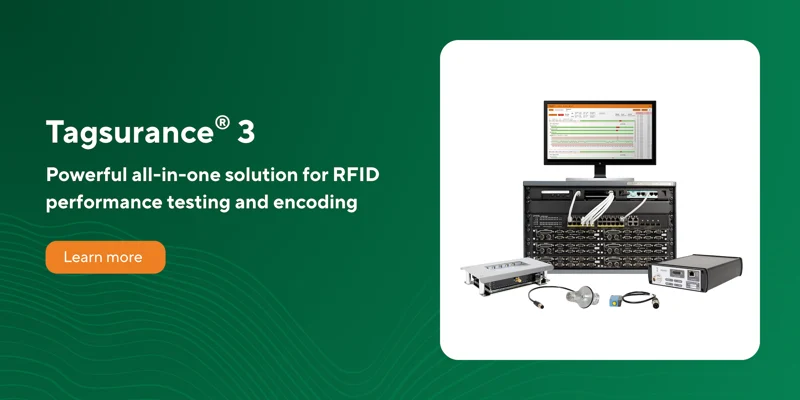
In addition, Tagsurance 3 enables encoding using the same system setup. The integrated encoding solution eliminates the need for separate devices and standalone processes, simplifying machine architecture and reducing integration complexity (see the system example image below).

From Windows PC to Industrial Embedded Platform

Earlier Tagsurance versions relied on Windows PCs, which introduced certain operational challenges and risks. Windows updates could occasionally cause disruptions, system security depended heavily on individual PC configurations, and visibility was limited to the local machine. In addition, there was no structured user privilege management, and data handling focused primarily on single-tag logs rather than broader production insights.

Tagsurance 3 software is embedded in the hardware and gives standard API interfaces and a browser-based user interface. This modern architecture provides:

  • Controlled updates
  • Industrial-grade stability
  • Secure system architecture
  • Remote visibility
  • Admin credential management
  • Structured production data: Single tag data, production / lot data, production run data (yield, capacity, lane speed and more).

Tester Performance Upgrade

Tagsurance 1 and 2 use the UHF tester version Tagsurance UHF. The minimum power level of this tester is –10 dBm, which can be too high for modern high-sensitivity inlays. As a result, marginal tags may not be detected early enough in production.

Tagsurance 3 uses the newer UHF tester, Tagsurance SL UHF, with several benefits over the previous tester version:

  • The minimum transmit power level of –25 dBm is matched with modern IC sensitivities.
  • The Tagsurance SL UHF also operates at a higher speed than earlier generations, typically the speed is doubled.
  • Tagsurance SL UHF is a power over Ethernet, simplifying the installation.
  • For ease-of-use, all connectors, leds and plates of the Tagsurance SL UHF are in the front panel.

For HF testing, Tagsurance 3 uses the Tagsurance HF 2 tester. It is backward-compatible with the previous Tagsurance HF version and offers Power over Ethernet (PoE) for simplified installation.

In summary, the higher receiver sensitivity, robustness, and accuracy, combined with higher speed, ultimately mean higher quality at higher production capacity.

Tagsurance 1 or 2Tagsurance 3
Tester only: Integration with a single tester was manageable, but adding devices or multiple lanes quickly made integration complex, often requiring PLC changes and resulting in unreliable multi-device setups.Complete system: Easily integrates with any machine without PLC changes, supports multiple devices per lane, and scales to multilane production (up to 12 lanes).
No system level featuresAdvanced system-level functionality, including software-based trigger control, lot management, IO device support, digital outputs for yield control — and a platform ready for further feature expansion.
Windows-based software with occasional update disruptions, PC-dependent security, mainly single-tag and lot log data, local visibility only, and no structured user privilege management.Embedded software with browser-based GUI, controlled updates, secure architecture, structured production data (tag, lot, run-level), remote visibility, and role-based admin access control.
APIs: Limited serial port command interfaceAPI: Comprehensive REST API (all features in GI are using the same API)
UHF tester: Tagsurance UHF, minimum power –10 dBm (may be too high for modern high-sensitivity inlays), with standard testing speed.UHF tester: Tagsurance SL UHF, minimum power –25 dBm and up to twice the testing speed compared to Tagsurance UHF.
HF Tester version: Tagsurance HFHF tester: Tagsurance HF and Tagsurance HF 2; HF 2 is backward compatible and supports Power over Ethernet (PoE).

Explore the system catalog for detailed specifications

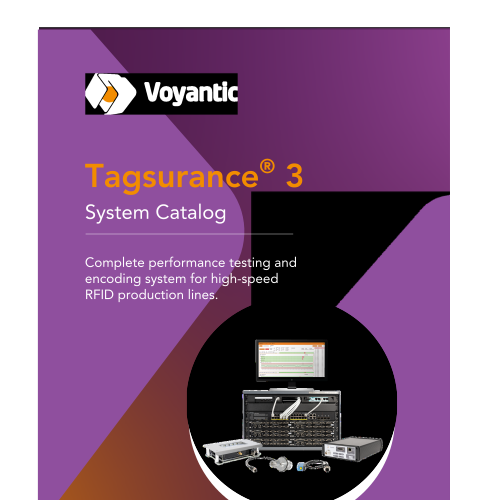
Comprehensive reference of Voyantic Tagsurance® 3 product range, with details on specifications, features, interfaces, components, accessories, spare parts, services, etc.

Ready to upgrade? Get a quote by contacting sales@voyantic.com or your local Voyantic sales representative.

How Tagsurance coupling elements upgrade: Snoop Pro™ Mini 3.0 & Snoop Pro™ Tiny 2.0

Feb 05, 2026

Voyantic Snoop Pro™ Mini and Snoop Pro™ Tiny have shiny new looks and upgraded features. Read this blog post by our Senior Hardware Designer Sami Rautanen to deep dive into the development work of the upgraded components. 

Last year we released the upgraded version of Snoop Pro™ coupling element and now it’s time to do the same for its little siblings: Voyantic Snoop Pro™ Mini & Snoop Pro™ Tiny. For the remainder of this text I’ll just refer to them as “Mini” and “Tiny”.

There has been quite a bit of detailed design work and testing to get these released. To see what’s new with them, keep scrolling to the longer article!

If you are too busy at the moment, here is a short summary of the article:

  • Snoop Pro™ Mini 3.0 with integrated strobe
    • Mechanically almost backwards compatible (shielding plates, attachment holes, geometry) but the strobe connector and cable take additional space
    • RF performance backwards compatible with v2 with a couple of exceptions:
      • Narrow tag near shielding plate opening edge when the opening is ≥ 50 mm long
      • Any kind of extensions
  • Snoop Pro™ Tiny 2.0 with integrated strobe
    • Mechanically almost backwards compatible (shielding plates, attachment holes, geometry) but the strobe connector and cable take additional space and one attachment hole was removed
    • RF performance not backwards compatible (although usually close)

New looks & integrated strobe feature

Okay, maybe the new look isn’t that new after the Snoop Pro™ 2.0 but it’s still new for Mini & Tiny. Their looks didn’t change too dramatically, some new colours, texts and switches.

Figure 1. Mini 3.0 & Tiny 2.0 appearance. 0603 SMD resistor for scale and confusion.

The new versions of Mini & Tiny feature a built-in strobe light, making it easy to use whenever the functionality is needed. The strobe light illuminates the tag from below, making the tag antenna visible in most cases and helping ensure accurate setup of the test start location. The white colour is actually no coincidence; it is used to make the strobe effect better. With the light coming from below the material the illumination effect is strong. 

Both Mini & Tiny have a switch to turn the strobe ON/OFF but only the Mini has the switch for the Fail indicator. There was simply no room for it in the Tiny so the Fail indicator in Tiny is always ON (well, at least as long as the strobe cable is connected to the Snoop). Mini & Tiny can also be used without connecting the strobe cable.

About the RF performance variance and backwards compatibility of the Mini v3.0

This is pretty awesome; with a careful design we were able to squeeze the unit-to-unit variance to better levels. This will allow a better tag production quality since the Snoop will have less impact on the result variance between different lanes. 

Here’s an example measured with a bunch of different Mini 3.0 with some tag:

Figure 2. Example of a typical unit-to-unit result variation of Mini 3.0.

You know what? Let’s look at a different one also:

Figure 3. Another example of a typical unit-to-unit result variation of Mini 3.0.

That’s not much variation, with this the Mini 3.0 should not be a limiting factor for result variation in tag production.

The backwards compatibility is divided in two parts: mechanical and RF. Mechanically the new version is pretty much backwards compatible:

  • Old shielding plates fit (different magnets to make the change easier)
  • No changes in the attachment hole sizes or positions
  • Adding the connector for the strobe took some space that breaks the borders of the previous version outlines and of course connecting the strobe cable takes space that was previously unused

So, we needed to break the mechanical backwards compatibility here to enable the strobe functionality.

With the RF performance it was way trickier to achieve backwards compatibility and actually it was not fully achieved. Let’s dig into that a bit more. We have defined the backwards compatibility as follows:

  • The results are within the envelope of the previous version

OR

  • The results are within ±1.0 dB from the center of the previous version envelope (need to allow some kind of unit-to-unit variance, unfortunately nothing is ideal in the world we’re living in)

Let’s take a look at some examples of how this looks like with real measurements. I took a small batch of both v2 and v3.0 Minis and some random tag that just happened to be close enough to my desk so I didn’t have to get up. The results with the that tag:

Figure 4. Illustrated example of the Mini 3.0 RF backwards performance with one tag type.

As you can see, with this tag the Mini v3.0 results are not within the v2 envelope across the frequency range, but the results are still within ±1.0 dB from the center of the envelope in those cases.

To find another tag I actually had to move from my desk, luckily my chair has wheels. Here are the results:

Figure 5. Illustrated example of the Mini 3.0 RF backwards performance with some other tag type.

Both results are similar. Again, there’s an area where the Mini v3.0 results are not within the v2 envelope but still very close, most of the time the results are within the envelope.But! Then there’s the situation where the Mini v3.0 results are not backwards compatible: a narrow tag near the shielding plate opening edge when the opening is ≥50 mm. Let’s take a look at an example:

Figure 6. An illustrated example of a narrow tag near shielding plate opening edge.

The narrow tag is relatively close to the shielding plate opening edge and with the Mini v3.0 it requires less power to wake up (yellow curves for v2, blue curves for v3.0):

Figure 7. Narrow tag near 60 mm (largest) shielding plate opening edge, Mini v2 vs Mini v3.0.

Even though the difference is not much it still breaks our definition of the backwards compatibility in some cases. Usually, such tags have a small pitch between consecutive tags at the inlay manufacturing stage and this problem gets smaller as the shielding plate opening gets smaller -> such a situation is unusual at the inlay stage. However, in label converting stage a larger pitch could be more common.

During the development a much larger set of different tag types was tested but of course it’s impossible to test every single tag type that exists so it’s important to keep in mind that the difference in results between Mini v2 and v3.0 is tag size, antenna geometry, chip and tag orientation dependent.

There are a few different extensions for Snoops such as the Swan and the situation can get very complex when any kind of extensions are used, no RF backwards compatibility can be promised with any of them. However, they do still fit the Mini and can be used but should only be used when really needed.

About the RF performance variance and backwards compatibility of the Tiny v2.0

Again, lets start with the mechanics. 

  • Old shielding plates fit (different magnets to make the change easier)
  • Removed one of the attachment holes to make room for the Strobe connector, but the rest remain unharmed
  • Adding the connector for the strobe took some space that breaks the borders of the previous version outlines and of course connecting the strobe cable takes space that was previously unused

RF-wise Tiny is a real tricky one to develop due to the small geometry, mainly because the distance between the coupling element and the tag is very small and therefore even small changes might cause surprisingly large differences. During the development we decided to make changes that break the RF backwards compatibility, so keep that in mind when mixing Tiny v1 with v2.0.

As with Mini v3.0, Tiny v2.0 has a very good unit-to-unit variation. Here are examples of a batch of 9 Tiny v2.0 with a couple of different tags.

Figure 8.Example of a typical unit-to-unit result variation of Tiny 2.0.

Figure 9. Another example of a typical unit-to-unit result variation of Tiny 2.0.

The result variation is at pretty much the same level as with Mini v3.0. As said before, this is nice because the Snoops don’t cause much variations between lanes.

Upgraded Snoop Pro™ Mini and Tiny for Tagsurance® 3 – More Consistency, Built-In Strobe, and Improved Production Reliability

Feb 03, 2026

Voyantic has announced upgraded versions of its compact RFID coupling elements, Snoop Pro Mini 3.0 and Snoop Pro Tiny 2.0, bringing key benefits previously introduced with Snoop Pro™ 2.0 to the smaller formats.

The updated coulpling elements are designed to improve production consistency, usability, and visual feedback in high-speed RFID tag and label manufacturing environments where space is limited.

Snoop Pro Mini 3.0 on the left and Snoop Pro Tiny 2.0 on the right.

Voyantic has released upgraded versions of its compact RFID coupling elements: Snoop Pro Mini 3.0 and Snoop Pro Tiny 2.0. The updates bring practical benefits for RFID tag and label manufacturers, improving usability, visual feedback, and measurement consistency on production lines.

The Snoop Pro Mini coupling element is ideal when there is limited space available and the tag size allows to use a smaller coupling element. In terms of coupling efficiency, the Snoop Pro Mini is often a better option for small tags when there is no need to also test larger tags in the same system.

The Snoop Pro Tiny is used when there is a need to test even smaller tags, when there is limited space in a multilane setup, or when specialized machines produce small tags and provide very little space for a coupling element.

Key features

  • Integrated strobe light – Built directly into both Mini and Tiny for clearer visual feedback during test set up and lane configuration. 
  • Lower unit-to-unit RF variation – More consistent results across parallel lanes, supporting higher and more stable production quality. 
  • Improved production reliability – Reduced influence of the coupling element on result variation helps maximize yield in high-speed manufacturing.

Compatibility highlights

Snoop Pro Mini 3.0 is mechanically almost backwards compatible and RF-compatible with the previous version in most typical production cases. Snoop Pro Tiny 2.0 introduces RF design changes to improve consistency; results may differ from earlier versions but are generally more stable between units. 

With these upgrades, Voyantic delivers a cleaner setup, clearer visual monitoring, and more predictable RF performance—helping manufacturers optimize RFID production with minimal disruption.

Key benefits

  • More consistent production results – Reduced unit-to-unit RF variation means less lane-to-lane difference, improving overall product quality and reducing tuning effort during setup. 
  • Higher yield, fewer rejects – When the coupling element contributes less to measurement variation, pass/fail decisions are more reliable, helping minimize false rejects and rework. 
  • Faster, more accurate test setup – The integrated strobe light eliminates the need for separate strobe components, simplifying mechanics and cabling on the production line. 
  • Clearer visual feedback for operators – The fail indication makes it easier to spot issues immediately, supporting quicker response times and smoother daily operation. 
  • Smooth upgrade path – Existing shielding plates and mounting solutions can largely be reused, reducing the cost and effort of upgrading current lines.

Ready to upgrade your solution components? Please contact sales@voyantic.com

Explore the system catalog for detailed specifications

Comprehensive reference of Voyantic Tagsurance® 3 product range, with details on specifications, features, interfaces, components, accessories, spare parts, services, etc.