RFID quality control has evolved beyond standalone testing. The same is true for the Voyantic Tagsurance system. Upgrading from Tagsurance 1 or 2 to Tagsurance 3 means moving to an integrated production system. The result is better speed, improved scalability, clearer production data, and greater long-term reliability. If your manufacturing operation is becoming more automated and connected, Tagsurance 3 can help you meet those demands.
Voyantic released Tagsurance 3 system a few years ago as the next step in this evolution. The key difference compared to Tagsurance 1 and 2 was architectural. Earlier generations were standalone test devices. Tagsurance 3, in contrast, is designed as a complete production system — one that not only tests tags, but coordinates devices, manages production data, and supports modern integration requirements.
At the same time, Tagsurance 3 is built for the long term. The platform is continuously developed, with new features and enhancements released regularly through controlled software updates. This ensures that the system evolves alongside industry requirements rather than remaining fixed in time.
The first- and second-generation testers have served reliably in simpler environments. But as production lines grow more advanced, many manufacturers are asking: what would upgrading to Tagsurance 3 mean in practice?
- Simpler Integration: Less engineering effort. Faster deployment.
- Production Intelligence: Lot management, yield tracking, trigger logic.
- Higher Speed and Sensitivity: Better quality at higher throughput.
- Industrial-Grade Stability: No Windows-related surprises.
- Digital Readiness: Full REST API and remote visibility.
- Scalability: From single lane to 12 lanes without architectural pain.
- High-Speed encoding: Both performance testing and encoding can be performed using the same setup.

Voyantic Tagsurance 1 and 2 test devices vs. Tagsurance 3 system
Test Devices vs. Complete Production System
Tagsurance 1 and 2 work well in simple production environments. However, today’s RFID production lines often include multiple devices and production lanes. These can include markers, punchers, encoding units, and visual inspection systems. As more equipment is added, system integration becomes more complex. Manufacturers may need PLC modifications, additional engineering work, and longer implementation projects. This can increase costs and make future expansion more difficult. Multi-lane production creates additional challenges. Integration projects often take longer, engineering costs increase, and scaling the system becomes harder. In some cases, reliability can also suffer.
Tagsurance 3 takes a different approach. Instead of operating as a standalone tester, it works as a complete production system. It integrates with production machinery without requiring PLC modifications. The system supports multiple devices on each lane and scales up to 12 lanes. This makes deployment faster and future expansion easier. It integrates easily with virtually any machine without requiring changes to the machine’s PLC code. It supports multiple devices per lane and can handle up to 12 lanes, including markers, punchers, inspection systems, and other equipment. This results in:
- Shorter integration times
- Fewer engineering efforts
- Flexibility and scalability
- Reliable integrations.
Tagsurance 3 is built to support your digitalization strategy. It also features a comprehensive REST API that enables clean and modern integrations. In contrast, Tagsurance 1 and 2 provided only a limited serial-port command interface.
Production Intelligence and Integrated Capabilities
Tagsurance 1 and 2 were designed primarily for tag testing. Tagsurance 3 goes further by adding production-level intelligence. The system helps manage lots, controls production triggers, supports external IO devices, and provides better yield monitoring. These capabilities give manufacturers greater visibility and control over the production process.
Tagsurance 3 can also handle encoding within the same system. This removes the need for separate encoding equipment and standalone workflows. As a result, machine architecture becomes simpler, and integration work is reduced (see the system example image below).

From Windows PC to Industrial Embedded Platform
Earlier Tagsurance versions relied on Windows PCs. While effective, this approach introduced challenges. Operating system updates could interrupt production. Security depended on local PC settings, and users had limited access to production information outside the machine itself. User access management was also limited. Data collection focused mainly on individual tag results instead of providing a broader view of production performance.
Tagsurance 3 software is embedded in the hardware and gives standard API interfaces and a browser-based user interface. This modern architecture provides:
- Controlled updates
- Industrial-grade stability
- Secure system architecture
- Remote visibility
- Admin credential management
- Structured production data: Single tag data, production / lot data, production run data (yield, capacity, lane speed and more).
Tester Performance Upgrade
The Tagsurance UHF tester has a minimum power level of -10 dBm. This may be too high for some modern, high-sensitivity RFID inlays. As a result, marginal tags may pass testing without being detected early enough.
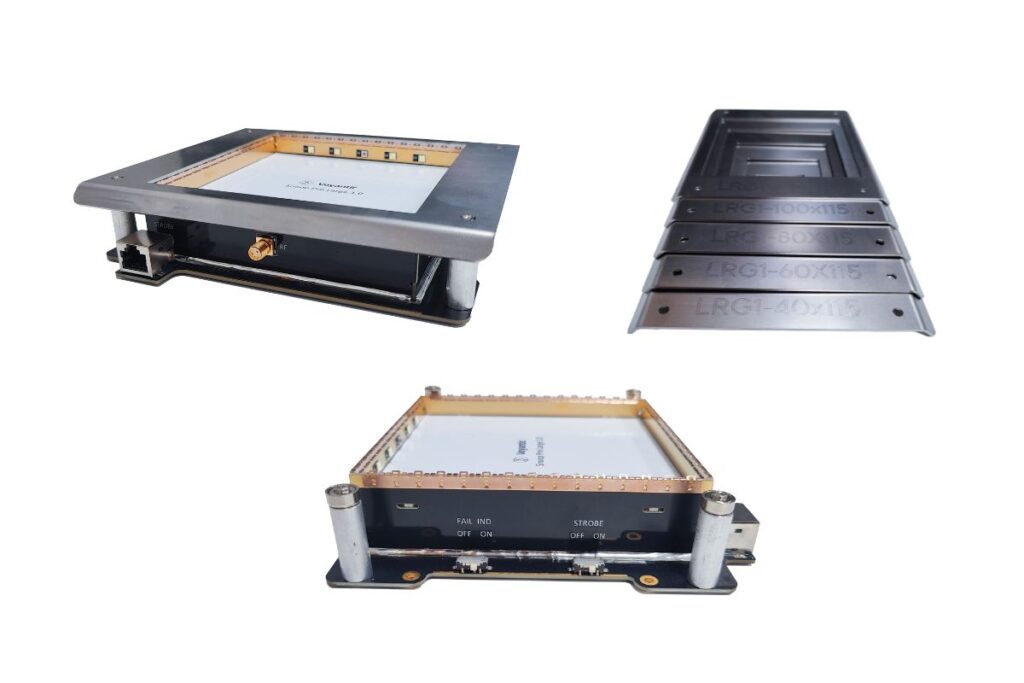
Tagsurance 3 uses the newer UHF tester, Tagsurance SL UHF, with several benefits over the previous tester version:
- The minimum transmit power level of –25 dBm is matched with modern IC sensitivities.
- The Tagsurance SL UHF also operates at a higher speed than earlier generations, typically the speed is doubled.
- Tagsurance SL UHF is a power over Ethernet, simplifying the installation.
- For ease-of-use, all connectors, leds and plates of the Tagsurance SL UHF are in the front panel.
For HF testing, Tagsurance 3 uses the Tagsurance HF 2 tester. It is backward-compatible with the previous Tagsurance HF version and offers Power over Ethernet (PoE) for simplified installation.
Higher sensitivity, improved accuracy, and faster testing help manufacturers improve quality without sacrificing production speed. This enables higher throughput while maintaining reliable test results.
| Tagsurance 1 or 2 | Tagsurance 3 |
|---|---|
| Tester only: Integration with a single tester was manageable, but adding devices or multiple lanes quickly made integration complex, often requiring PLC changes and resulting in unreliable multi-device setups. | Complete system: Easily integrates with any machine without PLC changes, supports multiple devices per lane, and scales to multilane production (up to 12 lanes). |
| No system level features | Advanced system-level functionality, including software-based trigger control, lot management, IO device support, digital outputs for yield control — and a platform ready for further feature expansion. |
| Windows-based software with occasional update disruptions, PC-dependent security, mainly single-tag and lot log data, local visibility only, and no structured user privilege management. | Embedded software with browser-based GUI, controlled updates, secure architecture, structured production data (tag, lot, run-level), remote visibility, and role-based admin access control. |
| APIs: Limited serial port command interface | API: Comprehensive REST API (all features in GI are using the same API) |
| UHF tester: Tagsurance UHF, minimum power –10 dBm (may be too high for modern high-sensitivity inlays), with standard testing speed. | UHF tester: Tagsurance SL UHF, minimum power –25 dBm and up to twice the testing speed compared to Tagsurance UHF. |
| HF Tester version: Tagsurance HF | HF tester: Tagsurance HF and Tagsurance HF 2; HF 2 is backward compatible and supports Power over Ethernet (PoE). |
Explore the system catalog for detailed specifications
Comprehensive reference of Voyantic Tagsurance® 3 product range, with details on specifications, features, interfaces, components, accessories, spare parts, services, etc.
Ready to upgrade? Get a quote by contacting sales@voyantic.com or your local Voyantic sales representative.