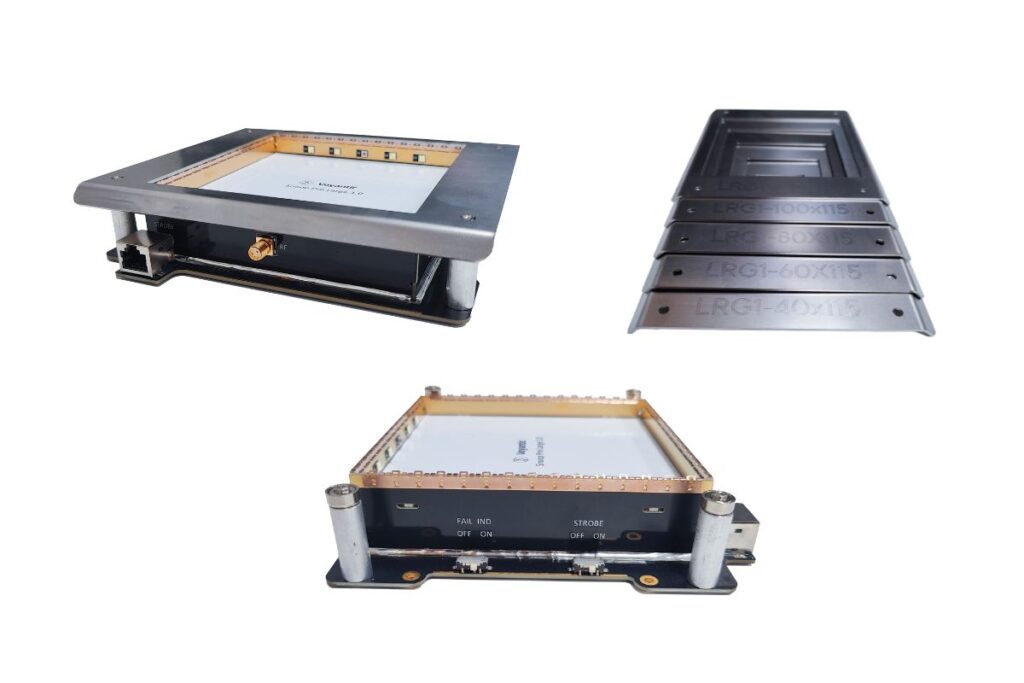
Voyantic Snoop Pro™ Mini and Snoop Pro™ Tiny have shiny new looks and upgraded features. Read this blog post by our Senior Hardware Designer Sami Rautanen to deep dive into the development work of the upgraded components.
Last year we released the upgraded version of Snoop Pro™ coupling element and now it’s time to do the same for its little siblings: Voyantic Snoop Pro™ Mini & Snoop Pro™ Tiny. For the remainder of this text I’ll just refer to them as “Mini” and “Tiny”.
There has been quite a bit of detailed design work and testing to get these released. To see what’s new with them, keep scrolling to the longer article!
If you are too busy at the moment, here is a short summary of the article:
- Snoop Pro™ Mini 3.0 with integrated strobe
- Mechanically almost backwards compatible (shielding plates, attachment holes, geometry) but the strobe connector and cable take additional space
- RF performance backwards compatible with v2 with a couple of exceptions:
- Narrow tag near shielding plate opening edge when the opening is ≥ 50 mm long
- Any kind of extensions
- Snoop Pro™ Tiny 2.0 with integrated strobe
- Mechanically almost backwards compatible (shielding plates, attachment holes, geometry) but the strobe connector and cable take additional space and one attachment hole was removed
- RF performance not backwards compatible (although usually close)
New looks & integrated strobe feature
Okay, maybe the new look isn’t that new after the Snoop Pro™ 2.0 but it’s still new for Mini & Tiny. Their looks didn’t change too dramatically, some new colours, texts and switches.

Figure 1. Mini 3.0 & Tiny 2.0 appearance. 0603 SMD resistor for scale and confusion.
The new versions of Mini & Tiny feature a built-in strobe light, making it easy to use whenever the functionality is needed. The strobe light illuminates the tag from below, making the tag antenna visible in most cases and helping ensure accurate setup of the test start location. The white colour is actually no coincidence; it is used to make the strobe effect better. With the light coming from below the material the illumination effect is strong.
Both Mini & Tiny have a switch to turn the strobe ON/OFF but only the Mini has the switch for the Fail indicator. There was simply no room for it in the Tiny so the Fail indicator in Tiny is always ON (well, at least as long as the strobe cable is connected to the Snoop). Mini & Tiny can also be used without connecting the strobe cable.
About the RF performance variance and backwards compatibility of the Mini v3.0
This is pretty awesome; with a careful design we were able to squeeze the unit-to-unit variance to better levels. This will allow a better tag production quality since the Snoop will have less impact on the result variance between different lanes.
Here’s an example measured with a bunch of different Mini 3.0 with some tag:

Figure 2. Example of a typical unit-to-unit result variation of Mini 3.0.
You know what? Let’s look at a different one also:

Figure 3. Another example of a typical unit-to-unit result variation of Mini 3.0.
That’s not much variation, with this the Mini 3.0 should not be a limiting factor for result variation in tag production.
The backwards compatibility is divided in two parts: mechanical and RF. Mechanically the new version is pretty much backwards compatible:
- Old shielding plates fit (different magnets to make the change easier)
- No changes in the attachment hole sizes or positions
- Adding the connector for the strobe took some space that breaks the borders of the previous version outlines and of course connecting the strobe cable takes space that was previously unused
So, we needed to break the mechanical backwards compatibility here to enable the strobe functionality.
With the RF performance it was way trickier to achieve backwards compatibility and actually it was not fully achieved. Let’s dig into that a bit more. We have defined the backwards compatibility as follows:
- The results are within the envelope of the previous version
OR
- The results are within ±1.0 dB from the center of the previous version envelope (need to allow some kind of unit-to-unit variance, unfortunately nothing is ideal in the world we’re living in)
Let’s take a look at some examples of how this looks like with real measurements. I took a small batch of both v2 and v3.0 Minis and some random tag that just happened to be close enough to my desk so I didn’t have to get up. The results with the that tag:

Figure 4. Illustrated example of the Mini 3.0 RF backwards performance with one tag type.
As you can see, with this tag the Mini v3.0 results are not within the v2 envelope across the frequency range, but the results are still within ±1.0 dB from the center of the envelope in those cases.
To find another tag I actually had to move from my desk, luckily my chair has wheels. Here are the results:

Figure 5. Illustrated example of the Mini 3.0 RF backwards performance with some other tag type.
Both results are similar. Again, there’s an area where the Mini v3.0 results are not within the v2 envelope but still very close, most of the time the results are within the envelope.But! Then there’s the situation where the Mini v3.0 results are not backwards compatible: a narrow tag near the shielding plate opening edge when the opening is ≥50 mm. Let’s take a look at an example:

Figure 6. An illustrated example of a narrow tag near shielding plate opening edge.
The narrow tag is relatively close to the shielding plate opening edge and with the Mini v3.0 it requires less power to wake up (yellow curves for v2, blue curves for v3.0):

Figure 7. Narrow tag near 60 mm (largest) shielding plate opening edge, Mini v2 vs Mini v3.0.
Even though the difference is not much it still breaks our definition of the backwards compatibility in some cases. Usually, such tags have a small pitch between consecutive tags at the inlay manufacturing stage and this problem gets smaller as the shielding plate opening gets smaller -> such a situation is unusual at the inlay stage. However, in label converting stage a larger pitch could be more common.
During the development a much larger set of different tag types was tested but of course it’s impossible to test every single tag type that exists so it’s important to keep in mind that the difference in results between Mini v2 and v3.0 is tag size, antenna geometry, chip and tag orientation dependent.
There are a few different extensions for Snoops such as the Swan and the situation can get very complex when any kind of extensions are used, no RF backwards compatibility can be promised with any of them. However, they do still fit the Mini and can be used but should only be used when really needed.
About the RF performance variance and backwards compatibility of the Tiny v2.0
Again, lets start with the mechanics.
- Old shielding plates fit (different magnets to make the change easier)
- Removed one of the attachment holes to make room for the Strobe connector, but the rest remain unharmed
- Adding the connector for the strobe took some space that breaks the borders of the previous version outlines and of course connecting the strobe cable takes space that was previously unused
RF-wise Tiny is a real tricky one to develop due to the small geometry, mainly because the distance between the coupling element and the tag is very small and therefore even small changes might cause surprisingly large differences. During the development we decided to make changes that break the RF backwards compatibility, so keep that in mind when mixing Tiny v1 with v2.0.
As with Mini v3.0, Tiny v2.0 has a very good unit-to-unit variation. Here are examples of a batch of 9 Tiny v2.0 with a couple of different tags.

Figure 8.Example of a typical unit-to-unit result variation of Tiny 2.0.

Figure 9. Another example of a typical unit-to-unit result variation of Tiny 2.0.
The result variation is at pretty much the same level as with Mini v3.0. As said before, this is nice because the Snoops don’t cause much variations between lanes.