
For many RFID manufacturers, quality assurance is often viewed through the lens of cost. Testing equipment, quality management systems, and process controls require investment, making it tempting to minimize testing in pursuit of lower production costs.
However, this perspective only captures part of the picture.
The real question is not how much quality costs, but how much poor quality costs. Once all direct and indirect consequences are considered, quality becomes one of the strongest drivers of profitability, operational efficiency, and customer retention.
The most successful RFID manufacturers understand that quality is not simply a production requirement—it is a business strategy.
Read more: RAIN RFID Quality: What Defines Reliable Tag Performance and Why It Matters
Understanding the two sides of quality cost
Every manufacturing operation carries two types of quality-related costs.
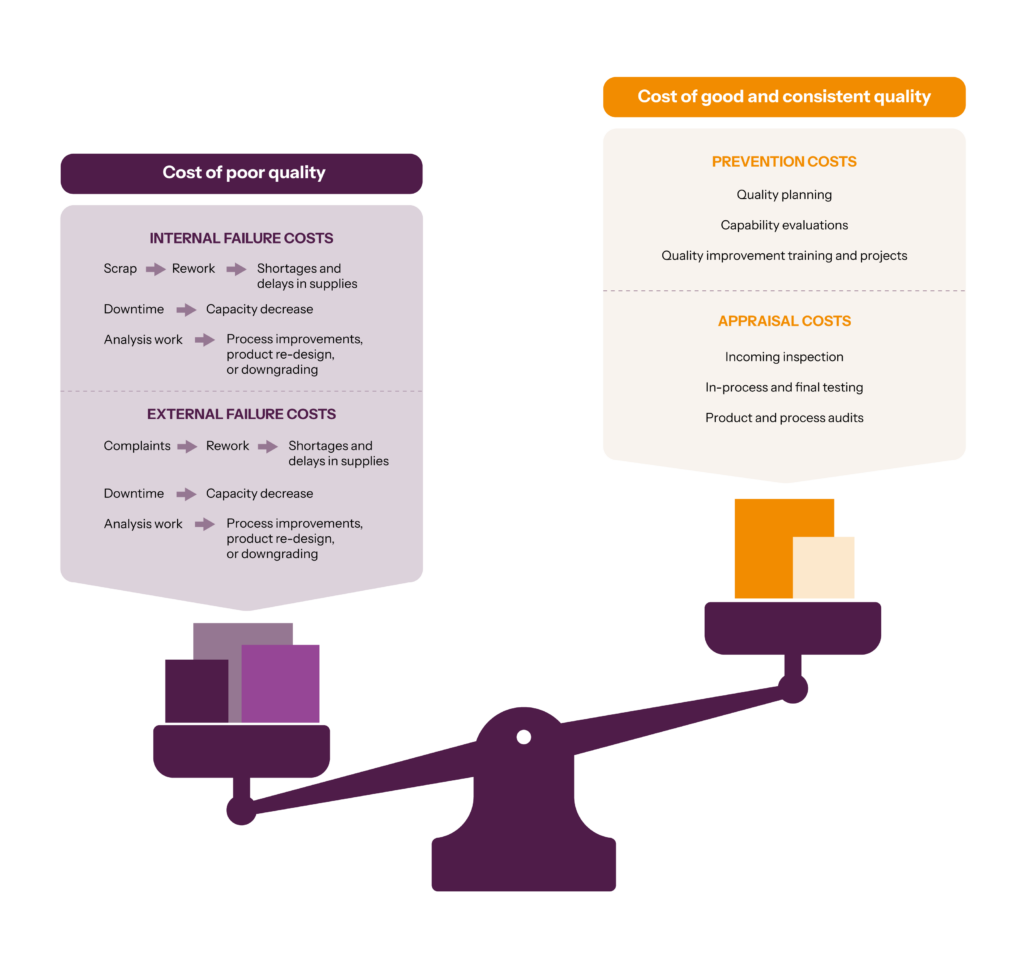
The first is the cost of good quality. These are planned investments that help prevent defects before products leave the production line. They include RFID testing equipment, process monitoring, quality assurance procedures, operator training, and production verification.
The second is the cost of poor quality. These costs only appear when something goes wrong. Scrap, rework, production downtime, engineering investigations, delayed deliveries, customer complaints, replacements, warranty cases, and damaged reputation all belong to this category.
While investments in prevention are easy to identify in a budget, the costs created by defects are often spread across multiple departments and business processes. As a result, they are frequently underestimated.
Every defect has a price—even inside the factory
The impact of poor quality starts long before a customer notices a problem.
When defects appear during production, manufacturing efficiency immediately begins to decline. Engineers investigate root causes, operators stop production lines, affected batches require additional inspection, and production schedules need to be adjusted.
For RFID manufacturers operating high-speed production lines, even a relatively short interruption can represent thousands—or tens of thousands—of labels that are no longer being produced.
The consequences quickly accumulate:
- Production downtime
- Material waste
- Additional inspections
- Rework
- Lost production capacity
- Delivery delays
Although these costs remain internal, they directly reduce profitability. The earlier quality issues are detected, the easier—and less expensive—they are to resolve.
The economics of quality become clearer at scale
As production volumes increase, even small defect rates begin to carry significant financial consequences.
Consider a simplified example.
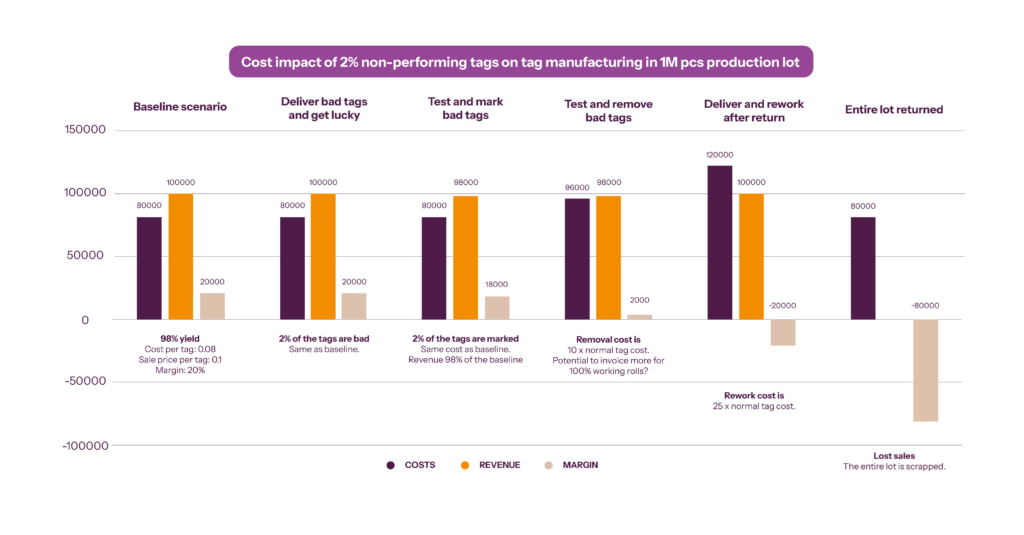
A converter manufactures one million RFID labels with a production yield of 98%. Two percent of the tags do not meet performance requirements.
At this point, there are two possible approaches.
The first is to ship every label without testing and hope the defects go unnoticed. On paper, this appears to maximize margins because no additional quality costs are incurred.
The second is to verify product quality during production, identify defective tags, and either mark or replace them before shipment.
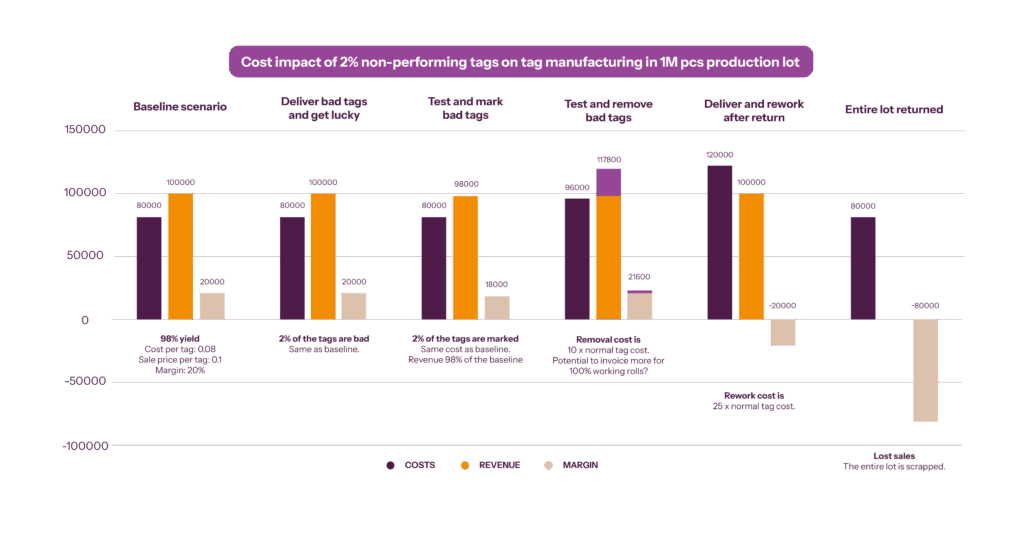
Testing naturally introduces additional cost. Yet it also prevents defective products from reaching customers, keeping margins positive while significantly reducing business risk. This illustrates an important principle of manufacturing economics: The cost of preventing failures is typically far lower than the cost of correcting them later.
Everything changes once defects reach the customer
The financial impact increases dramatically when poor-quality RFID labels leave the factory. What was previously an internal production issue quickly becomes a customer issue.
Instead of simply replacing defective tags during manufacturing, suppliers now face a much longer chain of consequences:
- Customer complaints
- Technical investigations
- Product returns
- Replacement production
- Additional logistics
- Customer support
- Production rescheduling
The original production costs have already been incurred.
Now the same order generates new costs through investigation, reproduction, shipping, and customer management.
An order that initially appeared profitable can quickly become unprofitable.
More importantly, production resources that could have been used for new business are instead consumed by correcting previous mistakes.
The biggest cost rarely appears in financial reports
While scrap and rework are measurable, the largest consequence of poor quality is often invisible.
Customer trust.
RFID labels are critical components in increasingly automated supply chains. Customers rely on consistent read performance and predictable quality because failures can disrupt their own production, logistics, and operations.
If quality problems occur repeatedly, customers begin asking difficult questions: Can this supplier consistently deliver? Will future shipments perform as expected? And finally, should another supplier be considered?
A rejected shipment may be expensive, but losing a long-term customer relationship is far more costly. The value of repeat business, future projects, and referrals often exceeds the financial impact of a single defective production batch.
Quality is becoming a competitive advantage
In today’s RFID market, manufacturers compete on far more than price. Customers increasingly expect suppliers to demonstrate—not simply claim—the quality of their products.
Manufacturers that can consistently verify performance, monitor production quality, and provide objective quality data strengthen customer confidence throughout the purchasing process.
This transforms quality from a manufacturing function into a commercial advantage.
Consistent quality leads to:
- Greater customer confidence
- Fewer complaints
- Stronger customer retention
- Improved operational efficiency
- Better long-term profitability
Rather than viewing testing as an expense, leading manufacturers increasingly see it as an investment in customer relationships.
The objective is optimization—not maximum testing
Investing in quality does not mean testing everything imaginable or adding unnecessary process steps.
The goal is to find the optimal balance between prevention costs and failure costs.
Initially, investments in testing and process control produce substantial reductions in scrap, rework, downtime, and customer issues. Eventually, however, the additional benefits begin to diminish.
The objective is therefore not to maximize quality spending, but to minimize the total cost of quality.
Finding that balance allows manufacturers to improve profitability while maintaining the level of quality customers expect.
Read more: Best Practices for RAIN RFID Label Quality Testing
Looking beyond today’s production costs
Quality decisions should never be evaluated solely against the cost of testing equipment or inspection processes. The more important comparison is between the visible investment in quality and the hidden costs created by poor quality throughout the entire business.
For RFID converters and inlay manufacturers, those hidden costs extend far beyond production. They influence manufacturing efficiency, delivery performance, customer satisfaction, reputation, and future revenue.
Companies that consistently invest in measuring, controlling, and proving quality are not simply producing better RFID products. They are building more resilient operations, stronger customer relationships, and a more profitable business over the long term.