Combining QA and Encoding: The Next Efficiency Breakthrough in RAIN RFID Production

Nov 21, 2025

RAIN RFID encoding has traditionally taken place late in the production process, often across multiple parties and disconnected systems. This blog looks at why encoding workflows may be shifting, how integrating encoding with quality control can streamline production, and what new business opportunities this creates for converters, manufacturers, and other players in the value chain.

In most RAIN RFID production environments, tag personalization is done at a late stage in the production process — just before the label is attached to the item. This is partly due to legacy processes, but at the center lies one key issue: data for encoding, such as unique item-level information, is often only finalized late in the process. Many times, the personalization part of the process is also outsourced to a separate party.

Streamlining the production chain can open up new business opportunities. Label converters can take on a larger role by handling encoding during the converting process, or partial data can be encoded already at the chip attachment stage when the process and data flows support it.

Encoding can thus shift from being a costly bottleneck to becoming a competitive advantage. RAIN RFID tag volumes will continue to grow, and the need for encoding—one way or another—will grow with them. With efficient, scalable processes, the margin per encoded tag can increase, and with large volumes, this margin improvement becomes significant. 

In our previous blog, we looked at the most common encoding methods, compared desktop printers with inline systems, and broke down how their ROI differs as production volumes grow. While printers work well for small batches, inline encoding with integrated quality assurance provides clearly lower per-tag costs and better scalability at higher volumes.

Combining Steps in the Process

For converters or manufacturers already using an integrated quality control system in their inline machines, combining two steps into one is already possible today. 

It is possible to handle both quality control and high-speed encoding within a single system — no handoff or secondary systems required. Unlike desktop printer setups, these integrated solutions scale: production can start with a single line and expand by adding more lanes or stations as demand increases, lowering per-unit costs while improving speed, quality, and traceability.

Quality control is already implemented in most bonding machines producing RAIN RFID. By including encoding capabilities, these machines can integrate encoding and verification directly into the production line, simplifying the process and enabling concrete opportunities for optimization.

These changes demand a lot from both processes and people, and optimization is always case-specific. However, the technology is already available. Moving beyond how things are done today and recognizing the future opportunities strengthens the position of the organizations that act early as the market continues to grow and tag volumes increase.

Things to Consider When Scaling Up

As the demand for RAIN RFID tags continues to grow, companies in the value chain needs a clear plan for scaling up. Encoding solutions must be able to grow with rising tag volumes, so that doubling volumes does not double the cost or complexity.

Manual and fragmented encoding processes tend to limit scalability and squeeze margins, especially when desktop printers are pushed beyond the small-batch use cases where they work best. In contrast, inline encoding solutions with integrated quality control help keep per-tag costs low and support high-volume production.

Encoding is no longer just a technical step; it can become a strategic business lever. Companies that treat encoding as part of their value proposition — for example by combining encoding and quality testing into a single, streamlined process — improve efficiency, strengthen their role in the value chain, and position themselves for profitable growth as RAIN RFID adoption expands.

Get insights on Tagsurance 3 system with encoding feature in action.

In this on-demand demo webinar, we will walk you through the new system in practice.

Choosing the Right Encoding Method in Large-Scale RAIN RFID Tag Production

Nov 21, 2025

Encoding influences the total cost, speed, and efficiency across the entire RAIN RFID tag value chain, from manufacturing to the end customer. In this post, we look at the most common encoding methods, compare desktop printers with inline systems, and break down how their ROI differs as production volumes grow.

Encoding, or personalization, is a crucial step in the RAIN RFID value chain, as it provides the tag with the meaningful data required for its intended use. It allows the tagged item to be synchronized with systems like inventory management, unlocking countless use cases where users can identify, locate, authenticate, and interact with each item. Therefore, the majority of the tags are encoded before they are shipped out, or the label is applied.

Although personalization is essential for the end use, encoding can often be an inefficient or costly step in the workflow.

The Costs of Label Encoding

There are some finishing lines for the personalization, and for many, desktop RAIN RFID printers have served — and continue to serve — well for encoding. The printers offer low initial investment costs, ease of use, and are sufficient for small batches.

However, these systems don’t scale. Their limitations become apparent as production volumes grow or complexity increases. Many of the finishing line systems are self-made or one-off (few off) systems from miscellaneous suppliers. Less-than-perfect systems and processes introduce delays, raise per-label costs, and increase the risk of errors.

Ultimately, you’re paying not just for the hardware, but also for operator time — and, in the worst case, for material waste and quality issues.

Real cost of encoding:

  • Hardware
  • Operator time
  • Unplanned downtime
  • Waste
  • Errors

Personalization can take place at several different stages of the value chain

Traditionally, personalization occurs in the final stages of RAIN RFID tag production, just before the tag is applied to its end-use item. In some cases, the inlay manufacturer handles encoding, selling inlays with customer-specific data already embedded. Label converters may encode and sell labels that already contain customer data.

RAIN RFID labels can also be encoded by service bureaus specializing in data management and encoding. End users may choose to purchase blank labels and perform encoding in-house. In addition, various intermediaries — such as system integrators or other service providers — may also handle encoding.

Regardless of who performs the encoding, the key question remains: how to encode in a cost-efficient way.

The comparison: when inline encoding is the better option

Larger machines are needed to address the scalability limitations of desktop printers. Industrial-grade RAIN RFID machines today can produce and encode tags at speeds ranging from 1,000 to over 1,000,000 units per hour. 

But speed alone isn’t the breakthrough. The question is at which point the investment becomes viable. For example, frequently starting and stopping a high-speed machine makes little sense if only small batches are being produced.

We have worked on some comparisons to evaluate the benefits and ROI of the industrial-scale encoding solution. The comparison and the key parameters are shown in the table below.

Metric10 pcs printersInline encoding
Initial Setup Cost10’000 USDContact Voyantic
Monthly Throughput1’500’000 pcs50’000’000 pcs
Operators per Shift11
Quality ControlN/A100% Quality Assurance
ScalabilityLimited due to the required floor space and the number of operatorsScales easily to large volumes

For short runs and smaller operations, printers still earn their place. Yet when volumes grow, the economics shift: inline encoding outperforms by delivering higher throughput, dramatically lower per-tag costs, and built-in quality assurance. In other words, if you’re preparing for mid to high-volume RFID adoption that meets the quality standards, inline encoding is the strategy that keeps your production efficient — and your business competitive.

Get insights on Tagsurance 3 system with encoding feature in action.

In this on-demand demo webinar, we will walk you through the new system in practice.

Advanced Label Replacement with Tagsurance® 3

Oct 16, 2025

In RFID tag production, one thing is certain: there are always tag rejections, and the yield is never 100%. Failures happen; everyone in the industry knows it and must be prepared for it. However, the end customers justifiably have requirements for the RFID tag batch deliveries. The requirements can define the minimum yield, maximum allowed number of consecutive failed tags, or total maximum number of failed tags in each roll of tags. 

To meet these requirements, the tag manufacturer may sometimes need to replace failed tags with new ones. This replacement can be done as a separate process in a reel-to-reel machine or directly in the manufacturing machine, such as a converting line, at a ‘doctoring’ station. Advanced quality control is needed to make this process efficient and reliable. With Tagsurance 3 version 4.3.0, released on September 29, 2025, we introduced new features that help label manufacturers make the replacement process easier and more reliable while meeting customer quality requirements.

Stop Signal for the Machine Based on Test Result

Based on the test results, Tagsurance 3 can now tell the machine to stop the lane when a replacement label is needed. When Tagsurance 3 is in charge of the lot management, manufacturers can implement the label replacement process on any machine that supports simple ‘slow down’ and ‘stop’ signals. This results in even more basic machines becoming compatible with advanced quality control workflows, as no built-in stopping logic is required. The user can define the result-based logic in Tagsurance 3.

Replacement Label TID Tracking: Keep Your Data Clean 

When tags are replaced, the original test results are no longer valid, and key statistics, such as yield, become inaccurate. For both the manufacturer and the end customer, it is essential that the reported results match the actual deliveries: the lot results must correspond precisely to the output tag reel.

With Tagsurance 3 integrated, the manufacturing process includes test stations both before and after the replacement location (the ‘doctoring’ station). As a standard feature, Tagsurance 3 enables the capturing and reporting of test results, data such as TID, and statistics as part of the lot results. The new improvement is that this same data can now also be captured for the replaced labels at the second test station. Lot management takes into account only the test station results after the replacement location, making the lot results accurate.

Watch the video to see how the advanced label replacement happens with Tagsurance 3.

Together with the stop signal feature, Tagsurance 3 can now provide a complete solution for quality control and label replacement process, as well as accurate encoding and batch data results.

Read more about the Tagsurance 3 lot data exporting capabilities: https://voyantic.com/blog/posts/improved-lot-data-export-during-test-runs/

Feature Update: Improved Lot Data Export During Test Runs

Aug 28, 2025

The number of RFID tags being produced has increased significantly in recent years, and the growth is expected to continue with the expansion of new application areas. As a result, the need for production speed, efficiency, and various levels of automation continues to grow. Production batches of RFID labels are now manufactured at an accelerating pace, creating greater demand for efficiency. At Voyantic, we continuously develop our systems to meet the future needs of the RFID industry.

With the latest software updates of Tagsurance® 3 (version 4.1.7 and up), we have improved how test data can be accessed and exported. Previously, the test data could only be exported after a job was completed or paused. Tagsurance would mark the transition between lots, but no batch-specific data could be accessed while the system ran. With the latest update, the system enables smooth exporting of lot-specific data even during an active run. Most importantly, you can now download a summary of the lot data—such as yield—during the production process. This makes it possible to review lot-specific performance in real time and, if necessary, mark certain rolls for rework if they don’t meet quality requirements.

Exporting batch results via browser UI while the job is running

While the top menu’s general “Export data” button remains inactive while the job runs, you can click the double-arrow icon to open the lot menu. By hovering over the desired lot, you can export data for that specific production batch while the run is ongoing.

The export function downloads a file package directly to the computer in use. The package includes test data in CSV format, containing the summary file and results for every individual tag tested, allowing for example, closer inspection of failed labels.

See below a short screen recording video demonstrating how the enhanced feature works in the browser UI

Exporting batch results via API while the job is running

With Tagsurance 3 version 4.1.7 (and up), the same new lot data export functionality is also available for customers using the API to export test data. 

Perform the lot data export following these steps:

1) Get the currently running job ID with calling status API `GET /v1/status`

2) Get jobs batches with batch stats API `GET /v1/jobs/{job id}/batch-stats`

3) Start batch result export by calling export `POST /v1/jobs/{job id}/batches/{batch id}/export`

4) Check that export is completed and ready for download by checking export status with status API `GET /v1/status`

5) Download the batch results zip file package

For a detailed demonstration or guidance on setting up API integration, don’t hesitate to contact sales@voyantic.com or support@voyantic.com.

Voyantic introduces reliable high-speed encoding into RAIN RFID converting and other machines with the Tagsurance® 3 system

Apr 11, 2025

Voyantic, a global leader in RFID testing solutions, is proud to announce the launch of the new encoding feature for Tagsurance 3 quality testing system. The latest software release enables encoding and quality control of RAIN RFID labels in high-speed production machines with a single system. 

As the demand for RAIN RFID labels is expected to grow exponentially, with billions produced annually, manufacturers need integrated, high-speed systems. The Tagsurance 3 system with encoding feature meets this demand, allowing seamless integration into production lines and eliminating the need for external encoding solutions. The Tagsurance 3 system is modular and scalable and can easily fit into various machine types. The user-friendly, browser-based operating UI helps with adoption at sites.

“At Voyantic, we are committed to delivering cutting-edge solutions that help our customers excel in RFID,” said Jukka Voutilainen, Voyantic’s General Manager. “This upgrade significantly enhances the Tagsurance 3 system’s capabilities, making it a powerful all-in-one solution for RAIN RFID inlay and label production.”

Uncompromised speed and reliability

The Tagsurance 3 system maintains high throughput without compromising the speed and efficiency of the production process. It supports encoding in high-speed machines and can even reach lane speeds for converting machines.

Additionally, the system’s reliability is paramount. Non-encoded, incorrectly encoded, or double-coded labels can create significant challenges for RAIN RFID users. To address this, the Tagsurance 3 system is designed for continuous, error-free operation during extended production runs, ensuring the highest reliability standard in large-volume manufacturing. 

Main specifications:

  • One encoding station per lane is supported
  • “BlockWrite” data to any writeable tag memory and lock the tag memories (Reserved, EPC, User)
  • Supported ISO 18000-63 (EPC Gen2v3) commands
    • BlockWrite
    • Lock
    • Read
  • 1-12 lanes
  • Lock the selected memories permanently
  • Verify the data is correctly encoded (Read test with verification)

The full specification is available in Tagsurance 3 product catalog.

The commercial release of the Tagsurance 3 encoding feature, available starting 10th of April, will be offered as a separate license on top of the existing Tagsurance 3 system. A hardware version 4.x is required to utilize this feature.

Save the date! We’re organizing a Tagsurance 3 encoding live demo on Wednesday, May 21, at 5 pm CEST / 10 am EDT. Register for the live webinar from here!

Tagsurance® 3 Online Connectivity Improves Usability and Maintenance
Mar 20, 2025

Voyantic recently launched a new version of the Tagsurance 3 system, an inline quality testing system for RFID tag production. With this update, we recommend that customers using the latest version (4.x) keep their systems always connected online. On the other hand, older versions (3.x) should still stay offline. But why the switch? And what benefits come with this new online connectivity?

Let’s dive in!

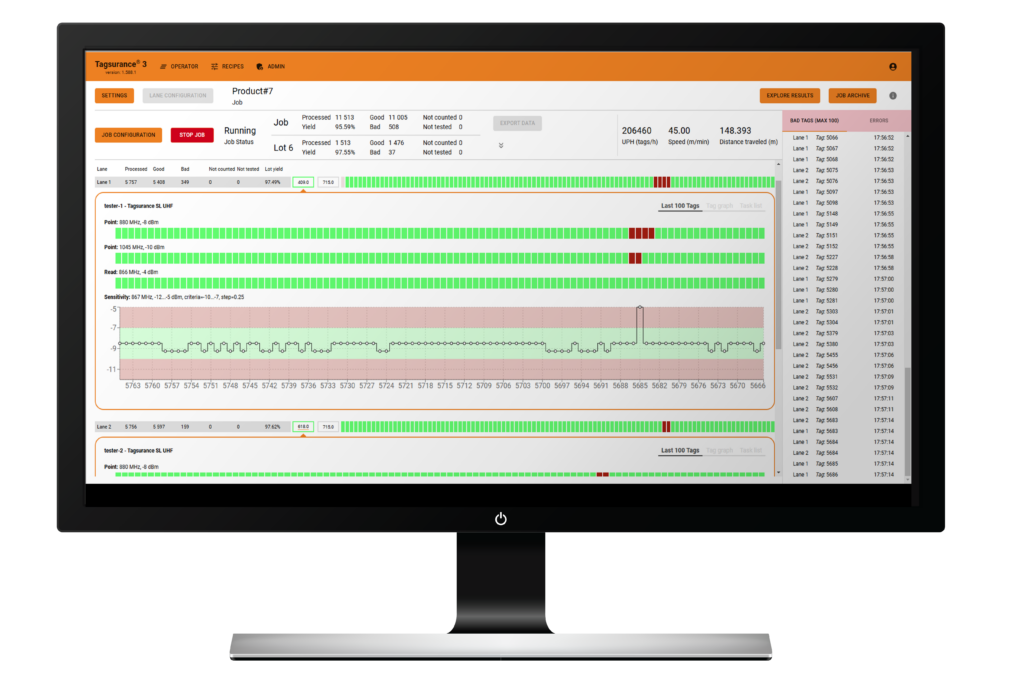
A screenshot of Tagsurance 3 Version 4.0 user interface.
A screenshot of Tagsurance 3 Version 4.x software user interface.

Cloud-based architecture enables future-proof quality management

With the new version, the Tagsurance 3 system’s architecture has been completely revamped under the hood. The Voyantic team has carefully designed this upgrade with the future and information security in mind. This release marks an important milestone, enabling safe network connectivity for the test system. Voyantic designs its systems using secure development best practices, and regular third-party audits ensure any identified issues are promptly addressed. 

The Tagsurance 3 Version 4.x with online connectivity paves the way for future possibilities, including encoding operations through the same setup. Enabling encoding will only require purchasing a software license, with no need for additional hardware upgrades.

Simpler, faster, and more efficient—whether it’s for daily use or maintenance tasks

Connecting the system to the internet is safe and recommended for unlocking a range of new features. Today, the concrete updates are most noticeable in the new browser-based user interface, which administrators and operators can access from any computer. Let’s examine the latest features designed to ease the system’s use.

1. Update software directly in the user interface

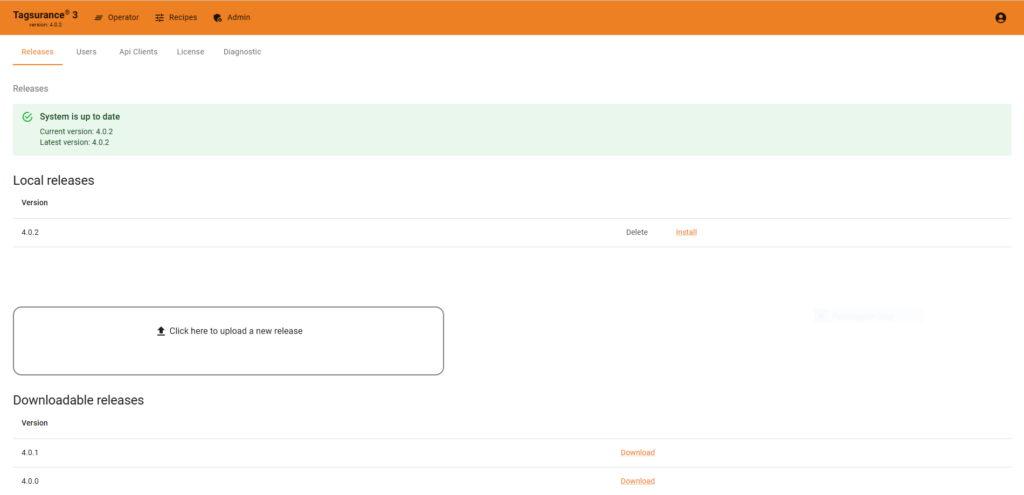
Gone are the days of downloading software update packages separately from voyantic.com and manually performing updates. With this new feature, admins can download and install the latest software versions directly from the user interface via the admin panel—as long as the system is connected to the internet. This ensures your system stays effortlessly updated with the latest features and improvements.

A screenshot from Tagsurance 3 4.x software showing what the releases page looks like.
Updating your Tagsurance 3 Version 4.x software has been made easy.

2. Simplified licensing

When your Tagsurance 3 version 4.x system is connected to the internet, it automatically connects to Voyantic’s license server and fetches the license information. Admin users can see all the essential details in the browser-based admin panel, including how long the license is valid, the number of lanes, and Tagsurance stations. It’s all there in one place, making it easy to manage your licensing.

3. Enhanced support

While we hope you don’t need to use this feature, we’ve significantly improved support for the new version. Suppose the system is connected to the internet, and you run into an issue. In that case, it’s now possible to download and send diagnostic files directly to the Voyantic support team through the admin panel. This helps speed up troubleshooting and resolution by providing our team with more accurate data with which to work. Ultimately, this reduces system downtime and takes the headache out of maintenance.

In summary

In the future, online connectivity of the new Tagsurance 3 version will open new business opportunities with the comprehensive management of quality data. Today, online connectivity improves usability and maintenance. It simplifies tasks, adds more features to the user interface, and provides a more efficient way to share information directly with Voyantic.

That said, online connectivity is still optional. Version 4.x systems can also operate offline like the 3.x systems. If you prefer to stay offline, you can still upload software releases and license files from a local computer through the admin panel.

Watch the recording below, where our Senior Product Manager Anirudh Wali demonstrates how the updated user interface and new features work in practice.

Tagsurance 3 product highlights from 2023 to 2024

Aug 23, 2024

It’s been a full year since we last shared the latest in our continuous journey of innovation with Tagsurance 3. Over the past year, we’ve been hard at work, rolling out several significant updates and enhancements. Now, let’s dive into the most noteworthy advancements that have propelled Tagsurance 3 forward!

Since our last update, Tagsurance 3 has evolved from version 3.5.0 to 3.12.0. That’s more than 10 releases packed with a combination of major feature introductions, minor enhancements, and diligent defect fixes. Our commitment to excellence ensures that every update enhances the accuracy and reliability of quality control for RAIN RFID product lines, from chip attachment and label converting to offline reel-to-reel items.

Here’s a quick overview of some of the most impactful and requested upgrades we’ve made to Tagsurance 3 over the past year:

Tagsurance has now improved tag response detection

Tagsurance SL UHF can consider a tag bad if the tag response is significantly weaker than the responses used to be for good tags tested by the same Tagsurance SL UHF tester. This response level detection, also called backscatter strength detection, improves the test result quality, especially in multilane processes. In the multilane process, the tester’s sensitive receiver may hear a tag response from the simultaneously tested neighbor tags, but this feature prevents a weak response from being interpreted as a good tag response.

Lot management-related improvements

Lot statistics (yield and tag counts) are shown for the current lot. The lot yield is also displayed per lane:

Screenshot from Tagsurance 3. Lot statistics per lane.

The completed lots are listed with counts and yields and the lot-specific results can be exported:

Screenshot from Tagsurance 3. The completed lists can be exported with counts and yields.

Support for external lot control via machine IO input: Tagsurance 3 supports an external signal for a lot change. It is possible for the production machine, e.g. turret rewinder, to give an IO signal when the liner is cut and the lot is changed. The lot change position is parametric in Tagsurance 3 and the position can be set according to the location where, for example, the liner is cut. The lot number is added to the tag results as before. When an external lot control is enabled, only a limited set of action triggers are available.

Screenshot from Tagsurance. Lot configuration.

Tagsurance has cut mark feature

Cut mark is a feature that separates lots visually from each other by the markers. Tags marked as cut marks are not counted in any lot.

Screenshot from Tagsurance. Lot configuration enabling cut mark support.

API trigger in Tagsurance

  • API trigger enables customers who integrate Tagsurance 3 via APIs to trigger any active device anytime. This feature is enabled only when a new type of job is running. When the API trigger is enabled, all other trigger sources are disabled and only a limited feature set is enabled.
  • Note: We also plan to bring this feature to operator UI shortly.

IO Only station enhancements 

Support for TAL15k jobs: Now three device types: Tagsurance SL UHF, Tagsurance HF, and IO-only devices can be used in systems using TAL15k or DDA serial interface, although one device type at a time.

The delay compensation for IO-only devices added:

Screenshot from Tagsurance 3. The delay compensation.

Tagsurance 3 can also support configuring if an IO-only station should return only a pass or fail signal. We have introduced a new configuration option for IO-only stations under lane configuration where an IO-only station can be configured to pulse on passing tags or pulse on failing tags. Users have the flexibility to set the deadline for waiting for a pulse. This can be either until the next trigger or a user-defined timeout value.

A screenshot from Tagsurance 3. IO-only station to pass or fail signal.

Puncher improvement

Tagsurance 3 can now configure a puncher-type station to adjust the puncher trigger pulse duration based on the distance in addition to time. Previously, the puncher station applied pressure against the tags based only on a fixed time duration.

Job archiving

The last 50 jobs (as long as 200 M results in total are not exceeded) can be stored and listed in the Operator UI and their CSV exports can be downloaded; note that the system automatically cleans up jobs from the oldest when the total number of jobs exceeds 50 or total number of stored results exceeds 200 million.

A screenshot from Tagsurance 3 what job archive looks like.

UX improvements

  • The speed value in the operator UI is shown in red when the machine runs backward and the speed is negative.
  • The Units Per Hour value is displayed in the operator UI. The UPH is calculated based on the past time window which can be configured in Tagsurance 3 settings.
  • In operator UI, users can increase the step size of fine-tuning offset by 0.5 mm (instead of the earlier 0.1 mm)
A screenshot from Tagsurance 3. What the fine-tuning off-set looks like.

Stay tuned as we continue to innovate and enhance Tagsurance 3. Our dedication to providing unparalleled quality control tools for the RAIN RFID industry remains unwavering. Thank you for being a part of our journey!

Notes: The latest Tagsurance 3 version 3.12.0 can be seen here.
If you’re interested in receiving product updates to your email, sign up here!

Voyantic Announces the End-of-life Schedule for RFID Protocol Analyzer

May 17, 2024

Today Voyantic announces the end-of-life schedule for the RFID Protocol Analyzer product as follows:

End-of-Life Schedule

  • The last order date will be Sep 27th, 2024
  • Tech Support and spare part availability until the end of 2025
  • New software versions will not be released

For any questions, don’t hesitate to get in touch with your Voyantic Sales representative or send us a message › 

Lot Management in RFID Tag Production – Essential Machine Requirements

Feb 08, 2024

Over the past few years, Voyantic has successfully implemented the Tagsurance 3 quality control system across multiple RFID tag production lines. These integrations not only enable the highest standards in tag manufacturing but also shed light on the positive advancements within the RFID industry. One notable development is the growing synergy between lot management and quality control. For an RFID production manager or quality manager, understanding the quantity of perfectly functioning tags in a delivery is far more meaningful than just having a count and yield percentage.

Incorporating lot management is more straightforward and cost-effective when done in conjunction with the purchase of new production machinery, rather than attempting to implement it post-machine deployment on the factory floor.

What is lot management? 

Lot management revolves around the concept of a known quantity of deliverables from a specific process step. In the realm of RFID label production, a lot typically corresponds to one roll of labels.

A closely related term is “job.” A job refers to an operation dedicated to producing a specific type of product for a customer or an internal order. Importantly, the process and output remain consistent throughout a job, which may encompass one or multiple lots.

The terminology is easiest to explain with some pictures.

Relation of a lot to an order from a customer, and a job in production.
A lot is typically the same as a roll.

Before starting a job in the Tagsurance GUI, it is possible to define the lot. The lot definition includes details such as.

  • Are all tags counted, or just the good ones? 
  • Is counting across lanes, or on a single lane? 
  • Is the lot change marked with a cut mark?
  • What should the machine do when the lot is complete?

Lot management

In a typical production setup, where delivery and production are roll-based, lot management includes:

  • Producing rolls with the desired quantity of labels,
  • Understanding the quantity of tags within each roll, and
  • Generating and reporting relevant data for each lot (each roll)

Tagsurance 3 system role in lot management

Tagsurance 3 quality control system plays a pivotal role in the seamless lot management in RFID tag manufacturing. It employs a sophisticated approach to decide whether an individual tag should be counted in the production result set, leveraging comprehensive test data to ascertain the number of tags produced on each lane, differentiating between good and failed tags.

One of the distinctive features of the Tagsurance 3 quality control system is its granular understanding of the location of each tag on the production line. It precisely tracks the lane and the distance from a trigger sensor in millimeters, providing essential position information. This combination of counts and position data serves as the cornerstone for effective lot management.

Given that the Tagsurance 3 quality control system possesses a wealth of information, it becomes the logical and secure choice to entrust with lot management. An alternative approach could involve transmitting count and fail status information to other machine components, such as the machine PLC. However, this introduces unnecessary complexity and potential risks. In high-speed production lines, even a minimal delay in data transmission (from Tagsurance 3 to machine PLC) carries the risk of misaligning counts by a single tag.

The optimal and most efficient solution is allowing the Tagsurance 3 quality control system to take charge of lot management for the following reasons:

  1. Precise Quantity Tracking: Tagsurance 3 is equipped to accurately determine the number of tags in a roll.
  2. Comprehensive Reporting: Tagsurance 3 generates and reports relevant data for each lot, providing a comprehensive overview of passed or failed tags.

When the Tagsurance 3 system manages the production lot information, the risk of split-brain problems between different systems is eliminated. Additionally, Tagsurance 3 offers the flexibility to provide precisely timed signals before, on, or after lot completion, ensuring a smooth and synchronized production process. This level of integration not only enhances operational efficiency but also mitigates the potential risks associated with data transmission delays in a fast-paced manufacturing environment.

Cut mark

The cut mark serves as a practical tool in lot management, providing a visual demarcation between the end of one lot and the commencement of the next.

Cut marks indicated in Tagsurance 3.

Tagsurance 3 system seamlessly integrates with the manufacturing process, triggering the device responsible for creating cut marks. In many instances, the same device used for marking failed tags is employed for printing cut marks as well.

What does the machine need to handle?

While the Tagsurance 3 system handles various aspects of lot management, the tag manufacturing machine still plays a critical role, particularly in the precise execution of cutting tasks to create the desired rolls.

There are different ways to do this: 

  1. Automatic turret rewinders 

Some machines incorporate automatic turret rewinders, presenting an efficient solution. In this setup, the production job operates continuously, and rolls are automatically cut to the correct size. This automation eliminates the need for manual roll changes by operators.

  1. Cut mark and manual cutting

In certain scenarios, manual or semi-manual cutting methods prove to be a better alternative. Safety considerations often drive this choice, as automatic cutters need to be well-shielded for the safety ofrom human operators.

In a manual or semi-manual process, the machine halts when the liner reaches the cut position, such as at a splicing table. The operator then manually cuts the liner before seamlessly continuing the process with a new output roll.

https://youtu.be/1M4SVh5I2OU?si=VT3-2XRcrJmjzk50&t=12
This video shows an example of a Turret Rewinder by GM where, at the end of a lot, the machine first slows down and stops, and then an operator cuts the web and finally restarts the machine.

Selecting the appropriate cutting method depends on factors such as safety requirements and the layout of the roll handling area. Whether through automated turret rewinders or manual cutting processes, the tag manufacturing machine’s role in achieving precision and efficiency ensures the delivery of high-quality RFID tags.

Must-have machine features for seamless integration

One indispensable feature that facilitates the seamless integration of lot management with automated testing solutions is a digital IO (Input/Output) input, acting as a control mechanism for the manufacturing machine.

Stop signal input

For efficient lot management, there is a need for precise and controlled stopping mechanisms. Particularly in high-speed machines, abruptly halting operations may compromise accuracy, leading to challenges such as incorrect cutting positions on automatic turret rewinders or misalignment at the splicing table. The inclusion of a digital IO input allows for a controlled cessation of the machine, ensuring accuracy and reliability in the manufacturing process.

Slow down signal input

In practical terms, high-speed machines benefit from a gradual slowing down process before coming to a complete stop. This gradual deceleration is vital for intricate operations, such as ensuring precise cutting positions or accurate alignment at various stages of production. The machine’s ability to receive a digital IO input for initiating the slowdown process enhances the overall control and precision of the manufacturing workflow.

The machine slows down before stopping.

Serial port interface alternative for stop and slow down signals

While digital IO inputs serve as the standard for most machines, it’s worth noting exceptions, such as the utilization of a serial port interface in certain models like the Muhlbauer DDA machines. However, in general, the industry standard leans towards the effectiveness of digital IO inputs for optimal control and coordination between lot management and quality control systems.

Nice-to-have machine features for improved efficiency

Two features that significantly contribute to this efficiency are Cut Mark Capability and Operator Signal Integration.

Cut mark capability

Having a discernible cut mark on labels proves invaluable for human operators, especially when machine stopping accuracy is not within a few millimeters. This visual indicator aids operators in clearly identifying which labels belong to the previous lot and which are part of the next one. Even with automatic turret rewinders, the presence of a cut mark provides operators with peace of mind regarding the correctness of quantities.

The Tagsurance 3 system excels in this aspect, precisely triggering the cut mark at the right position. This feature not only enhances accuracy but also empowers operators with a clear demarcation between lots, ensuring seamless continuity in the production process.

Operator signal

Efficient lot management extends beyond just machine capabilities; it involves effective communication with operators. Even in the case of automatic turret rewinders or manual cutting scenarios, alerting operators when a lot is nearing completion proves invaluable. This proactive approach allows operators to prepare for tasks such as cutting the liner and changing the roll promptly, minimizing machine downtime.

The Tagsurance 3 system takes the lead by providing timely signals, either on lot completion or even a predetermined quantity before completion (e.g., 500 labels before the lot concludes). These signals can be utilized by the machine to trigger visual alerts, such as signal lights, or audible notifications through loudspeakers. This integrated communication ensures that operators are well-informed and can take prompt action, contributing to a more streamlined and efficient RFID tag manufacturing process.

Signal lights alert the machine operator.

Strategic considerations for a label manufacturer to optimize lot management

The seemingly minor features within the production machinery play a pivotal role in the seamless execution of lot management. Features such as

  • slow down signal input,
  • stop signal input,
  • serial port interface on some Muhlbauer DDA machines,
  • ability to print cut marks and,
  • ability to signal the operator

might appear subtle, but their absence can pose challenges in implementing effective lot management.

When investing in a new label manufacturing machine, ensure that lot management-related details are explicitly specified. The absence of connectors and signaling means can prevent lot management from working optimally. As RFID technology evolves, these features become indispensable for RFID production and quality managers seeking to elevate standards and achieve greater efficiency in the tag manufacturing process.

Connect with us to learn more about Tagsurance 3 lot management features and integration into production machines.

Request a Tagsurance 3 Demo

Trigger Sensors in RFID Production – Get It Right

Sep 06, 2023

In the past couple of years, I have been following several projects where the Voyantic Tagsurance systems have been integrated into production machines.  Surprisingly often, the biggest problems have been related to triggering – “seeing” accurately when a label enters the system. The experience even turned into a rule of thumb: “If something does not work correctly, first check the triggering”. I have realized that getting the triggering to work correctly is of utmost importance.

At the same time, I have been pleased to see plenty of new Tagsurance features that help to avoid challenges with triggering.  

In this article, I will discuss:

  • Why it is so critical to get triggering to work perfectly?
  • Why triggering can be difficult?
  • How do Tagsurance 3 features help get the triggering reliable?

Principle of Triggering

All (or most?) trigger sensors work with the same few simple principles:

  • Each sensor has a physical parameter it monitors. Depending on the sensor type the parameter can be the strength of light of a certain color (through a beam sensor), amount of conductive material (an inductive sensor), darkness of view (a contrast sensor), darkness and shade of color in view (a color contrast sensor), and so on.
  • The sensor has a window of view.  It only senses the parameter within this window of view.
  • The sensor is trained/programmed to recognize when the parameter passes a threshold value. For example, if a view of a contrast sensor gradually turns from white to light grey to darker greys and black in the end, the sensor is trained to see a specific point in the continuum as the threshold point.
  • At the threshold point the trigger sensor’s digital output changes from 1 to 0 (or vice versa, or the trigger sends a pulse).
A contrast sensor is designed to see the edge between light and dark areas when the edge passes the window of view. In the sample, the labels have a printed trigger mark to make the triggering easy.

Why does triggering need to be perfect?

Any problem in triggering will affect the overall quality system performance, production machine performance, and production process accuracy and efficiency. Some triggering problems are obvious, some are more subtle.

  • Missed triggers
  • Double triggers
  • Not detecting missing labels
  • Suboptimal timing
  • Suboptimal positioning

If a trigger is missed on a tag, that tag flies through the machine undetected. It would not be tested or otherwise processed. It would not be recorded in production logs. It would not be counted to output quantity. But it would be on the roll and get delivered to the customer – free of charge, of unknown quality, and probably incorrectly processed. With a high likelihood, there would be problems awaiting the customer.

A double trigger is an opposite issue. One label is counted twice and attempted to be tested and processed twice. There is a high likelihood that one or both of the process actions fail. The customer would only receive one label instead of the two that were counted.  Counts, log files, yield data, and so on would be incorrect.

In some processes, a label can be detached from the liner. Recognizing these missing labels can be important for keeping the entire process optimal. The challenge is to notice when a label does not pass the trigger sensor when expected. A bit of smartness needs to be added to the trigger signals.

In RFID label production machines, there are usually only a few milliseconds to test an individual tag. Accurate results are based on the inlay being at the right position on top of the test coupling element when the test is made.  

In this example, a label can move 7 mm on top of the Snoop Pro coupling element while being tested. With 60 m/min lane speed, this gives 7 ms of test time. If 1 mm is wasted because of suboptimal or non-consistent triggering, the test time is reduced to 6 ms (about 14.2% less time available).

Why triggering can be difficult?

The root causes for triggering difficulties vary:

  • One sensor type may not fit each produced material.
  • The “edge” may not be clear enough for the sensor in use.
  • There may be multiple edges per inlay at the path crossing the window of view.
  • When the liner moves, it may also drift across the lane, or vibrate up and down.
  • Materials have imperfections.
  • With fast-moving material, it is not easy to see the exact position of triggering – optimization is difficult.

In RFID label machines typical materials to trigger are:

  • Inlays
  • Cut labels
  • Uncut labels
Cut RFID labels

Cut labels are usually the easiest material with clear edges between the label and out of the label.  Triggering issues may arise, for example, if lighting conditions change. Glossy materials would amplify the difficulty. The issue is that the threshold position within the window of view can drift if the sensor receives a variable amount of light. If the color of the liner is close to the color of the label, detecting the edge may not work with a contrast sensor.

Uncut RFID labels. Note also material being wavy, this is a potential problem for accurate triggering.

Uncut labels without a trigger mark cannot be triggered with contrast sensors. Depending on the material a through-beam sensor or metal sensing inductive or capacitive sensor is needed.

Inlays with no single-edge trigger path (multiple edges per label).
(inlay outline from www.tageos.com)

Some inlays (antenna on a transparent liner) may not have a clear trigger path, but the trigger sensor would fire multiple times per inlay. Sometimes the antenna shapes are small compared to the window of view, in this case, even the smallest drift across a lane could be a problem.

Inlays with a clear trigger path (inlay outline from rfid.averydennison.com)

In label machines lane speeds are typically tens of meters per minute and can be even hundreds of meters per minute. At high speeds, materials start easily vibrating. If the material happens to jump when the edge is in the window of view, there is a risk of double trigger.

Voyantic Tagsurance 3 system has several built-in features that help with triggering.

The Tagsurance 3 system has features that help in avoiding typical trigger problems. When used correctly, the Tagsurance triggering is 100% reliable.

Tagsurance 3 Triggering Features

The Tagsurance 3 features that help with triggering include:

  • Support of multiple sensor types
  • Advanced pattern recognition
  • Simulated triggers
  • Visibility on trigger performance
  • Strobe light

Tagsurance 3 Supports Multiple Trigger Types

Several types of trigger sensors can be used in the Tagsurance system. All these sensors are plug-and-play compatible with the Tagsurance system.

  • Contrast sensors (grayscale or color contrast) recognize differences in color or darkness, such as the edge between a liner and a label, as long as there is a contrast difference.
  • Through-beam sensors sense changes in materials’ capability to pass light, as long as some part of the material passes light.
  • Capacitive triggering senses edges between metal and non-metal
  • Ultrasonic triggers sense differences in material thickness
Several trigger sensor types can be used in the Tagsurance 3 system.

Pattern Trigger

Pattern trigger is a feature that can always be used.  Defining a simple pattern has proven to be an efficient way to avoid double triggers regardless of the root cause. It eliminates double triggers arising from complex antenna patterns, varying light conditions, a vibrating liner, and so on.

An example of a simple pattern trigger settings.

The above picture illustrates settings defining a simple pattern. This pattern replaces a plain edge recognition, by expanding the edge. In this pattern, when the label passes the window of view of the trigger sensor, the sensor must first see 3 mm white, and then 2 mm color (trigger mark). When the defined pattern is seen, the trigger is fired at the actual edge position inside the 5 mm long pattern.

This pattern efficiently eliminates double triggers. If the trigger saw 2 edges – for example, because of liner vibrating, the pattern rule would not be met. This is when simulated triggering comes into play.

Simulated Trigger

In the above settings, the repeat length, aka pitch, is defined to be 25.01 mm, and a simulated trigger is generated after 7 mm has passed from the expected trigger position. The following actions are performed at the expected label position (and not 7 mm off).  

The trigger is simulated if the sensor doesn’t fire as expected, regardless of the reason. Reasons for not triggering could be poor-quality printed trigger marks, missing labels, lane drifting, or trigger patterns not matching the set trigger pattern conditions.

The simulated trigger feature fixes most of the issues causing the trigger sensor not to see the edge as expected.

The simulated trigger feature is also used in detecting missing labels.

Hold-off Distance

Another possibility to avoid double triggers is to set a hold-off distance. With this feature, a double trigger is discarded within the hold-off distance. For example, if a 0.5 mm hold-off distance is set, it eliminates most of the double triggers.

Hold-off distance should be used with caution when used to avoid double triggers in complex inlays.

Use hold-off distance with caution. In the example, an inlay is normally triggered on the first edge, and triggering on the second edge is avoided by setting a hold-off distance (1). But, if a trigger is missed (2), the triggering will permanently go off sync (3).

Visibility into Triggering

Tagsurance 3 system provides visibility on trigger reliability.  The trigger sensor view shows the actual repeat length as seen by the trigger sensor.

Trigger sensor view

In the above example, there is periodically one repeat that is about 0.5 mm longer than others. This 0.5 mm must be considered when optimizing the trigger position. An additional 0.5 mm safety margin must be used.

Trigger sensor view – missing label

In this example, the liner drifted and for a short period, triggers were missed. The scale of the repeat length changes for a while because of the exceptionally long trigger interval. Similarly, double triggers would be observed as exceptionally short trigger intervals.

Strobe Light

For optimizing trigger position Voyantic offers a strobe light that automatically synchronizes with trigger signals. The strobe light flashes whenever a label is in the test position. And because the human eye works as the human eye works, the strobe light shows perfectly where the label is on the coupling element when testing starts.  Optimizing trigger positioning becomes easy.

When the trigger position is adjusted in the GUI, the trigger mark shift can be observed with the help of the strobe light. (Note that the video with frame rate limitations does not do justice to the strobe light, the real-life view is even better)

Recommendations – How to Make Triggering Perfect

  1. Select a sensor type that matches the material.
  2. Use the pattern trigger feature combined with simulated triggering.
  3. Confirm reliable triggering with the trigger sensor view.
  4. Use strobe light to fine-tune the trigger position.

With the above principles, the trigger sensor will work perfectly.


See Tagsurance 3 in Action

Book an online demo

Fill in your details, and we’ll be in touch to schedule an online demo.