
Future-proofing RAIN Connectivity

Mar 14, 2019

中文版 Chinese version

The RAIN RFID market has been growing nicely throughout the latest years. The latest news is that last year a total of 15.4 billion RAIN ICs were sold – and we are nicely on track for more than 20 billion in 2020. At the same time, the market penetration is still very low. According to IdTechEx, in the most successful market segment, retail, we are at around 10% of the total accessible market, and with other segments, such as Industry 4.0, aviation, and food it is even lower. So, there is plenty of room to grow.

We can already see 100 billion tags a year in the horizon. I don’t know if it will be in 8 or 10 years, but we are getting there. Then maybe another ten more years, and we will be at 1 trillion. However, several things in our thinking will need to change for that to happen.

I can see three obstacles that we need to overcome.

  1. We need to think about what happens when applications overlap. We are already starting to reach the situation where tags from one application are entering the read zones of other applications, and it is causing problems.
  2. We need to prepare for people intentionally messing with the applications. This is something that has not been a big problem for now, but it will increase as RAIN RFID spreads wider.
  3. We need to stop thinking in terms of tags and start thinking about RFID enabled items. There will not always be a separate tag that is attached to a product.

Since the industry has accepted that source tagging is the way to go, there needs to be a way for the party that owns the RAIN system to specify to the party that tags the product, how to tag.

For that I propose the Tagging Specification.

The specification is a common language between the parties, and it could also work as a checklist to make sure that all aspects have been considered. But what should be in a tagging specification? This is my proposal:

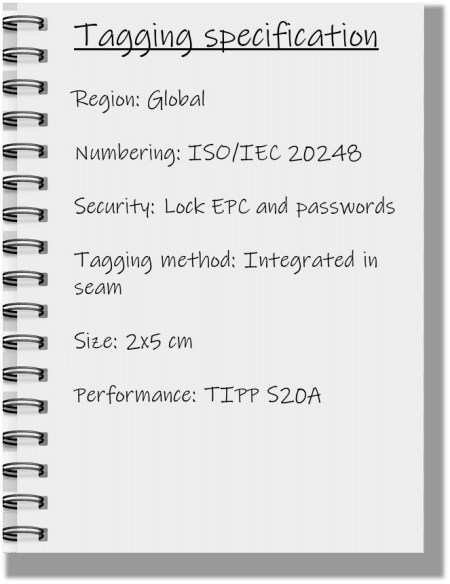
Geographic Region

In which geographic regions does the tagged item need to be identifiable? This could be for example ETSI, FCC, or global; and this choice will affect the tuning of the tag. With the upcoming upper ETSI band we have more and more countries working around 915 MHz.

Tag Numbering Scheme

How do we encode the tags? This is one of the areas where we need to look into the future. When there are more and more tags out there, the applications start to overlap.

For example, in a running race we have tags in the bibs of the runners provided by the timing system provider. But we also have tags integrated in some of the garments or accessories of the runners, courtesy of the sports retailer. When the runners pass the RFID readers, there is a limited amount of time to detect each runner – or even get several readings for reliable timing – if there are tags around that don’t belong to that application. Juho’s blog post about tag flooding talks more about this. The radio protocol provides ways to ignore the irrelevant tags, but it takes more time, and it requires that all parties think about the numbering.

Security

One action that is closely related to encoding the tag data, is securing it. At the moment, RAIN RFID is not everywhere, and most RAIN RFID readers are professional equipment. But, we are already close to the time when different electronics enthusiasts get their hands on RAIN reader modules. It may take some more time, but at some point we will have more RAIN readers integrated in mobile phones. And when there is an opportunity, there will be sabotage and people trying to get gains for themselves by affecting the RAIN RFID systems.

Of course, different applications have different security needs. There are still surprisingly many applications out there, where there is zero security – the EPC is encoded and that’s it. Most applications lock the EPC memory and passwords. That may work for a while, but in the long run, you need a way to manage passwords, and Nedap’s Danny Haak’s proposal for managing RAIN passwords could be a solution. Finally, in some application there might be a need for authentication functionalities.

Tagging Method

There is a fundamental shift in the industry, where more and more tags are integrated either into the packaging or into the products themselves, be it a running backpack or a tire. Thus the specification is no longer about the tag itself but about the RAIN-enabled product – or maybe a smart product. So, another line in the tagging specification would be tagging method. Is the tag a sticker applied to the product? Is it a hang tag? Is the tag applied to the package? Or is it integrated somewhere inside the product? Perhaps it is up to the supplier to decide? This all depends on whether there is a use for the tag after the point of sale; for example for product returns, warranty etc.

Tag Size

Tag size is often the first specification that comes up. Usually we want the tag to be as small as possible. But there is a compromise between the bandwidth of the tag which affects the geographic range; its performance – how far it can be read from; and size. You can choose any two, but the third one will be a compromise.

Tagged Item Performance

Radio performance matters as well. But it is not the performance of the tag, it is the performance of the entire RAIN-enabled product. And that’s where inlay lists widely used in retail will be insufficient. Still several retailers maintain lists of inlays that are allowed for products sold in their stores. And Auburn University is certifying tags for different product categories. That is an ok starting point, if you want to do hang tagging. But not everyone does.

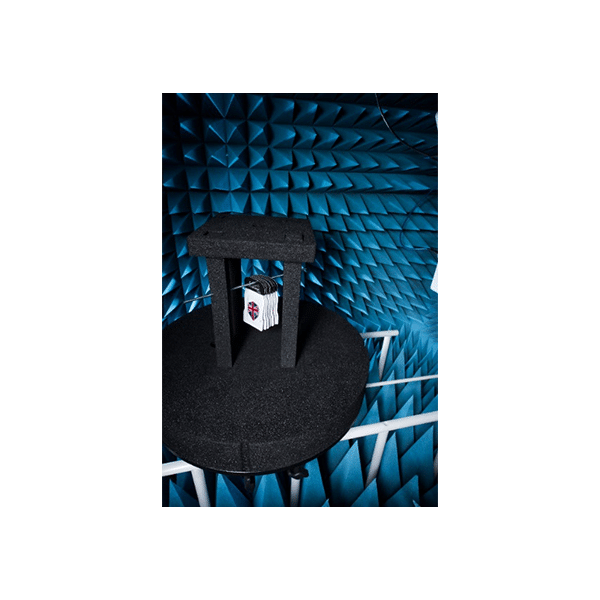
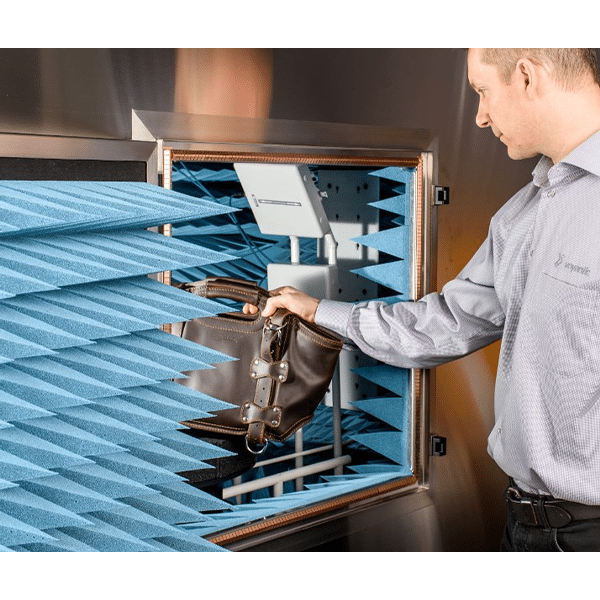
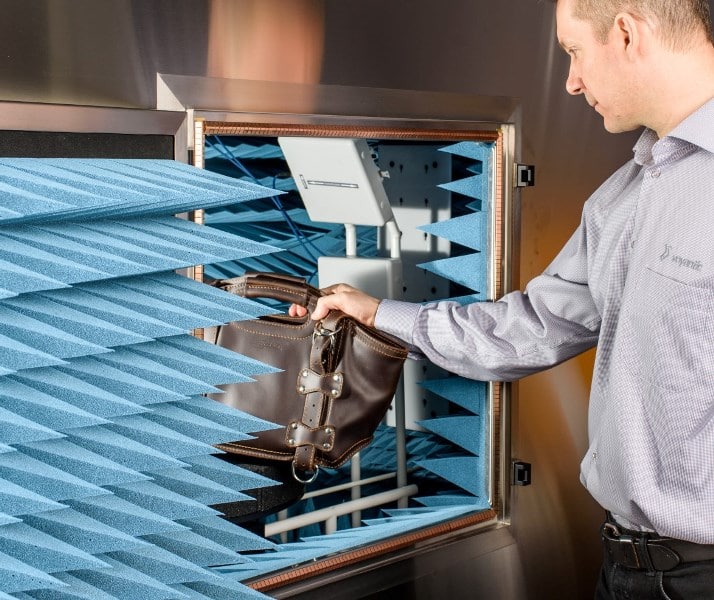
Determining radio performance for RAIN-enabled products is somewhat more difficult than for just inlays or tags; and the testing methodology should be thought out for each industry. The TIPP methodology was developed for retail several years ago, and now there is an ISO standard family coming out for RFID in tires. The application determines whether in the typical reading scenario there are multiple tags close to each other and from which directions the products need to be identifiable. The reader type used in the application, on the other hand, may determine the requirements for sensitivity and backscatter strength.

It is extremely important that the tagging specification includes a clear verifiable performance requirement – and that it is vendor agnostic. That is the only way that the industry can improve and innovate.

Example of a tagging specification; what elements a specification should contain.

The tagging specification is my proposal for overcoming the obstacles we are facing – and this is my idea about what should be in the specification. Let us hear what do you think should be there!

Zwei Faktoren die verhindern, dass Anwender von RFID RAIN Systemen von den Verfgbarkeit der hheren ETSI-Frequenzen profitieren

Dec 06, 2018

Im Januar 2016 hatte ich einen Blog darüber geschrieben, wie RAIN RFID-Unternehmen ihre Interessen vor allem in Europa vertreten sollten. Die Regulierung der Frequenzzuteilung schreitet langsam voran und jetzt, zweieinhalb Jahre später, ist es mir eine große Freude festzustellen, dass die bisherigen Ergebnisse beeindruckend sind. Lassen Sie uns einen Blick darauf werfen, wie die Nutzung des höheren ETSI-Frequenzbandes möglicherweise die Art und Weise der Optimierung des Tagging (Markierung von Objekten mittels RFID RAIN UHF Transpondern) verändert. Sicherlich werden sich diese Änderungen nicht unmittelbar bemerkbar machen. Mein Beitrag hebt zwei Faktoren hervor die derzeit einen unmittelbaren Vorteil dieser neuen Verordnung für den Anwender behindern.

Wie Tags traditionell abgestimmt werden

Im Jahr 2005 wurde das RAIN-Tagging in Europa weitgehend für das Frequenzband 866-868 MHz weitgehend optimiert. Eine solche Kennzeichnung bot in den USA nur eine sehr begrenzte oder nicht vorhandene Lesbarkeit, dies führte schnell zur Entstehung globaler Tag-Designs.

Während die weltweite (globale) Lesbarkeit im Prinzip keine so große technische Herausforderung darstellt, hat dies die Entwickler von Transponder (Tag) Antennen gezwungen, Einbußen bei der Sensitivität der Transponder in Kauf zu nehmen. Bei der Entwicklung von RFID Transpondern für die Montage auf Metall verlangt die globale Lesbarkeit in den Abmessungen deutlich größere Transpondern im Vergleich zu den winzigen Designs für einen stark eingeschränkten Frequenzbereich (ETSI 868 MHz oder FCC 915 MHz). Dies führt nicht nur zu weiteren technischen Herausforderungen sondern stellt auch einen zusätzlichen Preisfaktor dar.

Die Europäische Kommission genehmigt 4W für RFID-Lesegeräte bei 916-919 MHz

Schließlich heißt es im lang erwarteten Durchführungsbeschluss [EU] 2018/1538 der Europäischen Kommission vom 11. Oktober 2018, dass die Mitgliedstaaten bis zum 1. Februar 2019 drei Kanäle innerhalb des Frequenzbandes 916,1 -918,9 MHz für RFID-Lesegeräte öffnen sollten. Damit wird die Norm ETSI EN 302 208 V3.1.0 ergänzt, die ebenfalls ein RFID-Band zwischen 915 und 921 MHz definiert, allerdings mit eingeschränktem Umsetzungsstatus innerhalb der EU und der CEPT-Länder.

Während all dies nach Jahren der technischen Argumentation und Lobbyarbeit nach einem ausgezeichnetem Ergebnis klingt, werden die Hersteller von Lesegeräten vor neue technische Herausforderungen gestellt. Jedoch wie wird sich diese Entscheidung langfristig auf die RFID-Transponder auswirken?

Der optimale Bereich für Tagging auf globaler Ebene

Wie beabsichtigt, wird mit dem oberen ETSI-Band ein global harmonisiertes Frequenzband eingeführt, in dem alle geografischen Regionen verfügbare Kanäle für RFID-Leser haben!

Auch in Europa bietet sich damit die Möglichkeit, das Transponder-Design speziell für den oberen Frequenzbereich zu optimieren. In Anwendungen, in denen die RFID RAIN Lesegeräte (Reader) viel Zeit haben eine Bestandsaufnahme (Inventory) aller Transponder im Lesefeld durchzuführen und durch alle ETSI-Frequenzen zu scannen, sollte eine solcherart eingeschränkte Reaktion von Transpondern, die nur bei den oberen ETSI-Frequenzen wirklich empfindlich sind, kein Problem darstellen. Dies setzt natürlich voraus, dass die ETSI-Lesegeräte in Zukunft sowohl das traditionelle Frequenzband 866-868 MHz als auch das neue obere 916-919 MHz Frequenzband nutzen werden.

Unbekannter Faktor Nr.1: Umsetzungszeitplan in Mitteleuropa

Derzeit nutzt die GSM-R(ailway) das 918-921 MHz Frequenzband in Deutschland, Österreich und Frankreich auf der Grundlage nationalen Rechts gemäß den Frequenz Verordnungen der Internationalen Fernmeldeunion (International Telecommunication Union, kurz: ITU). Leider überlappt sich dieses Frequenzband und das für Europa neue obere ETSI RFID-Band. Die militärische Nutzung desselben Frequenzbereiches in Deutschland ist ein weiteres Fragezeichen und möglicherweise auch ein Hindernis. Die Europäische Kommission hat dieses Problem erkannt und gibt den Mitgliedstaaten die Möglichkeit, die Nutzung von GSM-R und RFID auf der Grundlage von Geographie, spezifischer Installation, Betriebsanforderungen oder ähnlichem zu koordinieren.

Was bedeutet dies nun in der Praxis? Schwer zu sagen. In Deutschland, Österreich oder Frankreich sind noch keine RFID-Umsetzungsrichtlinien veröffentlicht, also ist es von Vorteil die GS1-Übersicht der Regularien für Updates im Auge zu behalten. Die gute Nachricht ist, dass sich das „Future Railway Mobile Communication System“ (FRMCS) nicht mehr mit RFID überschneiden sollte. Die schlechte Nachricht ist, dass noch nicht bekannt ist, wann die Bahnen ein solches System entwickeln oder einsetzen. Das FRMCS-Projekt ist erst seit 2012 im Gange…. Ich persönlich erwarte, dass der Umsetzungsplan in Mitteleuropa bis zur zweiten Jahreshälfte 2019 weiter an Klarheit gewinnt.

Unbekannter Faktor Nr.2: Auswirkung der Leserempfindlichkeit

Der Lesebereich ist oft mehr eine Abschätzung als eine Tatsache, aber die Sensitivität des Lesegeräts ist in der Tat bereits in vielen Anwendungen ein limitierender Faktor. Ein gutes Beispiel ist die Zeitmessung von Marathonläufen. Herr Nikias Klohr von der race result AG hat dieses Thema in seinen exzellenten Präsentationen bei der Konferenz RFID Tomorrow und dem RAIN Face-to-Face-Meeting in Wien 2018 wiederholt angesprochen.

Wir alle haben in den letzten 15 Jahren gesehen, wie sich die erhöhte IC-Empfindlichkeit der Tags zur Entwicklung von Transpondern mit geringeren Abmessungen und nicht zu extrem langen >20 Meter-Lesereichweiten geführt hat. Wenn sich meine Vorhersage zur Optimierung des Tag-Designs für das 902-928 MHz-Band als richtig erweisen sollte, dann werden sich die Abmessungen und Kosten der Transponder weiter verringern.

Bis zum Jahr 2021 könnte die Stärke des rückgestrahlten Signals (Backscatter) von Miniatur-RAIN-Transpondern auf unter -90 dBm bis hinunter zu -100 dBm fallen. Die aktuelle Leserinfrastruktur wird solche geringen Transponder-Signale nicht so einfach interpretieren können. Daher müssen möglicherweise immer noch Transponder in den Abmessungen größer als notwendig verbunden mit höheren Kosten verwendet werden. Aus diesem Grund wird langfristig eine neue Gattung von Lesegeräten und eine Infrastruktur mit verbesserten Lesefähigkeiten benötigt, um die Gesamtkosten der RAIN RFID-Technologie weiter zu senken.

Fazit: Die Arbeit geht weiter

Wie schätzen Sie die Bedeutung der höheren ETSI-Frequenz ein? Haben Sie Einblicke in die regionalen Regulierungsdebatten in Deutschland oder Frankreich? Ich würde mich über einen Austausch zum Thema sehr freuen! Kontaktieren Sie uns dazu gerne.

Can Versatility and High Capacity be Combined in Smart Label Personalization?

Apr 04, 2018

中文版 Chinese version

Smart labels are basically really simple RF devices and look identical to each other. However, smart label deliveries are highly customized especially in high value specialty label segment. This sets two conflicting requirements for production machinery: high capacity and high flexibility.

To address this dilemma, Voyantic has spent more than two years developing a new breed of smart label personalization solutions. At the RFID Journal Live 2018 exhibition in Orlando we are proud to unveil the Reelsurance Pro – a flexible reel-to-reel machine for smart label personalization.

Large Smart Label Manufacturing Volumes are often Sum of Numerous Small Projects

Global RAIN RFID tag production volume continues to grow and NFC is doing very well, too, especially now that the majority of iPhone users can utilize the technology to its fullest extent. According to IDTechEx there will be more than 30 Billion tags sold in the year 2020.

A peculiar fact is that even as the tag volumes grow, still the demand of customer specific tag production lots remains high. Practically this means that smart label production must remain flexible enough to meet the various requirements of end user projects.

Printers are an Obvious First Step for Many

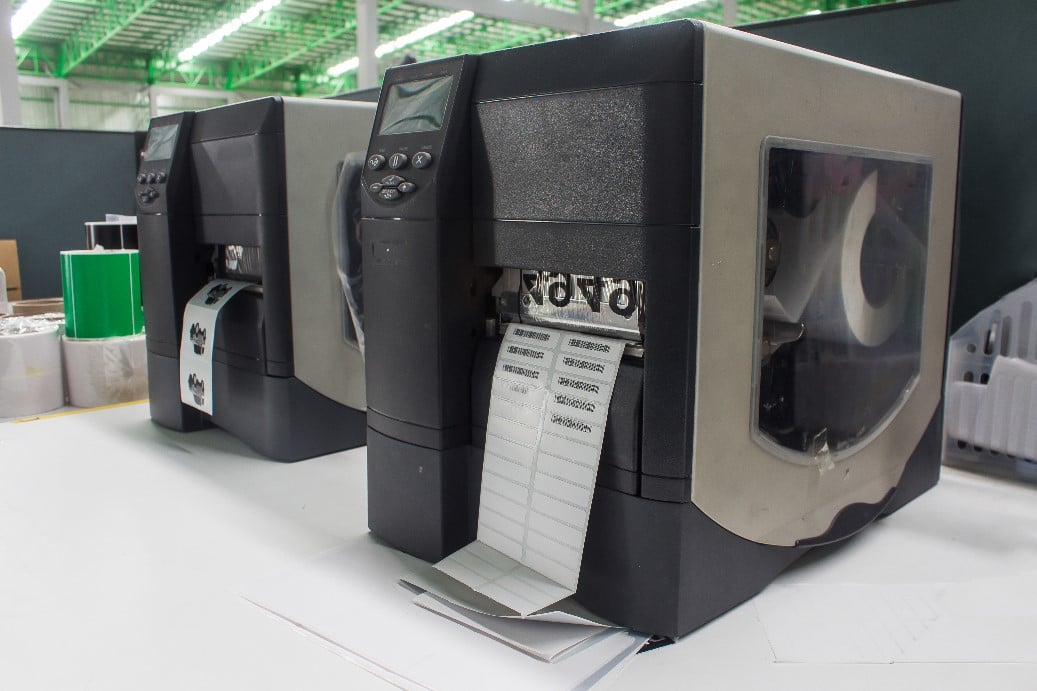
RFID label printers are the perfect way to supply small quantities of labels that are often immediately applied on products. As such printers will continue to serve a great variety of customers engaged with luggage tracking, healthcare and event management.

The sheer scale and complexity of production often exceeds a point where buying more printers is not feasible: special label form factors, sophisticated substrate materials, large reel sizes or complicated NFC / RAIN / custom encoding. I’ve come to learn that managing specific encoded data over numerous printers requires plenty of manual processing, which especially in the long term may not be sustainable.

Printers are good for many applications, but how is the scalability?

Industrial Grade Machinery Available for High Volume Label Programs

On the other end of the spectrum, label presses and high-end personalization lines serve the needs of high volume label and ticket suppliers. If you are in the business of supplying steady volumes of tickets, hang tags or bulk labels, those machines should serve you well.

But what is the option for those ambitious companies, that want to take both NFC and RAIN jobs, and dispense variable and highly specific label batches day-to-day?

Perfect environment for label presses and high-end personalization machines

Reelsurance: Office-sized Machine for Varying Smart Label Projects

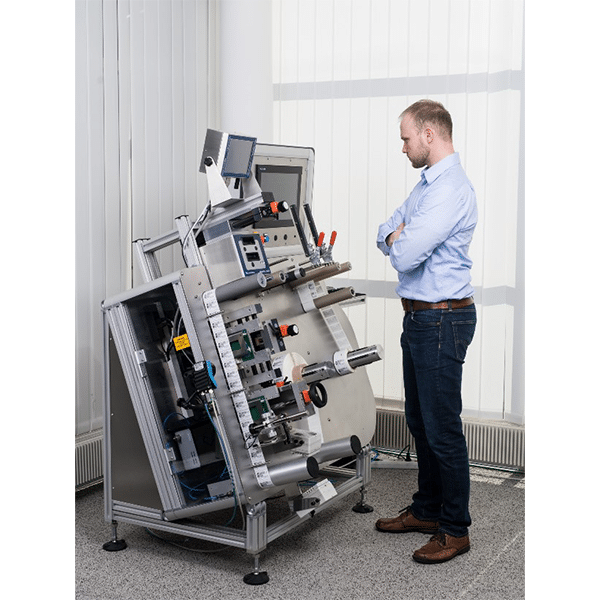
Voyantic Reelsurance Pro fills the gap for those who need a flexible reel-to-reel machine to finalize a range of different smart label jobs for their customers every week. The machine won’t stop shy of features either!

Voyantic Reelsurance Pro is a small footprint machine dedicated for RFID smart label personalization

Voyantic Fitted NFC, RAIN RFID, Barcodes and Quality Control in a Smaller-than-a-horse-sized* Machine Frame

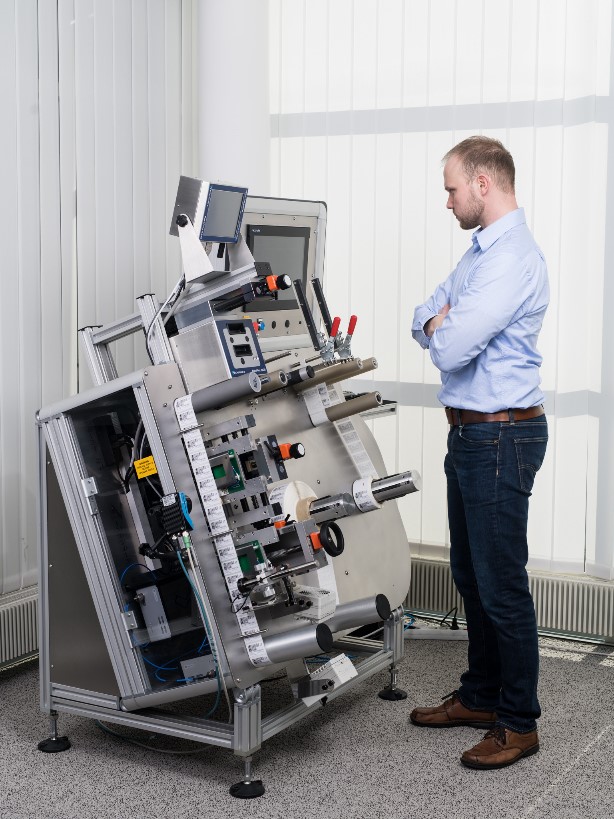
The list of printing and encoding options on this machine is impressive, and special effort is put on label output quality. Sophisticated RFID quality testers, line tension control, ESD protection, splicing table and slightly tilted machine frame provide reels that are 100% quality tested and immediately ready to deliver. The tilted frame also makes the machine ergonomic for the operator!

May We Propose a Machine for You?

Since 2013 we have supplied quite a number of Reelsurance machines for inlay and label quality assurance processes. Now that the Reelsurance Pro supports printing and encoding too, we would be thrilled to craft a proposal that meets your specific requirements. Please contact us to schedule the first demo and conversation!

(*) As a salute to honorable Mr. Tauno Matomäki, a highly esteemed Finnish businessman, President and CEO (EVP), Voyantic is still working hard to supply larger-than-a-horse-sized machines after more than a decade of exporting smaller-but-way-more-expensive-than-a-horse-sized testers around the globe.

Managing RAIN RFID Production Quality

Nov 03, 2017

中文版 Chinese version

RAIN RFID use has grown rapidly and implementations are expanding. Nowadays RFID is business as usual and quality management is an essential part of normal business operations. In past few years the RFID industry has learned a lot about quality management methods and processes. In my opinion there is still room for improvement. Quality really matters in RAIN tag manufacturing as high readability of tags is expected practically in all applications. In this text I describe how some quality management principles relate to tag manufacturing.

Continual Improvement in RFID Tag Manufacturing


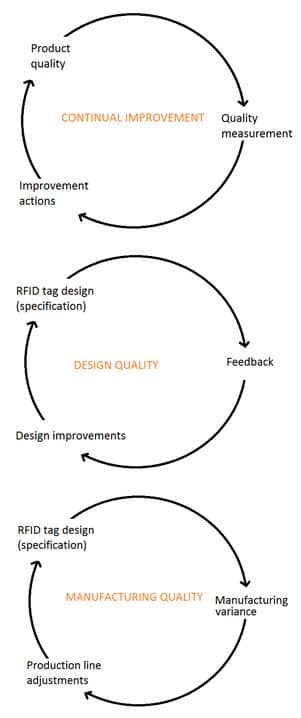
One of the key principles in ISO 9000 quality standard series is continual improvement and accordingly

  • quality must be measured;
  • results need to be analyzed; and
  • operations will be improved.

There are two ways to look at the quality:

1 – Quality of design is measured against the properties (e.g. features, functionalities, performance) the supplier intends to deliver to the customer. Improvements can be driven for example by new kind of customer requirements, changes in competing products and availability of new components.

Typical performance measures for RAIN tags are sensitivity/read range and orientation pattern, performance on different materials (tagged items) and in proximity of other tags. Additionally, for example memory options, command support, mechanical design and dimensions and durability are ingredients of design quality.

Improving Quality of design is responsibility of the R&D and usually requires new product development, e.g. modifying the antenna geometry. Improvement cycles are relatively long.

2 – Quality of manufacturing describes how much variation there is in performance of the key properties compared to the defined design quality.

In RAIN tags the typical measure of quality is sensitivity. For example: Sensitivity of the tag attached to PVC plastic, with 915MHz frequency is -20dBm +/- 0.5dB. In this example the -20dBm is design quality and +/-0.5dB is variation describing manufacturing quality.

In managing Quality of manufacturing the performance is measured by the quality organization and corrective actions can be implemented very quickly.

The basic methods for controlling quality in tag manufacturing are sample testing and continuous in-line testing.

RAIN Tag Manufacturing Quality Control

One single solution doesn’t fit all RAIN tag manufacturing processes, but the principles of applying either sample testing using an off-line tester or implementing the tester into the production machines to enable 100% in-line testing are universal.

Sample-Based Testing

For example, with 100,000 tags daily production, 99% confidence level with 2% margin of error requires about 4,000 tags to be tested. In practice, 1-2 tested tag rolls per day per manufacturing line would be the statistically valid sample size. This can be done with off-line reel-to-reel tester capable of testing RAIN tags either in inlay or label form. 

100% Testing and Quality Log

Voyantic Tagsurance tester can also be integrated with various manufacturers’ chip attach, converting or personalization machines enabling 100% testing.

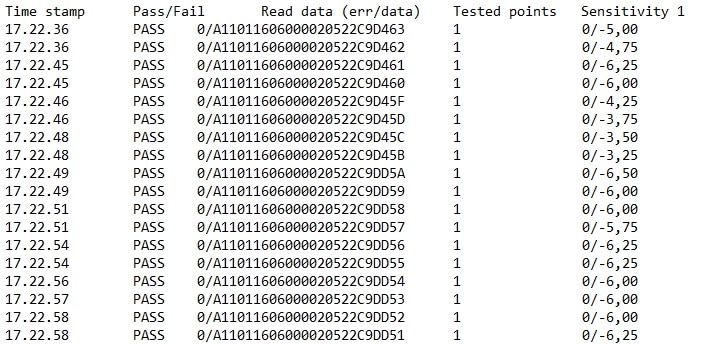
The testing creates a log file that can include TID and EPC codes of the tested tags, as well as test results. This is a handy tool for communicating 100% test results. The data can be used for finding out statistical information from the manufacturing quality: variation, standard deviation, percentiles, mean values.

Real-time Visibility to Production Quality

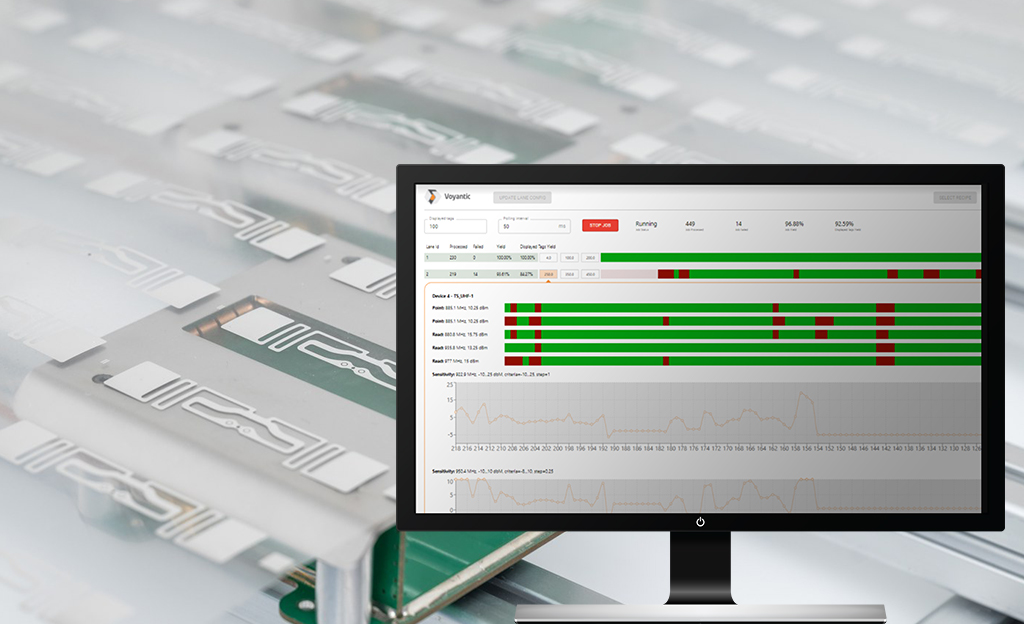
When information is available for the production line operator real time, it is easy to see when quality starts to deviate, and corrective actions can be taken immediately, without sacrificing production yield.

RFID Tag Manufacturing and Six Sigma

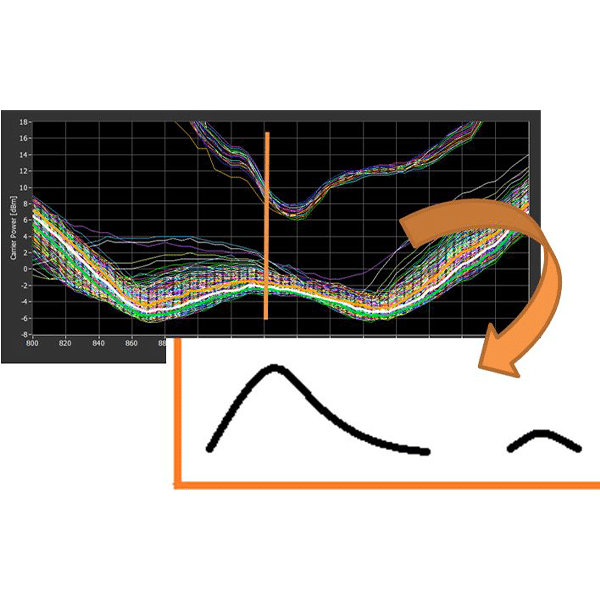
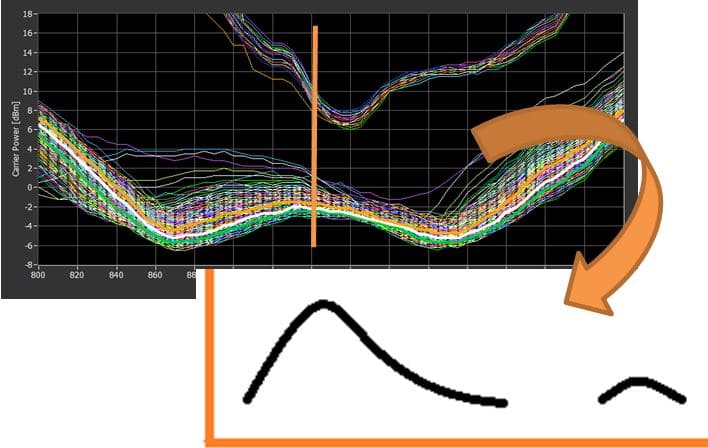
A typical output from a tag manufacturing process used to be skewed normal distribution with additional second peak as shown in the picture across wide frequency band: the “stray” tags made it impossible to implement Six Sigma to the letter. Instead, deviating tags can be sorted out, and Six Sigma limits may be used for the remaining part.

Developments in new RFID chips have changed the situation. Some tag models can be manufactured with normal distributed sensitivity variation. It is possible to implement Six Sigma quality control, maybe with 4-sigma limits to start with.

Contact us to arrange an online demo and to discuss more about quality control in RAIN RFID tag manufacturing!

A picture of Tagsurance 3 software in action.

Quality Testing Solution for RFID Label Production

Tagsurance 3 is the next-generation quality control solution for high-speed RFID inlay and label production lines.

Using Tagging Performance Specifications to Secure 100% Readability of RFID Enabled Tires

Aug 17, 2017

中文版 Chinese version

Identification of tires has been one of the early use cases of RAIN RFID already back in 2005. It took almost ten years for the technology and value chain to mature to a state when this extremely challenging application became finally possible.

Million Reasons to Tag Tires

There are countless ways to utilize RFID enabled tires. Early deployments follow the use cases familiar in the generic retail business: improving the traceability in the supply chain and raising efficiency in warehouse inventory and management. Over time I bet we will also see use cases after distribution, such as tire fleet management, safety monitoring (pressure, wear, retreading), and eventually even in recycling.

Once tires are RFID enabled, it opens enormous possibilities for companies to streamline processes and even create new business models.

“Scrapping a Finished Tyre is Not an Option”

If an embedded RFID tag is defected, it cannot be replaced with a new one because of safety and practical reasons. At the same time, no manufacturer is willing to scrap a new baked tire because of a non-functional RFID tag. Is there a way to avoid such a situation?

A carefully implemented quality monitoring helps keep the tire manufacturing process lean and efficient. RFID is implemented in various ways within the tire industry. Thus, preparing the tagging specifications according to actual use cases of the complete value chain is a prerequisite. Read more of this framework:

What is the Framework of RFID Tagging in Tire Industry?

Learn how to prepare tagging specifications according to actual use cases of the complete value chain!

Embedding RFID UHF Tag into Rubber and RF Testing

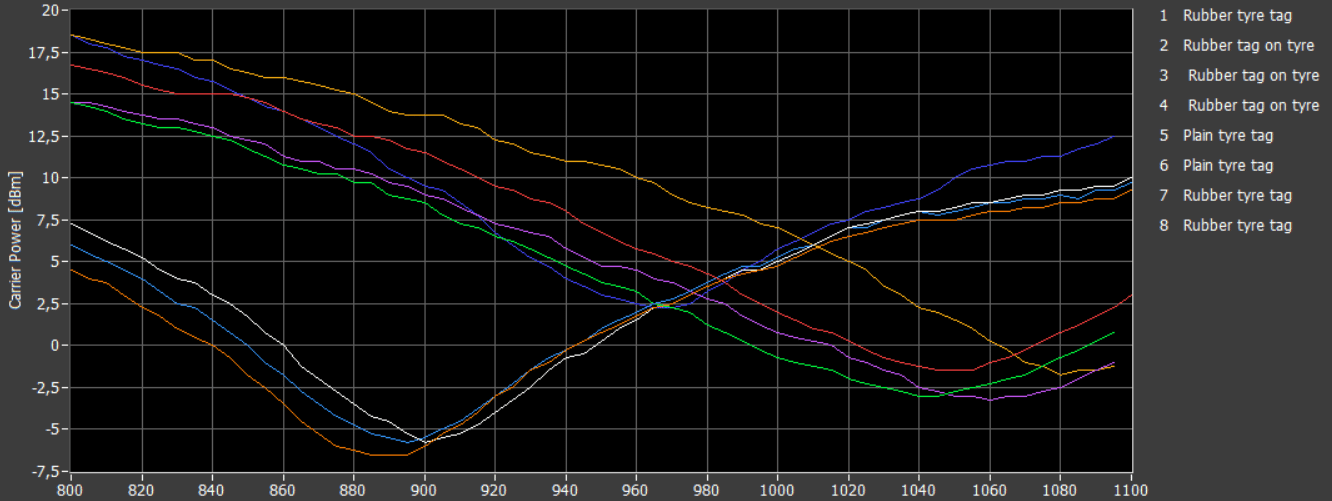
Before embedding in rubber, the tire tags are tested in free-air conditions. UHF tire tags are typically over tuned to frequencies over 1 GHz. This makes RF testing a challenge because standard RFID readers operate at frequencies below 1 GHz.

Sensitivity of RAIN RFID UHF tag in different situations. The lower the graph, the higher the sensitivity and thus longer the read range.

From the manufacturing standpoint, additional requirements include:

  1. individual tag test should be wireless;
  2. test may be performed on trays with a large number of other tags in close proximity;
  3. the production flow cannot be slowed down.

The Voyantic solution is to utilize Tagsurance RFID tester together with the Snoop Pro near field coupling element. This enables accurate READ sensitivity tests for the complete dipole tag structure with excellent correlation to far-field performance.

RF testing used to be one of the bottlenecks in the tire tag production process. However, the sophisticated test features of the Tagsurance tester mean that the slowest processes are the mechanical ones.

Please read of our testing solution in more detail from our customer case study Michelin – Tire Tags with Consistent Quality!

Industry-Wide ISO Standards in the Horizon

The industry is currently waiting for the work group to finalize following standards, like

For an update on the ISO standards process, please stay tuned for an upcoming blog from Juho Partanen later this year.

If you’d like to hear how Voyantic can enable you to perform tire RFID testing in your facility, just drop us a line – it will be my pleasure to walk you through the process!

The Evolution of RAIN RFID Testing Started with Inlays, and Ends with…

Jul 07, 2017

中文版 Chinese version

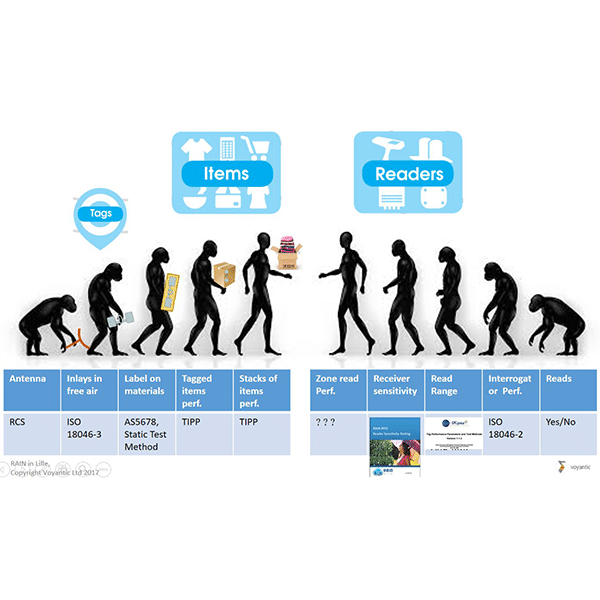
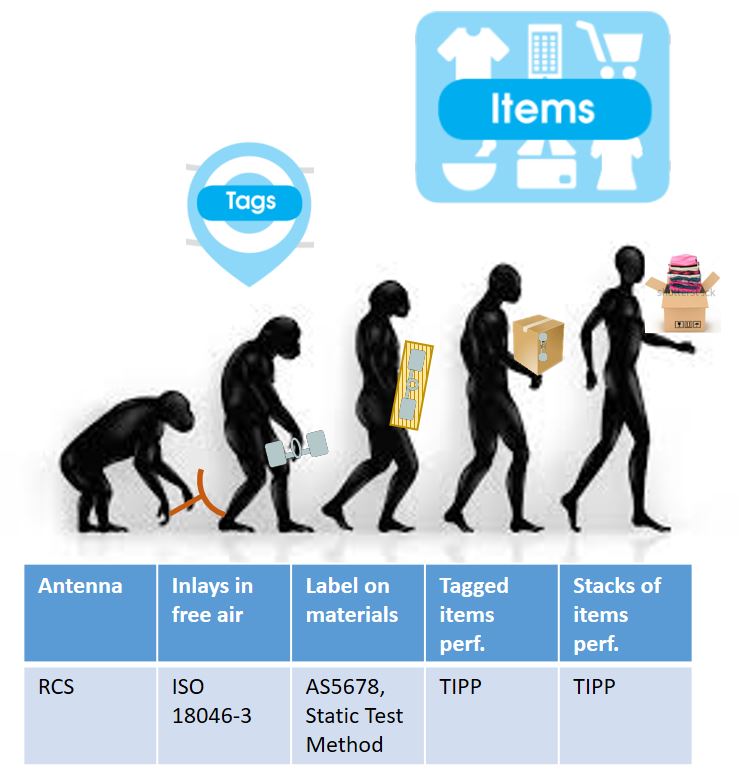
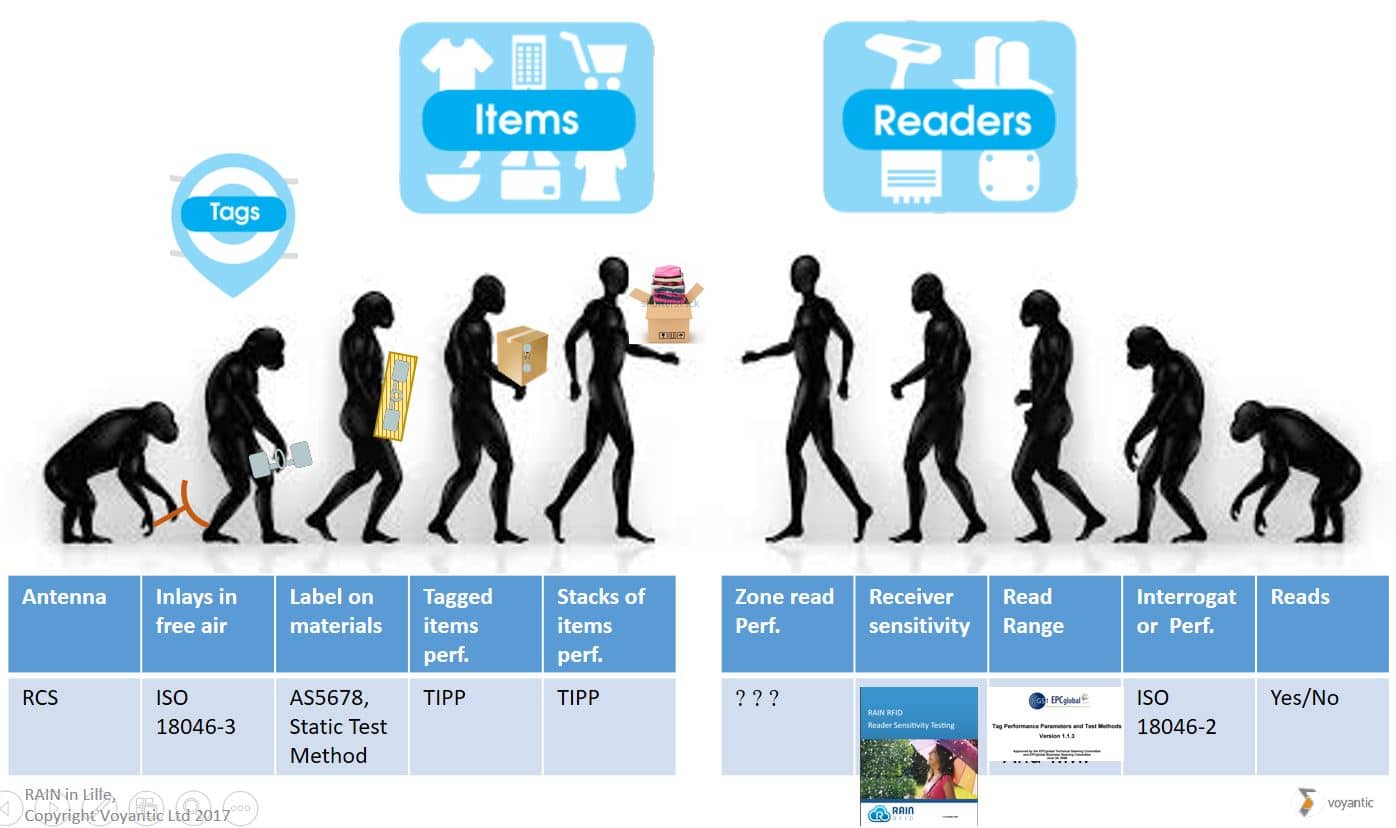
Evolution of organisms is one broadly accepted theory. Let me walk you through the phases evolution has taken when it comes to RAIN RFID tag testing.

Starting Point: The RFID Inlay

In the end of 90s there were no off-the-shelf solutions to start doing RFID research and tag testing. Hence the classical Radar Cross-section (RCS) seemed like a great way to characterize the UHF antenna of an inlay. It’s just that such a passive antenna test didn’t enable designers even to optimize the forward link: matching the impedance of IC with the impedance of the antenna. As a result, it was a struggle to get the tag tuning right. Additionally, the RCS measurement told nothing of the read range that the inlay design can deliver.

Delta Radar Cross-section (deltaRCS) was a serious step in the right direction for two reasons: the impedance match could be better analyzed and the fundamental reverse link parameters were brought into consideration. Read ranges started to improve. Around 2005-2007 also the first commercial tag test systems became available. Those systems, such as the Tag Analyzer from SAVR Communications, the Voyantic Tagformance and MeETS from CISC, already utilized the Class 1 Gen2 protocol to better grasp the actual performance of an RFID inlay. Pavel Nikitin’s paper from 2012 explains the theory and practicalities of diverse test systems in detail.

As tag prototypes were made and production samples tested, many companies focused mainly on the inlay performance in free air conditions. It didn’t take long for the first experts to realize that the test results better correlated with the real-world use case performance when the inlays were attached on various materials prior to testing. So, approaching the current decade it seemed half of the industry was busy working with various reference material sets, and the other half with aluminum plates of various sizes.

Era of Testing Tags on Items

To bring more sense into real-world performance of inlays, Voyantic introduced the Application Development Suite already in 2008. With the Population Analysis function anyone could visualize and study the behaviour and properties of tags in groups. As we have later learned, very few did such analysis before 2011, which manifests two related findings:

  1. The more groundbreaking the concept, the longer time it takes to really sink in
  2. It takes a lengthy period of time for engineers to learn how to explain certain groundbreaking concepts in an understandable way.

Tag-to-tag close coupling effects are indeed complex, and only partially understood and explained by the academic community even today. As a kind of workaround, the ARC Program emerged in 2011 to combine exhaustive label testing with data collection from actual RAIN use cases in retail. Outcome of that analysis are the ARC performance categories and the related certified inlay lists.

These ARC inlay lists simplified tag selection for the US retailers. I’d also state that the success of the ARC program pushed the technology vendors to seek additional ways to ease the adoption of RAIN RFID technology by collaboration. It can be said that the Program may have slowed down the market entry time for new inlay types and vendors obviously because they needed to pay and wait for certification tests before getting on those lists.

On the positive side waiting pays off, because the ARC inlays lists are one functional way for a new vendor to gain access to the US retail deployments.

Early this decade the performance testing elsewhere in the RFID ecosystem already focused on tags on actual items. However, the industry lacked a documented and open framework to correlate various test setups with each other. This void, together with the industry’s quest to improve the scalability of deployments, led to VILRI’s tagged item prototype project. Eventually that project gave birth to the Tagged Item Performance Protocol, aka TIPP, in 2015.

TIPP is a standard-like guideline from GS1 that establishes and combines three fundamental aspects:

  • Key performance metrics for RAIN enabled items
  • Test methodology that anyone can repeatedly use to extract these metrics
  • Performance grades for individual and stacked items.

Among its other benefits, the open and thoroughly documented TIPP guideline enables anyone to easily communicate their tagging requirements without sharing details of their processes and use cases.

Following the TIPP approach tagging solution providers are free to innovate and offer their latest products and solutions immediately without the need to have them certified by third parties.

How Would You Like Your RAIN Enabled Items? Separate, Boxed, Stacked, Hanging…

Close coupled RAIN enabled sporting goods

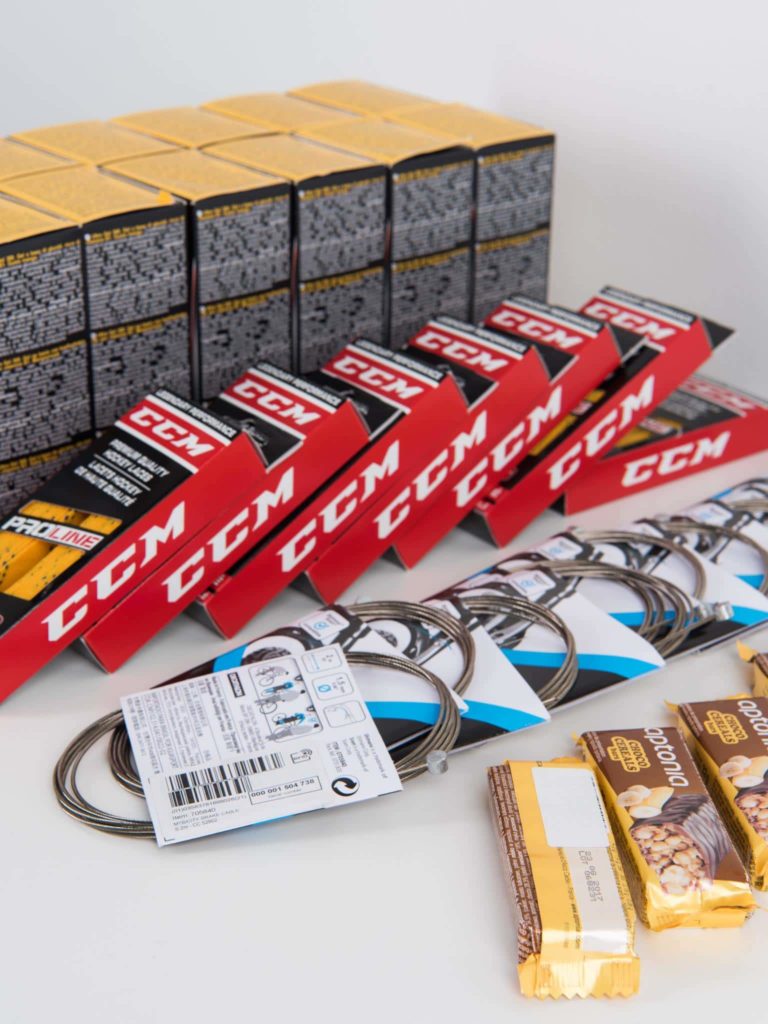
In the fall of 2017 an update to TIPP introduces a new test protocol for dense hanging stacks. This test protocol puts 100% reads of all the items to the focus, and thus leaves the close coupling effect purely for tagging experts to handle and solve. I anticipate that RAIN deployments especially around sporting goods retail will benefit from this new test protocol.

RAIN Read Performance Requires Input Also From the Reader Side

Albeit the tag side already enjoys highly sophisticated performance test framework, there are still a few missing pieces on the RAIN reader side. The Reader Sensitivity Test Recommendation from the RAIN Alliance was a grand milestone already. The dialogue and evolution would greatly speed up if the industry stakeholders, such as GS1 and RAIN Alliance, would take initiative to derive meaningful open performance metrics for read zones and readers in general.

That’s my evolution story for now. And no, the evolution of RAIN tag testing has not stalled, instead it’s constantly looking for new paths to make RAIN technology spread more efficiently. That’s also where Voyantic keeps on investing in. Your feedback on these thoughts will be greatly appreciated!

When Buying Tags – Ask the Right Questions

Jun 16, 2017

中文版 Chinese version

I frequently lecture in RFID training events, and now and then, a question comes up from RFID users and system integrators: “When buying RAIN RFID tags, what should we ask from suppliers, and what should we tell the potential supplier?”. I asked the same question from some RFID tag manufacturers and spiced the answers up with my own experiences and collected the following summary from the answers.

How to Get a Good Quotation for RFID Tags

Plenty of information is related to the tag selection. The more information that can be given to the tag supplier, the easier it is for them to propose a good tag. And the better questions you ask, the better answers you get, and the easier it is to make an educated decision. At the same time, it is essential to keep the focus – what is important for the project at hand and what can be left out.

The issues to consider and communicate are in the following areas:

  • Use case – what can I tell about the tag use
  • Tag functionality
  • Tag format, shape and size
  • Durability requirements
  • Performance requirements
  • Delivery format and quantities
  • Printing and encoding needs
  • Quality data
  • Delivery terms and pricing
  • Change management
  • Additional services from the supplier

There are plenty of questions under each of these areas. Download our free RAIN RFID tag buyer’s guide to get a more comprehensive understanding and an example request for a quotation!

Download the RFID Tag Buyer’s Guide

Learn what to ask when buying RFID tags.
Get our example request for quotation to help you get relevant quotes.

GS1 Releases the TIPP Global Guideline – Streamlines RAIN RFID Adoption in Retail and Fosters Tagging Innovations

Feb 01, 2017

中文版 Chinese version

After over 18 months of hard work, the TIPP work group under the GS1 Global Office has now released the Tagged Item Performance Protocol (TIPP) for global usage. The guideline focuses on readability of tagged items, supports all the global RAIN RFID frequencies, and also comes with additional supportive documentation to make the adoption process easier.

Many experts have invested a considerable amount of time in the creation of this guideline, and I am personally pleased with the outcome. The feedback that I’ve already collected leads me to believe that the standard lays out useful guidance also for RAIN RFID projects outside of the retail sector. Read on to learn what this standard means for the industry and end users.

TIPP Simplifies RAIN RFID Adoption for Retailers

The early adopters of RAIN RFID technology needed to cope with plenty of piloting, in-store testing and other iterative procedures to make the technology work out for them. A decade later, now in 2017, both the technology itself and the surrounding ecosystem have matured. Standards also emerge to make adoption of technology easier, faster and less expensive.

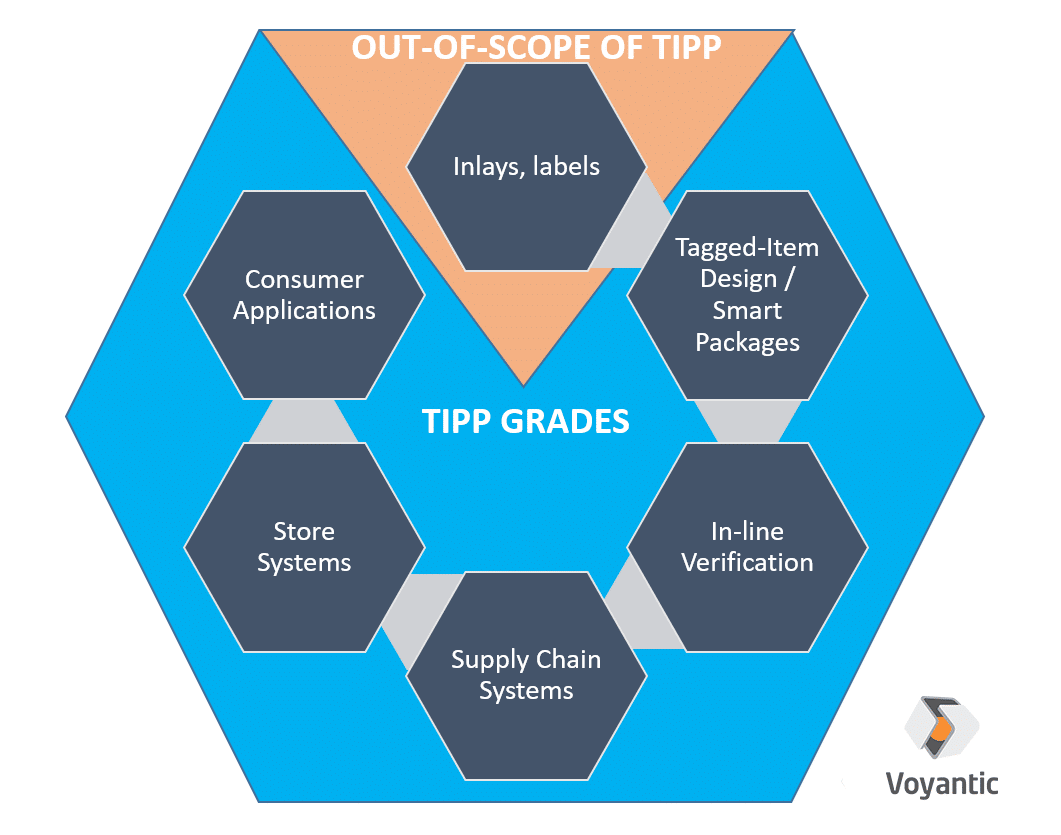
TIPP grades establish a common vocabulary and methodology for the RAIN RFID ecosystem. Original chart adopted from Impinj Inc., with modifications.

The end users define their specific tagging requirements as TIPP grades that are easy to communicate between stakeholders. Similar standard communication methods are already utilized in barcoding, EPC tag data standard and product attributes – standards boil down complicated technical issues into simple ones thus removing headaches and misunderstandings.

But wait a minute – some retailers rely on the approved inlay lists from the ARC Program, so what is the relevance of TIPP for them?

TIPP Scales – Removes Bottleneck of the ARC Program

The well-known ARC Program uses a sophisticated test system to gather and compile a database of RFID label performance characteristics. Combined with the end user specific requirements gathered during pre-pilot tests, the local experts then maintain certified inlay lists across retail item categories.

However, a limitation of the ARC Program is that the only official place to perform the tests for a newly developed inlay or retail item category is the one Auburn University test laboratory in Alabama, USA. There are only a limited number of experts available for pre-pilots, thus a bottleneck gradually developed.

As the number of deployments started rising across continents, the ecosystem simply needed methodology that scales. Now that the TIPP guideline establishes open grades and open test methodology, anyone can start performing TIPP tests locally and the bottleneck is removed.

Under the hood TIPP is about 95% the same as the ARC test setup. The main difference is how the test data is interpreted. In fact it should be acknowledged that the ARC Lab Director Justin Patton and Director of Technology Dr. Senthilkumar CP both gave significant contribution during the creation of TIPP US.

TIPP grading test system is essentially a similar 4 channel setup as the ARC test system.

TIPP grading test system

Building the Future for Smarter Packages

An aspect of TIPP is that it enables tagging solutions providers to innovate with new breeds of smart packages since they are no longer dictated to work only with inlay-based RAIN labeling. Moving away from diverse inlay lists also brings increased possibilities for suppliers to drive down the cost of tagging. In this perspective I don’t expect the cost of an inlay to drop as such, instead I am confident that management, stocking of labels and finishing processes around tagging will find new efficiencies.

Origins of TIPP Date Back to VICS and ILRI

For the folks out there that want to understand how TIPP came to existence, I’ve gathered a brief history piece in another document. If ILRI, VICS or ARC Arkansas rings any bells, you may want to give the History of TIPP document two minutes of your time.

In essence TIPP is rooted on

  1. the joined effort within the retail industry to increase the efficiency and transparency of supply chains
  2. the pain that RFID projects caused for the early adopters in the retail industry
  3. the learnings from prior technology implementations, such as barcodes
  4. the ongoing RAIN RFID deployment evolution from handheld scanners to zone sensor infrastructure.

Next Step: Guideline to Be Adopted by Retailers

As the TIPP guideline was developed for the retail community by the request of the retail community, I next look forward to the retailers and their suppliers to start adopting this global guideline. To make the transition smoother this time around, the guideline comes with supportive documentation both for the retailers and solution providers.

The GS1 TIPP website offers new fantastic documentation for both techies and non-techies.

Needless to say, if there are any obstacles on the way, both the GS1 Member Organizations and technology vendors are glad and available to assist. A new test protocol for dense stacks will be added to the standard in Q2/2017 together with new grades – mighty good news for anyone in the sporting goods business!

Over time we all should learn more about the benefits that the standard offers. When it comes to simplifying RFID vendor compliance management, my recent blog post already discussed that side of the story.

Methodology Likely to Find Ground Also Outside of Retail

I’ve had the privilege to explain and justify TIPP for various stakeholders over the recent couple of years. Received feedback suggests that the end user segments outside of retail consider TIPP as a benchmark of how to express tagging requirements in a scalable way. One hurdle for those folks in various businesses will be to find and motivate an un-biased association to efficiently nurture the standard creation – same as VILRI and later GS1 did for retail.

Any comments or concerns? Please let me hear it!

Testing Requirements of NFC/RAIN RFID Dual Frequency Labels in Production

Jan 09, 2017

中文版 Chinese version

There are applications, where fast data collection and high read distances of RAIN RFID (UHF) tags fulfill the overall application requirements only partially. Especially the missing capability of a consumer to easily access the tag contents limits the usability for marketing, product information and authentication purposes. A NFC tag would remove that limitation but also induce additional costs and complexity to the label finishing stages: double encoding and possible data compliance verification between these two tags. Interestingly the first IC chip with both high frequency (HF) and ultra-high frequency (UHF) communication interface was launched in 2015 by EM Microelectronics. In this text I will take a closer look at the quality aspects of dual interface tags: How do you verify that each tag produced meets its specification?

Is It Sufficient to Test the Performance of Either Interface to Guarantee the Performance of the Tag?

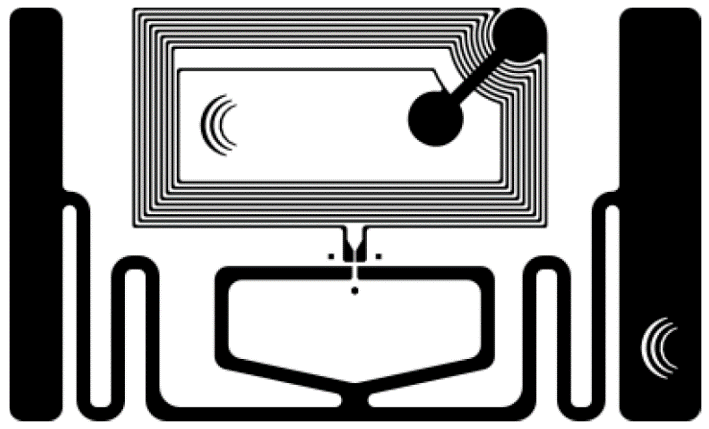
Let’s dig into the tag structure a bit to understand more detailed where the performance comes from. The chip itself is one complete entity with two interfaces for each frequency. This allows conveniently accessing the memory locations of the chip through either HF/NFC interface using for example your mobile phone, or through UHF interface by for example the retail in-store inventory system. On the inlay level there are still two separate antennas; one that is used for HF coupling and the other for UHF field communication. Both of these antenna structures are connected to the IC through separate chip I/Os. Below we can see an example of such a tag design from Lab ID:

There is certainly some coherence in the process quality for both interfaces, as the antennas are both processed simultaneously, and a single chip is assembled to work with both, but is it enough to guarantee the good performance for both if only one interface is tested? Based on some further analysis on possible failure mechanisms, the answer to the question is

No, it is not!

NFC and RAIN Performance on a Dual Interface Label Needs to be Separately Tested

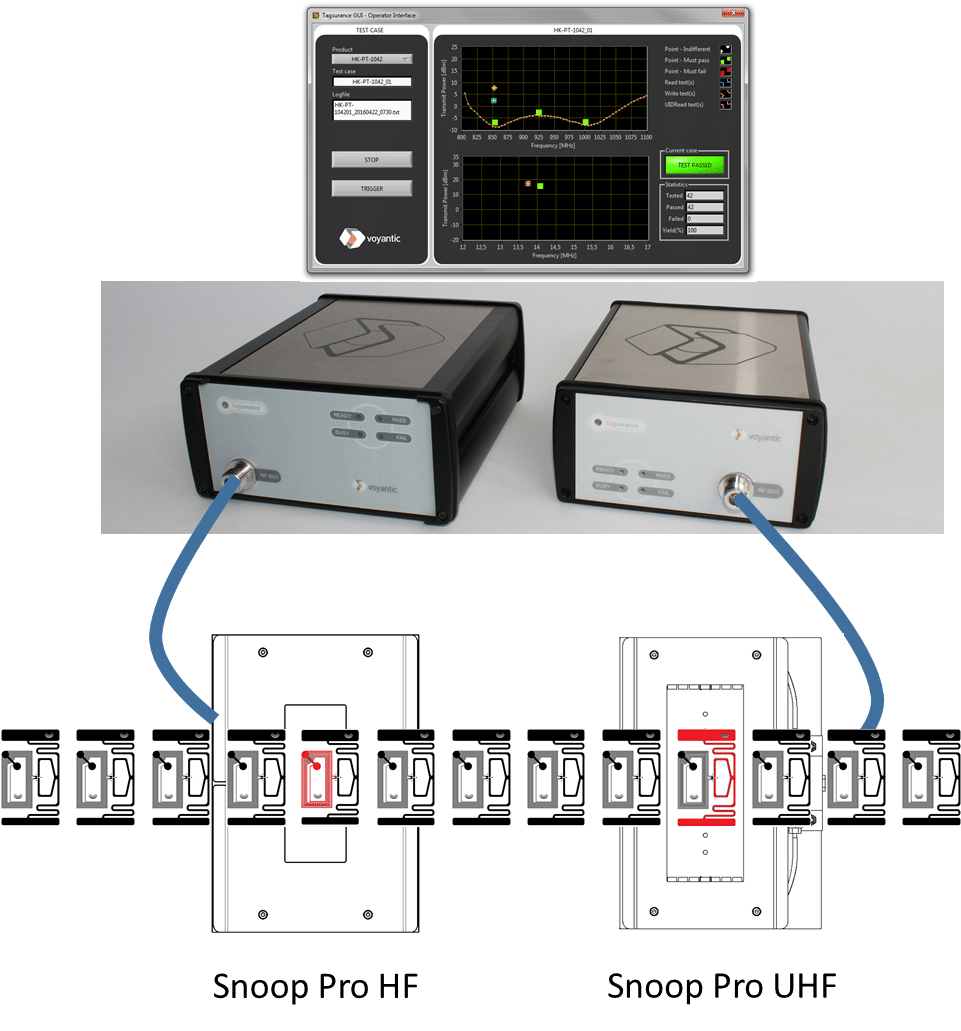
We ran some tests using both Tagsurance UHF and Tagsurance HF testers to identify less sensitive tags from a roll of dual frequency tag samples. The test setup for testing dual frequency tags consists of two separate Snoop Pro coupling elements – one for UHF testing and one for HF testing – and a Tagsurance unit connected to each of them.

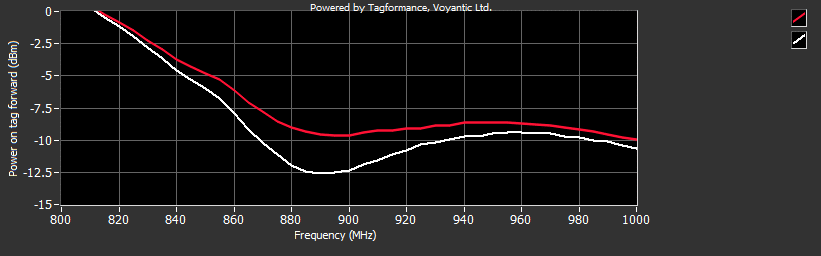
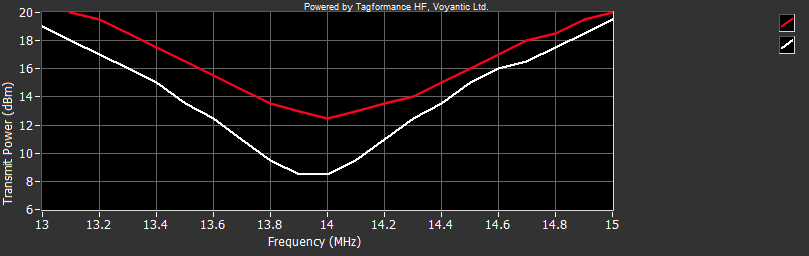
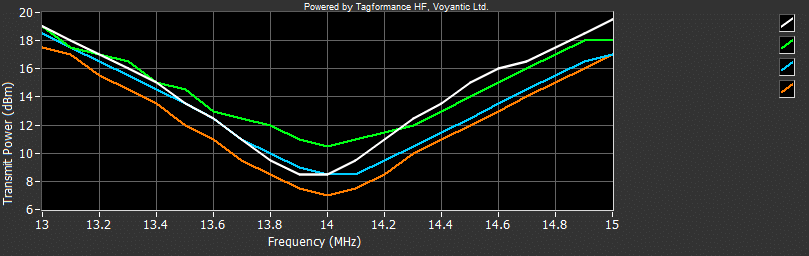
One graphical user interface handles both testing units and gathers the test results and read data from each tag in a combined log file. Based on this information we were able to identify tags with lower performance either on UHF communication or in HF communication. In many failed samples the performance had decreased in both interfaces. In the graphs below we can see the UHF performance on upper graph and the HF performance on lower graph for a normal tag (white curve) and for a tag with decreased performance (red).

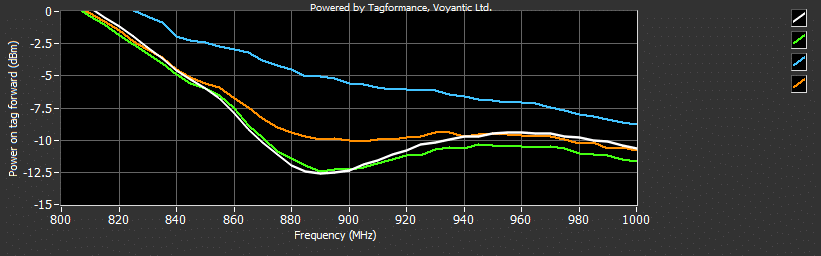
This is not always the case though, as we could also identify tags where one interface was performing good, but the other one was either not functional at all, or the performance was just significantly lower compared to normal level of variation in the sample set. In the graphs below there’s the UHF performance and the HF performance of four tags; one normal (white curve), one with decreased UHF performance and normal HF performance (blue) and one with decreased HF performance and normal UHF performance (green). There you can also find one tag with decreased UHF performance and HF performance slightly better than the typical tag (orange).

NFC/RAIN RFID Combo Test Solution Is Available

As always with disruptive new technology, it takes some time for the components and new manufacturing technologies to fully mature. As this brief study shows, the performance of either interface can vary independently of each other, even if they are integrated on the same IC. Therefore both interfaces should be tested in production.

Voyantic provides turn-key solutions for testing of all your RFID production. With our equipment you can test your RAIN RFD tag; HF/NFC tags with ISO 15693, ISO 14443A, ISO 14443B, Felica and ISO 18000 3M3 protocol; and dual frequency tags. We would be happy to tell you more and tailor the best suited solution for your exact requirements!

Download our new Application Note about testing of UHF, HF/NFC and dual frequency tags, giving a detailed understanding on the equipment and test setup used in production. Contact us to learn more!

Learn How to Test Dual Frequency Tags

Download our application note to learn how to get things right the first time when testing UHF RFID, HF/NFC and dual frequency tags!

TIPP Offers Both Low-Hanging Fruits and Long-Term Efficiencies for Everyone in the Retail Supply Chain

Dec 13, 2016

中文版 Chinese version

In the name of vendor compliance, many suppliers and brand owners are facing new RAIN RFID product tagging requirements from their retailer customers. The new TIPP standard harmonizes these requirements, bringing transparency and new cost efficiencies within grasp of all parties. Continue reading to catch some more good news coming your way!

RAIN RFID Adoption Challenge #1: Managing a Multi-Party Technology Project

I am sure you have all been there: a room full of people and a couple over remote connection, and someone with opening words – “Good Morning Everyone. We now have this new vendor requirement we need to satisfy. It concerns most of you and some of our partners, too.”.

What happens then is roughly a factor of project management, technology maturity, number of involved parties, communication skills and team endurance.

Adoption Challenge #2: Balancing the Short-Term Goals and Long-Term Efficiencies

You may have noted that when a deadline approaches, the time perspective also shortens. It’s only human nature that this leads to decisions that seem simple and make sense in the short-term, but which lead to excess expenditure and even re-engineering projects in the long-term. It’s a twisted set of requirements that is difficult to put in balance.

When it comes to an RFID implementation, I would personally list the signs of short-sighted decisions to include usage of inlay lists, selecting the cheapest label supplier, and utilizing of proprietary numbering systems.

Transition from an IT Project to a Compliance Process is Easier if Implementation is Based on Standards

During the roll-out phase, an RFID project definitely involves the folks over at the IT department. There are new streams of information flowing between companies, and also bits going back and forth in the new RAIN reader infrastructure within the company itself.

However, as all that is successfully solved and implemented, the IT maestros turn their focus back on geek black magic, Linux and Dr. Pepper. The whole thing basically turns into a compliance and quality management process that runs 24/7 and is managed by different people: Vendor Compliance Manager, Quality Manager, or similar. It is at that time when standards, defined maintenance routines and ISO 9001 quality systems show their power.

Take the Simple Route and Base Tagging Requirements on TIPP

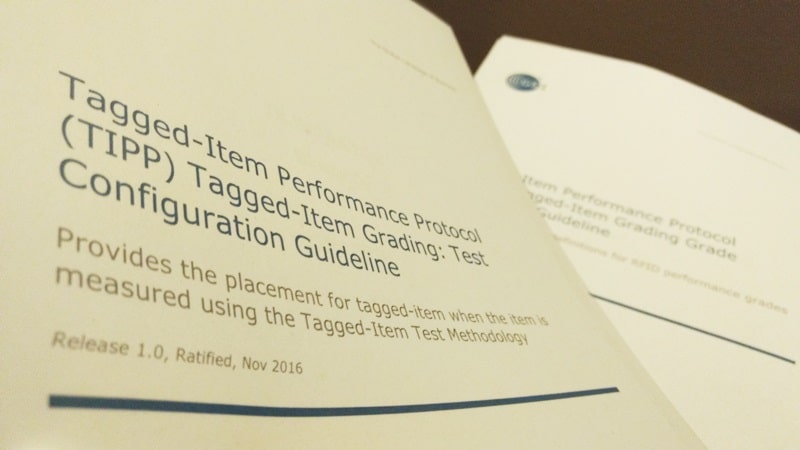
Tagged Item Performance Protocol (TIPP) is a global standard developed by the spearhead retailers, their suppliers and the RFID technology community. TIPP utilizes a grading approach that enables anyone to define varying tagging requirements for different product categories.

I’d actually like to point out the TIPP analogy to hangers, where the “Voluntary Guidelines for Hanger Specifications for Floor-Ready Merchandise” by GS1 states that “Hanger performance is the key metric, not the material.” The very same applies to RFID, where the readability of tagged items is the key, not the logo on the RFID inlays.

TIPP grades enable retailers to efficiently determine tagging requirements based on their own read scenarios without sharing any sensitive information unnecessarily with outsiders. Naturally it’s ok to turn to trusted solution providers that can perform the necessary tests and determine which TIPP grades to utilize in different product categories.

Paving the Way to Long-Term Process Efficiencies

TIPP grading enables the suppliers and brand owners to work with their partners and solution providers to find cost-effective tagging solutions that both meet the vendor compliance requirements, aka TIPP grades, and their own process preferences. This way the decision making on label purchases is distributed to where costs and supply chain efficiency can be best managed.

Wait, there is more: TIPP practically removes the in-store validation tests that are now essential to the maintenance of retailer specific inlay lists! In-store testing of labels is a significant operational burden and expense, which was indeed quite necessary at the early days of RFID adoption in retail. Now that the technology has matured, it’s time to reassign all performance and validation testing to parties that efficiently perform it as part of their daily routines.

Lean on the Technology Providers

Today there are numerous technology providers close by you that can assist you in meeting your RFID retail mandates and requirements. To find solution providers try these search engines:

It goes without saying that you ought to be a demanding customer for all these folks out there – don’t accept the first proposal without hearing more about the alternatives. Always demand a standard solution without vendor-lock and have the short- and long-term implications spelled out.

Yes, We Can (in January)

The original TIPP guideline came out in the USA in 2015. The guideline already introduced the performance grades approach, but was limited to the FCC frequency band. To create a global version that also covers the ETSI, Chinese and various other bands, the GS1 Global set up a workgroup in summer of 2015. I have been co-chairing the workgroup for about a year now together with Plamen Iliev of Embisphere.

January is going to be exciting in many ways. I am delighted to point out that a global TIPP standard is already ratified and will be officially released by the GS1 in January 2017. Please contact us if you want to discuss these issues in more detail, and see you at the NRF in New York!

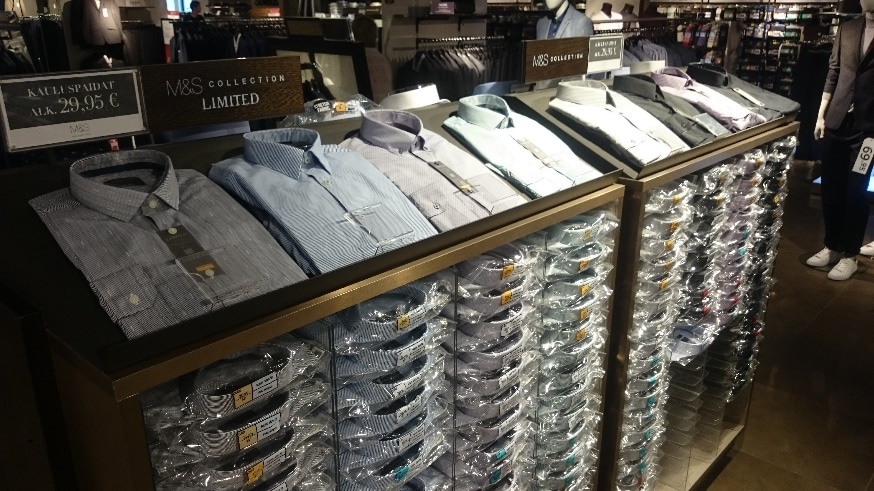
RFID tagged men’s shirts in a department store in Helsinki, Finland. I simply wanted to add this picture here in the end because it’s just such a beautiful sight.