RAIN RFID on Label Processing Machines: An Overview to Help with Your Choices

Oct 28, 2021

Traditional label producers entering the RAIN RFID business are faced with strategic and practical questions:

In this third blog of the series created with NXP® Semiconductors, we specifically address production machinery. Read on to learn about the machine types, what approaches to consider, and how to avoid pitfalls that would cost you time, money, and nerves.

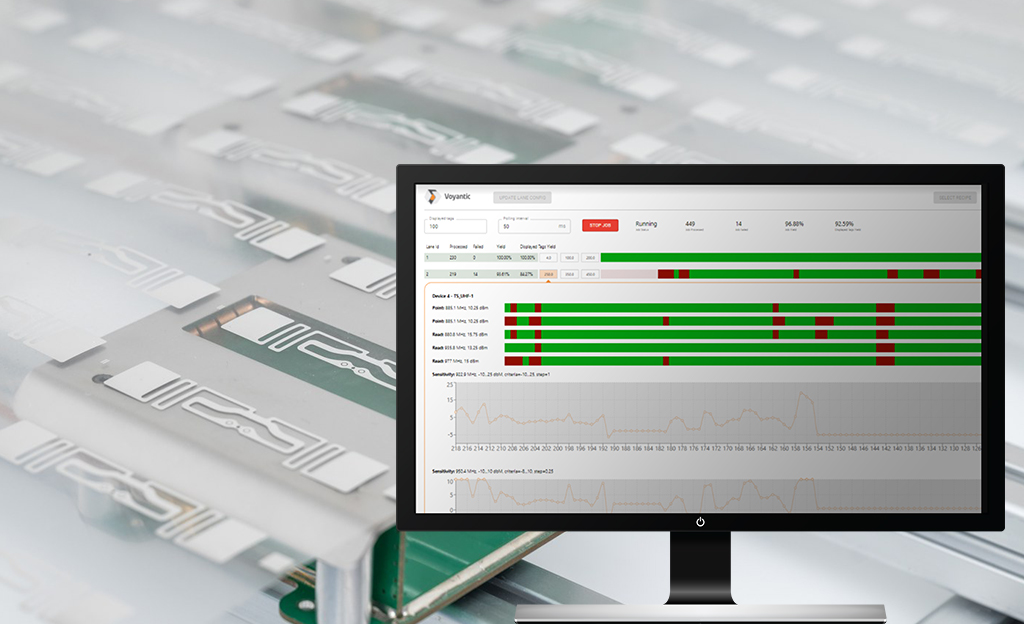
A picture of Tagsurance 3 software in action.

Quality Control for RFID Label Production Lines

Many variables in the RFID inlay and label production processes affect the RF performance of the finished product. Voyantic provides the industry-standard quality inspection systems for measuring the RF performance every tag on the production line.

Yes, There Is a Growing Market!

RAIN RFID adoption is growing at an unprecedented rate; with those markets that have already seen the benefits of the technology, such as retail and automotive, continuing their adoption. Other markets are emerging, for example parcel services, which is driven by the e-commerce boom.

Majority of these applications are based on RAIN enabled labels being added to the item. If you are already supplying labels to consumable products, the day will come when your customer asks you to add the RAIN labels on your supply program.

It Is Easy to Get Started with Outsourced Inlays

If you already have the ability to produce labels, adding RAIN RFID inlay on the backside of your current products would be one easy way to get started. You will need a capable inlay vendor, and you will need to teach the basics of RAIN RFID to your sales and production staff. Investments required to upgrade your current machines are modest, and inlay vendors are easy to find.

As you learn and build your customer base, it is possible later to expand your business also to cover the inlay part. At that point you will likely need to do a few new hires for development and production, as well as make investments on new machinery – the stakes become higher.

Manufacturing Process is No Magic

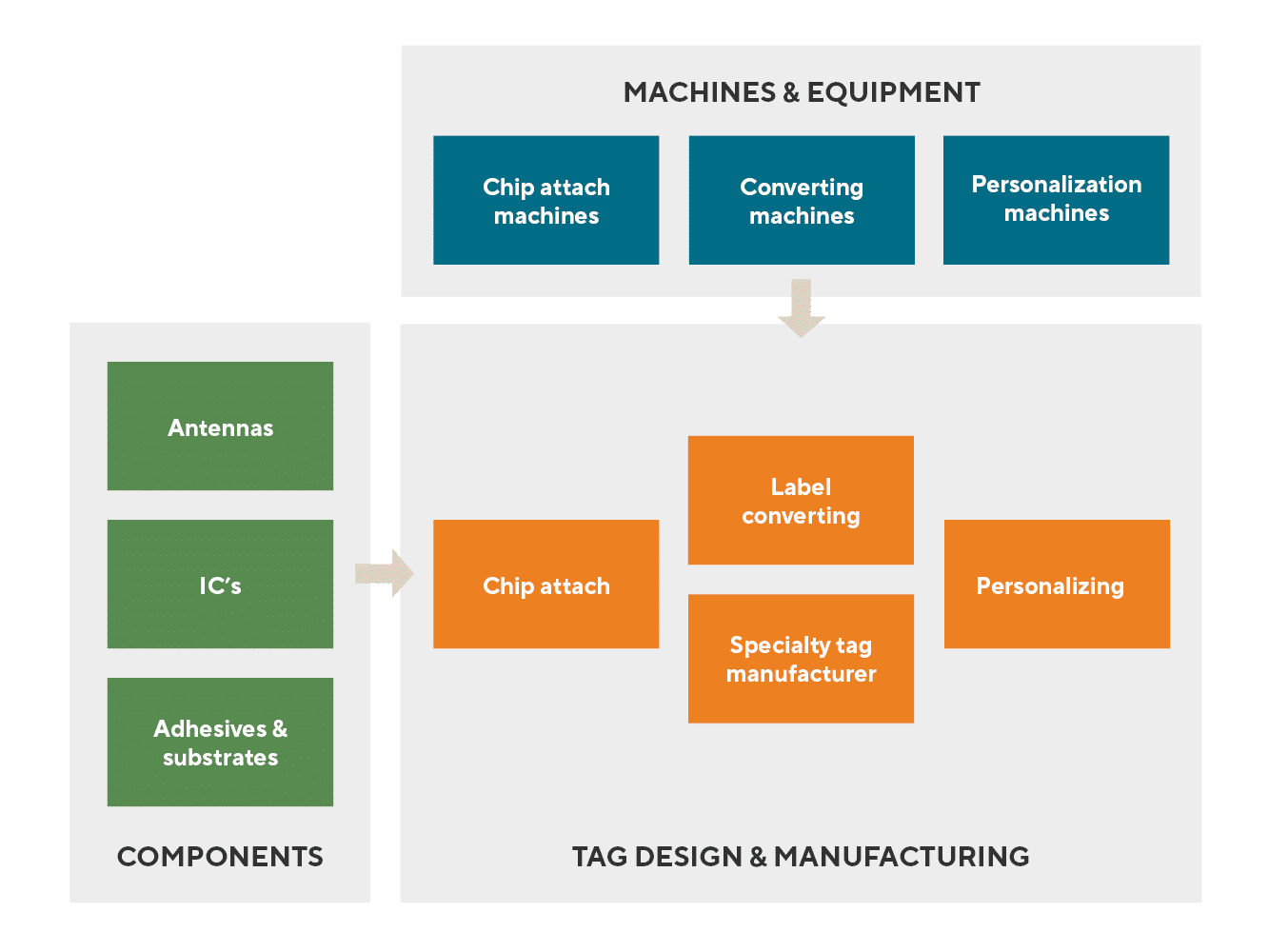
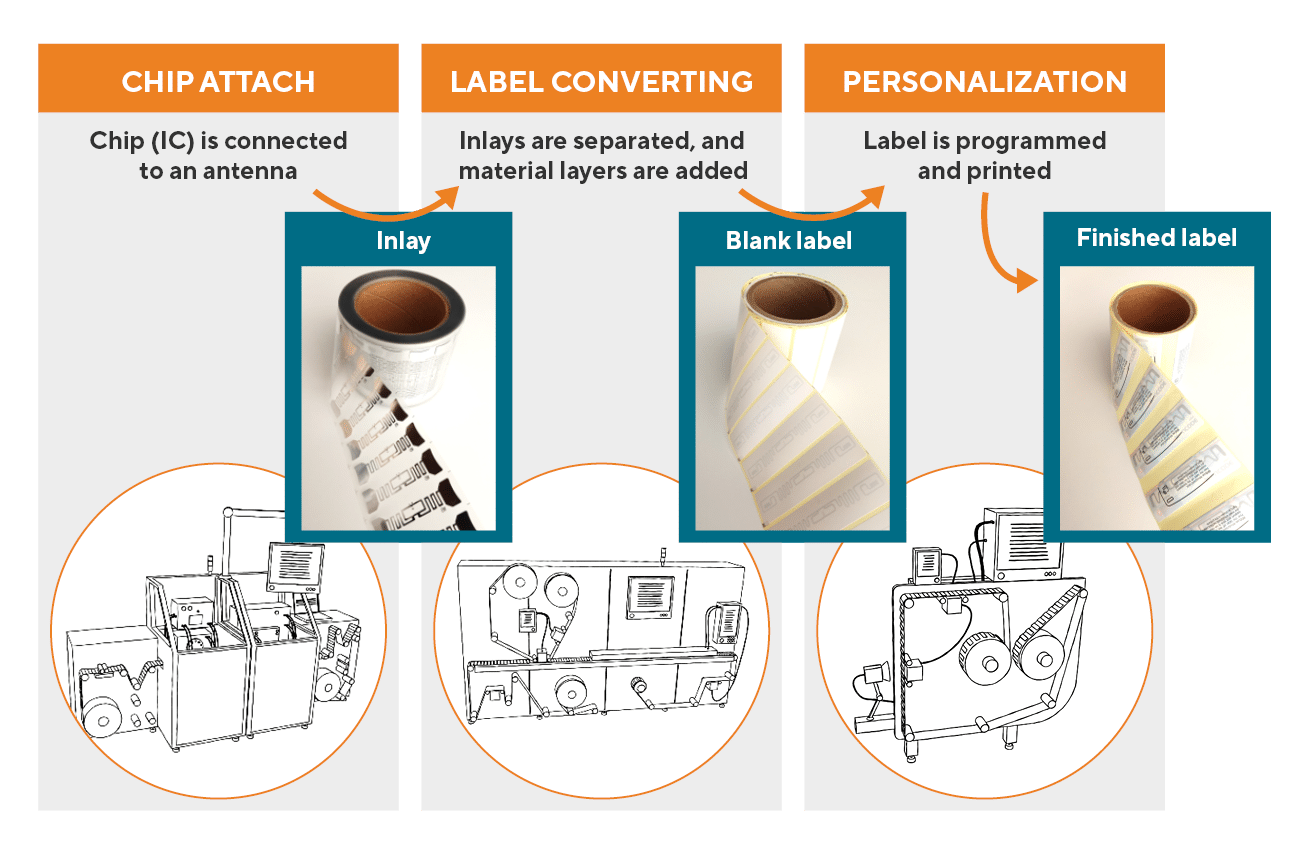
The manufacturing process of smart labels follows quite a standardized flow, as in the picture below. While some companies cover most of the process steps in-house, other manufacturers have assumed a more networked business model. Traceability across processes is a tremendous asset for failure root cause analysis, which is one cornerstone for enabling continuous improvement in any organization.

The three essential machine types that you should become familiar with are presented in the next picture:

Let’s understand these machine types and some of the related choices.

The IC Attach Machine Is Where the Inlay Quality is Achieved

The main technologies are flip-chip, and direct die attach. The RAIN IC placement on the dipole antenna requires high precision. Precision, combined with high line speed and sophisticated mount pressure control, makes the IC placement head the most expensive subassembly of the whole machine. You should make sure that the placement head is compatible with current and future RAIN IC’s.

As you look at the machines, you will quickly realize that the number of lanes in the machines varies. Multilane machines typically have higher throughput than single-lane machines, at the expense of added machine complexity. On the positive side, a multilane machine does not need that high line speed to reach an impressive throughput, which may lead to a more straightforward technical construction on the IC placement head. If you’re focusing on bulk, go with a multilane system.

A single lane IC attach machine is less complicated and thus easier to operate. It’s also easier to configure for new antenna models, making it better suited for smaller production runs. The capital investment is also lower.

Three Topologies of Converting Machines

In label converting, different material layers are added on top or under the inlay. There may also be cutting and testing involved. Converting machinery is more versatile, but three separate machine families can be found:

You can have a single lane machine that runs in a continuous mode very fast. Alternatively, you have a multilane machine running slower, and even in intermittent mode. At the end of such a machine, you may have a cutting and slitting module to separate single reels from a web.

A third approach, especially for traditional label suppliers, is to start with an industrial press, and add an inlay insertion section on the machine. An outcome is a multilane machine running in continuous mode.

Personalization Makes Labels Unique

Personalization focuses on getting the data right. Data on the tag is stored both in optical and electrical forms. Therefore, most personalization machines handle both printing and RFID encoding.

While that may sound trivial, managing the data, performing all the needed data conversions correctly, and keeping all the process peripherals in sync is easier said than done. When process speed increases, you will need to pay more attention to details, such as triggering. When working with variable data, you should make sure the optical markings match the unique identifier encoded in the RAIN IC.

Got Machines Already? Consider a Retrofit

It is often possible to retrofit the needed RAIN RFID peripherals on an existing production machine. With a low capital expenditure and a short lead time you’re able to pursue your first RAIN projects.

Voyantic delivers solutions to control sub processes, manage the data between the processes and keep both data and sub processes in sync. We also offer transferable bolt-on alternatives. Such frames come complete with the needed sensors, cabling and antennas, and won’t require changes on the signaling of your current machine.

You don’t need to figure all these details out. Let our experts talk with your machine vendor, and come up with a proposal!

Contact us


On-Demand Webinar:

Quality Management Approaches in RAIN RFID and NFC Manufacturing

Hear industry experts share their experiences in RFID tag manufacturing and quality management. The webinar includes case examples and presentations on how to set quality goals, which standards are relevant, and best practices for quality testing — from setting up the quality program to managing the day-to-day activities.

Watch now

Smart Label Durability – Bring Facts to the Table

Aug 18, 2021

When there is a need to increase smart label production volumes, it can be done by adding new machinery, more lanes to existing machinery, or by increasing production speeds. All these methods are in use, and they are combined frequently. For example, new production machines have more lanes and higher lane speeds.

At Voyantic, we are seeing that increasing lane speeds combined with smart label component development has put durability testing into the spotlight. In this article, I analyze the reasons behind the increased interest in smart label durability testing, and I will share the basics of the test methodology.

Why is the interest in durability testing increasing?

I believe that part of the increased interest can be seen as a healthy sign of technology maturation and market growth. RAIN RFID and NFC just work. Technology suppliers do not have to fight with the basic functionality and the focus is shifting to scalability. Outside of some special use cases, durability has been taken as given.

Let’s have a look at the drivers that are now challenging label durability.

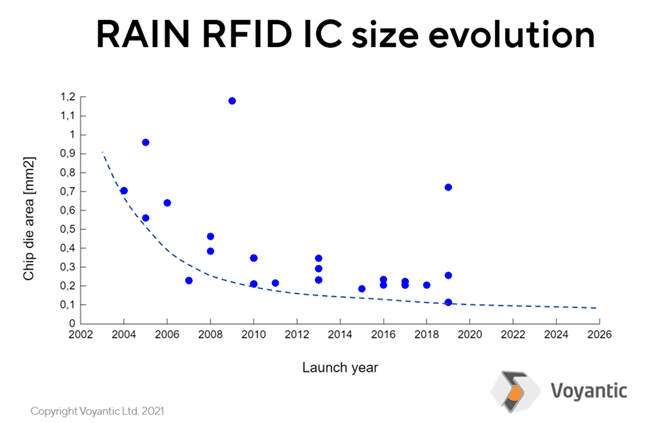
Decreasing IC sizes

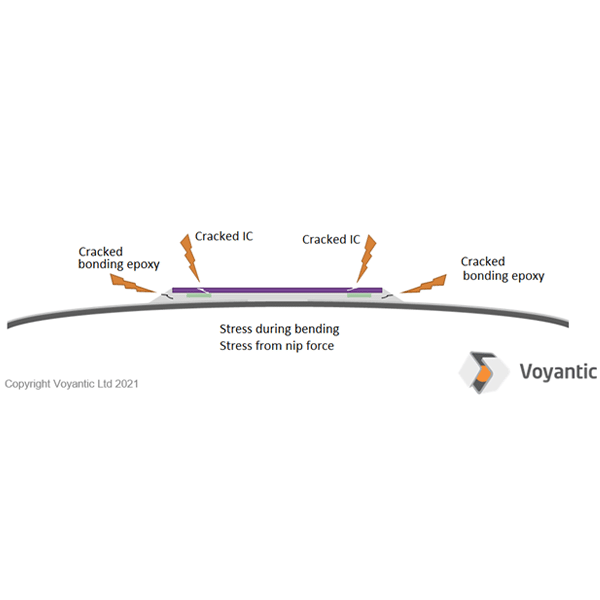
The latest generation of RAIN tag ICs is becoming smaller. When ICs are getting smaller, a natural question is what happens to the connection between the IC, the antenna, and the liner. And what is the effect on the inlay durability?

The latest generation of RAIN tag ICs is becoming smaller

The transition from plastic to paper-based labels

Due to ecological aspects, paper is used increasingly as label base material. The “stickiness” of antennas and ICs to paper is different compared to a plastic liner. Paper also stretches and bends differently than PET.

All paper is not just paper, but different additives and fillers are used to create different properties. All these properties, whiteness, polishing, and so on, may affect how the antenna and IC stick to the paper. Finally, add humidity as an environmental variable, and the durability of the paper-based label needs to be studied for sure.

Faster IC attach processes and new bonding epoxies

IC attach machine speeds keep on increasing and the machine vendors are working their way towards 100,000 UPH. The stress to an inlay with a freshly attached IC is higher when lane speeds increase. There is also less time to cure the bonding glues, which has led to new glues being introduced. These new glues require less time to cure, but may need higher curing temperatures. Again, a question about durability comes up: How to fine-tune the bonding process so that the label durability is not compromised?

Faster converting machines

Converting process speeds are also increasing. Higher machine speeds stress the inlays and labels. An obvious worst-case to avoid would be inlays starting to break already during the converting process. Do the inlays survive intact through these fast processes?

Label type NFC tags

Traditionally a label has been one of the major RAIN RFID tag formats. NFC tags have been made more as smart cards, various key fobs, and other more rigid formats. Lately, NFC label production has also started to grow. This extends the label durability question from RAIN RFID to also NFC. Are NFC labels also durable enough to survive through the label life cycle?

All the above changes are happening in parallel. The combined outcome is what matters. Are the inlays durable with all the new materials, components, and processes?

Standard durability test method

Test principles

The basic principle of durability testing is to compare a meaningful parameter before and after a stress, and to analyze the results to determine whether the stress creates unwanted consequences. Because the tags under testing are stressed, potentially to the point of breaking them, the method cannot be used for testing every individual tag. It is rather used to test the designs, and indirectly the manufacturing processes.

For many electronics products, heat cycling is a standard durability test method. Also, drop tests, pressure tests, tumble tests, and shear tests are frequently used. For smart labels, the default test method is bend testing. The need for bend testing comes from the typical smart label failure methods.

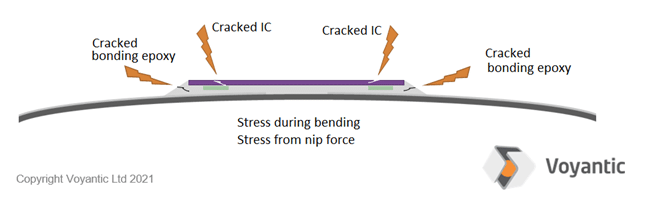
The two most likely points to fail in smart labels are chip bonding and the edges of the IC. Bend testing is a way to verify the sufficient durability of both of these possible failure points.

Test method

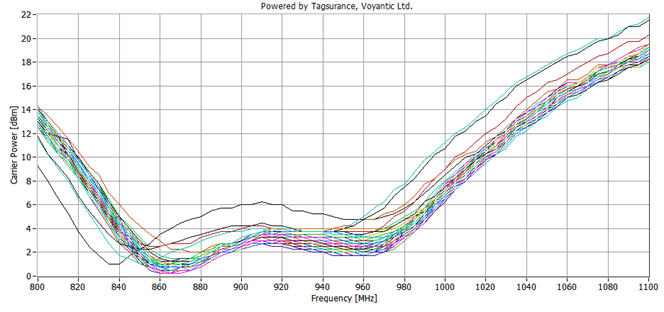
At the beginning of the test, a baseline performance needs to be measured. The baseline performance of the sample set consists of the threshold sweep result of each of the tags in the sample. The threshold sweeps can be done with Voyantic Tagsurance® devices. The curves describe how much power is needed for waking up the tags at different frequencies.

Threshold sweeps of 98 pieces of RAIN RFID inlays before the durability testing

After the baseline test, stress is applied to the tags, and then the tag performance is tested again.

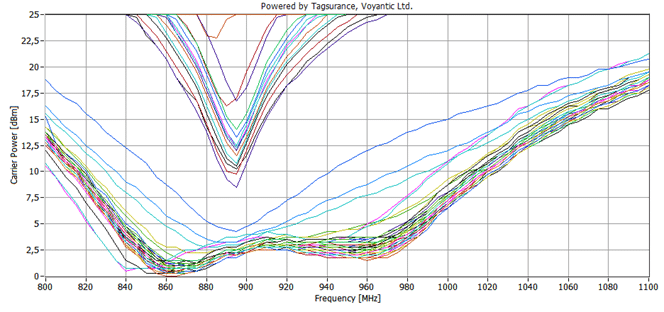
This cycle of test rounds and stressing the labels are repeated until a targeted performance decrease has been reached. The more test rounds an inlay (label) survives, the better is the durability test result aka durability rating.

Threshold sweeps of 98 pieces of RAIN RFID inlays after several rounds of stressing

The test method document describes the details of the test parameters and stress parameters.

Download the detailed standard test method description

Special tags

There are some special tags where bend testing is not (the only) relevant durability test method. For example, aerospace tags are tested according to the SAE AS5678 standard, which defines environmental conditions such as temperatures, vibration, etc., which the tag must sustain. With these standards, the tag is stressed with vibration and extreme temperatures instead of the typical bend testing, which is designed to highlight the common failure methods of cracked bonding and cracked ICs.

The same test principles can also be combined with other durability testing methods. For example, laundry tags could be tested using ISO15797 standard, which defines how garments are stressed with washing cycles. The idea is the same: to find out whether the tag performance decreases too much when stress is applied.

Also, specialty tags that are intended to be used in extreme conditions, exposed to heat, cold, or chemicals, should be tested in combination with applicable stress methods. IEC60068-2 standards (environmental testing of electronics products) provide help for these. IEC60068-2-2 (dry heat) and IEC60068-2-14 (temperature variation) are likely useful methods, and both can be combined with Tagsurance testing. The IEC60068 family also includes test methods for different mechanical stress types, chemicals, humidity, and so on.

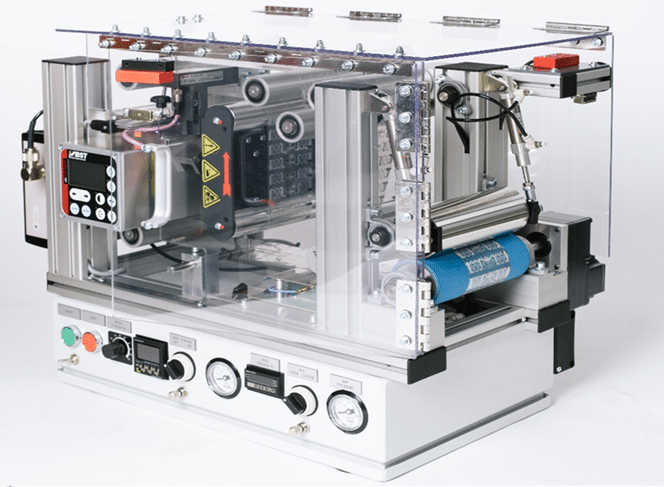
In these special tag durability tests the RFID testing, both baseline and the test after stress, can be made with Tagsurance® systems. Between the RF tests, different stress is applied with the Voyantic Bendurance machine.

Voyantic Bendurance™

How durable is good?

An obvious question related to durability testing is: How durable is durable enough? Or: How durable is good and what is not good enough?

There is no clear answer to these excellent questions. Laundry standard ISO15797 has its criteria and a way to define what is durable enough. SAE AS5678 similarly has its criteria for aerospace tags. But those criteria cannot be extended to other use cases and tag types.

One answer could be: Durable enough is when a smart label survives its intended life cycle. That answer does not help in practice.

Another way is to look at comparison data. It doesn’t give a simple answer but probably helps in practice. If an inlay is as durable as others, most likely it is durable enough. And on the other hand, if an inlay is less durable than a typical inlay, a closer look should be taken, and possibly an improvement is needed.

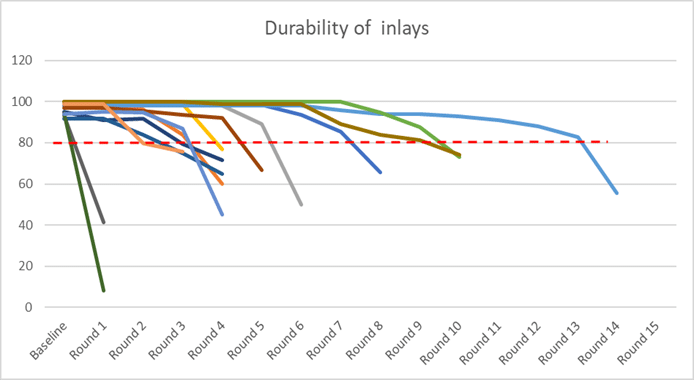
Comparison data in mind we tested some dry inlays with the following results.

Change of dry inlay yield after each test round

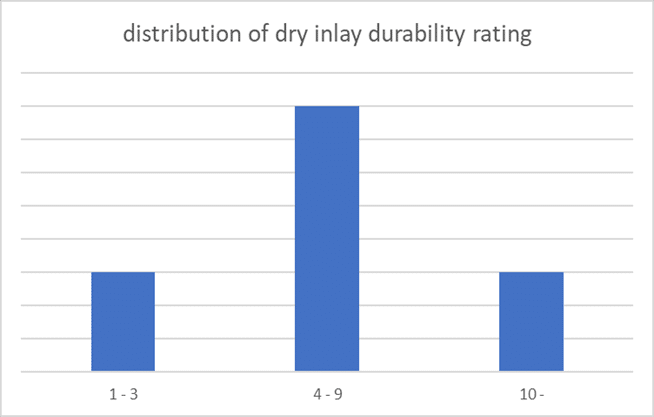
There were significant differences in the dry inlay durability. With the weakest dry inlay model, over 90 % of the inlays broke beyond specified performance with the first test round. The strongest inlays survived more than 10 stress rounds.

  • About 20 % of the dry inlays got a durability rating of 1-3
  • About 60 % of the dry inlays got a durability rating of 4-9
  • And about 20 % of the dry inlays got a durability rating of 10 or higher
  • Median durability rate for all the tested dry inlays was 4, and average about 5.5

This suggests that dry inlay durability could be considered typical if the durability rating is between 4 and 9.

Summary

Faster manufacturing machines and new materials have increased the need for testing the durability of RAIN RFID and NFC inlays.

Voyantic Bendurance is a durability test system focusing on bending, the typical failure mechanism of the inlays. Bendurance with its standard test method gives comparable durability data of the inlays.

A similar approach can also be used with other durability testing such as the SAE AS5678 test for aerospace tags, ISO15797 tests for laundry tags and tags integrated into apparel, and IEC60068-2 for durability against extreme temperatures, other types of mechanical stress, chemicals, and so on.

Download the standard test method description

Request a Bendurance demo

Request a durability test system quotation

Switching into a New IC in Inlay Design – Is There a “Quick n’ Dirty” Way?

Jul 01, 2021

A few months ago, I started receiving questions about switching to a new IC in inlay manufacturing. All these vendors had done several IC changes over the years, but there was something new going on. The questions were centered around possible shortcuts in the process.

  • “What if I just change the IC and don’t change the antenna design at all?”
  • “What if I don’t waste time in machine settings and just do it quick n’ dirty?”
  • “Are there any ICs that are ‘plug and play’ with other models?”

Unfortunately, I could not offer any help. I did find the question interesting though. At first, I tried to figure out some approaches on my own but did not get past the very basics. That is when I asked help from my colleagues Juho Partanen and Jesse Tuominen, and started doing some research on the topic.

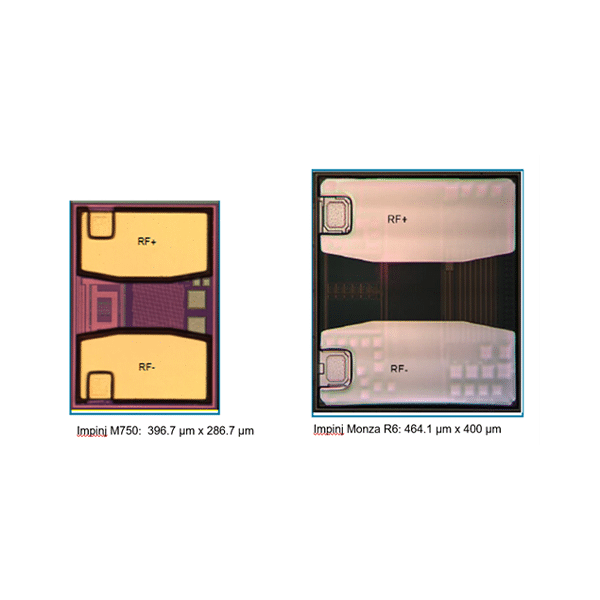
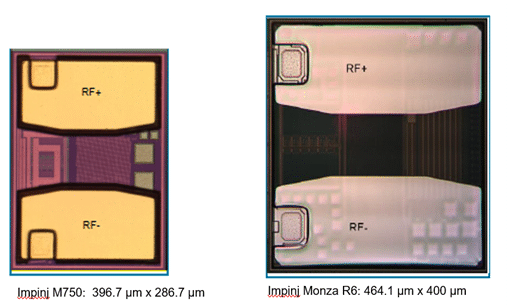
In scale comparison of Impinj M750 and Monza R6

Together with Juho and Jesse we put together a whitepaper that outlines the process and key considerations for switching from one IC to another.

Download the white paper

Key considerations for switching from one IC to another

The IC vendors have plenty of helpful material available:

  • IC Datasheets
  • Reference antenna designs
  • Industrialization guides.

Some of the material is not publicly available, so reaching out to the IC vendor for help is a good starting point.

  • Start by verifying the suitability of the IC functionality.
    If you only need 96bit EPC pretty much any IC can do it. But some IC’s have a lot more functionality. More EPC memory, different amounts of user memory, and they support various optional EPC gen2 commands.
  • Then focus on production.
    Getting all the details and settings in the IC attachment process adjusted for the new wafer, for the new IC, and possibly for the new bonding paste can take time. This is also a time to check the durability of the new IC attachment.
  • When the production compatibility is confirmed, focus on the antenna design.
    Optimizing antenna design is always recommended, and with the IC vendor’s reference designs as a starting point, the design is not that huge of a project. In some cases, it is possible to take small shortcuts, but the time saved is not much. A good and optimized design is a better approach.
  • Focus on quality.
    As with designs, shortcuts do not make sense. The best approach is to fully utilize the new IC and optimize the tag performance and quality.

Learn How to Switch from One RAIN RFID IC to Another

Learn more about each step in the process of switching from one IC to another

RAIN RFID Industry Paving the Way for Eco-friendly Tagging

Jun 11, 2021

For more than a decade, RAIN RFID tag antennas were etched, and the substrate was PET film. Copper was first substituted with aluminum, and various other technologies have emerged, such as printed antennas, and cutting, milling, or laser engraving metal foils.

More recently we have seen antennas being applied on paper and even directly on the packaging and on other surfaces. Much of that development has been driven by cost, but the ecological and sustainability aspects are rising in importance.

Juho Partanen recently moderated an online panel discussion on various aspects and implications of sustainability and eco-friendliness of RAIN RFID tagging. The panelists included Sipi Savolainen from Stora Enso, Jerome Lemay from Decathlon, and Emmanuel Arene from Primo1D. The discussion ranged from ecological tag materials to the technology itself contributing to system-level sustainability through enabling and driving applications for the circular economy.

Watch the panel discussion recording

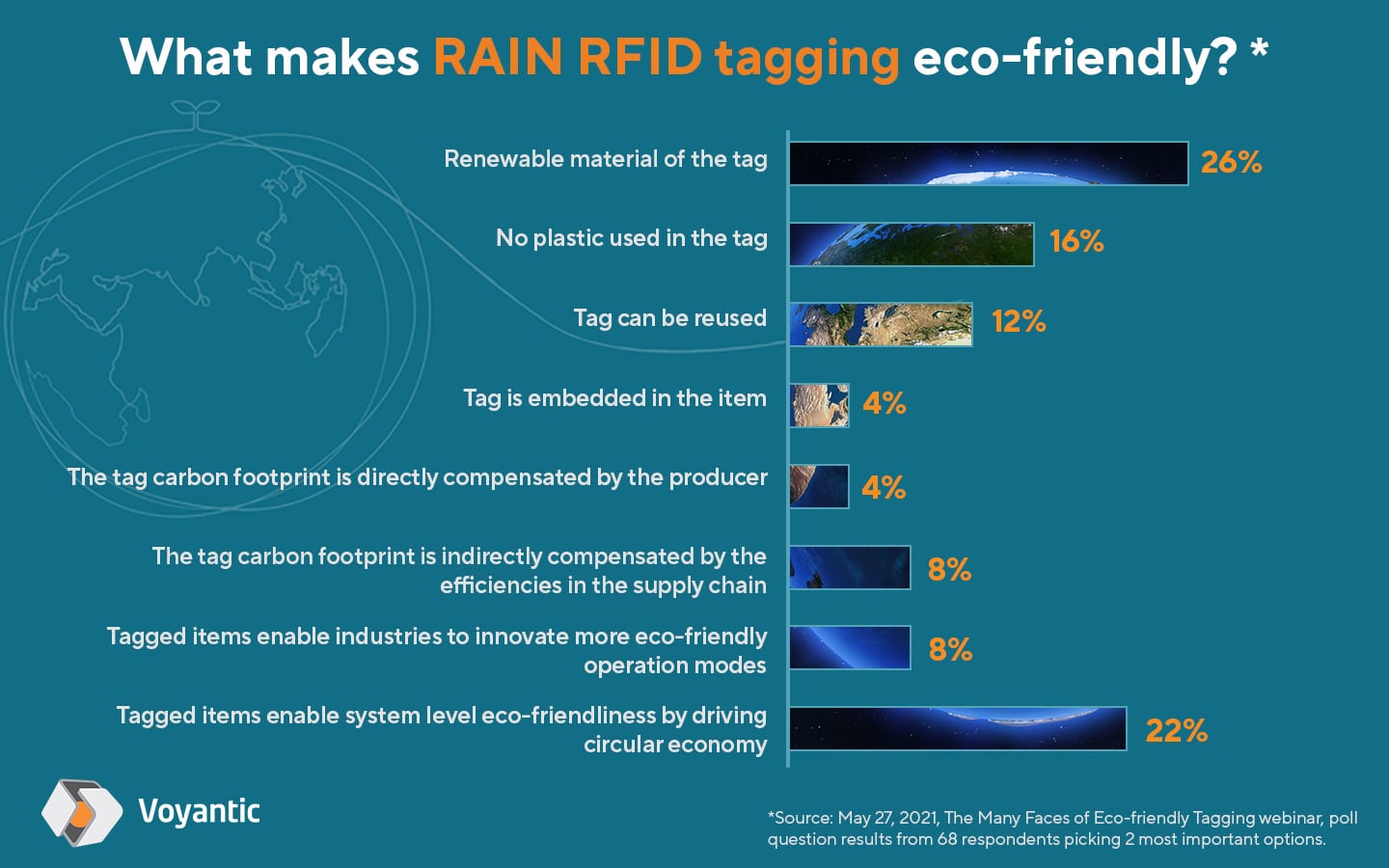
Before the discussion started, we asked the attendees how they would rate various aspects of eco-friendliness? A quick poll revealed the following:

The initial attendee views support the notion that although moving to renewable and recyclable materials for the tags is a no-brainer in terms of eco-friendliness, there needs to be a more holistic view of the whole system – how the technology enables cradle-to-grave traceability, waste reduction, efficiency improvements, transparency plus other aspects crucial for driving the circular economy and sustainable consumption.

We received a lot of attendee questions during the discussion and since the webinar time was limited, we were not able to address them all during the live session. So we asked our panelists to provide some additional answers for this blog.

Follow-up Q&A from the panel discussion

The responses to the following questions have been written by Mr. Sipi Savolainen from Stora Enso.

Question: If a tag is paper-based, could it be placed in the paper recycling bin, as it includes electronics and metal?
Answer: All paper and cardboard recyclability testing is based on the ability to separate non-fiber-based materials from fiber materials and screen those components before re-pulping. According to the results of PTS RH 021/97 Recyclability of Packaging Products and TAPPI UM 213 Repulpability testing (mod.), ECO tags are recyclable within paper and paper board recycling processes.

Question: According to WEEE regulation, RFID label is still regarded as electrical waste, I doubt if the paper-based label can be recycled as paper?
Answer: Passive tags are considered to fall under the scope of the WEEE directive. However, as tags are being attached to items they are naturally disposed with the material/object they are applied to. The best suited waste management process is defined based on the material/object type.


The response to the following question comes from Jerômé Lemay from Decathlon.

Question: What are the most influential factors that can move world businesses towards practicing environmental sustainability?
Answer: For Decathlon, sustainability is considered in a holistic way and, in addition to preserving nature, also includes taking care of people, and creating sustainable value through governance and business ethics, for example. Environmental sustainability is the third pillar and includes tackling climate change and driving the circular economy.

Environmental sustainability needs to be incorporated into the strategy and values, and forward-looking businesses should see that it is also what their customers are expecting.


The response to the following question comes from Emmanuel ARENE of Primo1D.

Question: Obviously, depending on which material the Primo 1D is embedded it changes its perfromance. Is the antenna re-tuned for each different material?
Answer: Yes, the performance of our embedded system is intimately linked to the permittivity of the tagged item. To make sure the RF performance and durability are optimized for each material, object, and use case, different elements can be tuned: the antenna material and its design, the chipset, and the packaging of our RFID UHF tag as well. Primo1D has all resources in-house to support product development and industrialization process till ramp-up.

Panel Discussion: The Many Faces of Eco-friendly Tagging

Listen to expert panelists from Stora Enso, Primo1D and Decathlon wrap their heads around the eco-aspects of RAIN RFID tagging.

Analysis of the Cost of RFID Quality – And How (Not) to Lose a Customer

May 03, 2021

We hosted a webinar on managing quality in RAIN RFID and NFC manufacturing. During the session, industry experts shared their views on setting quality goals, on the relevant standards, and on best practices for quality testing through case examples and practical tips. While veterans in RFID quality testing recognize the need for it to achieve excellent and consistent quality, for many less experienced in the field, it can be puzzling to justify the investment for the required RFID test equipment.

With this in mind, it is worthwhile to explore whether the cost of good quality in the context of RFID is justifiable. In an earlier blog post, we discussed optimizing the cost of quality. In this post, we give an example analysis of RFID quality costs.

Analysis of the Cost of RFID Quality

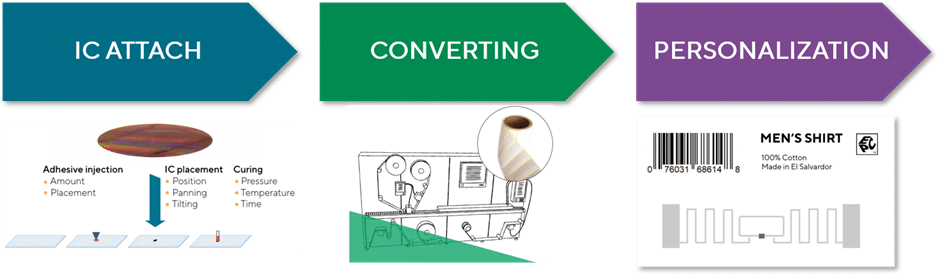
Typically, the three main process steps in smart label manufacturing are chip attach, converting, and personalization. While the process details are specific to the manufacturer and machine, the analysis methods are universal:

  • Failure analysis: What is the impact of possible machine failures?
  • Process analysis: How do quality defects impact the process?
  • Cost analysis: What is the cost of quality defects?
Three main processes in smart label manufacturing

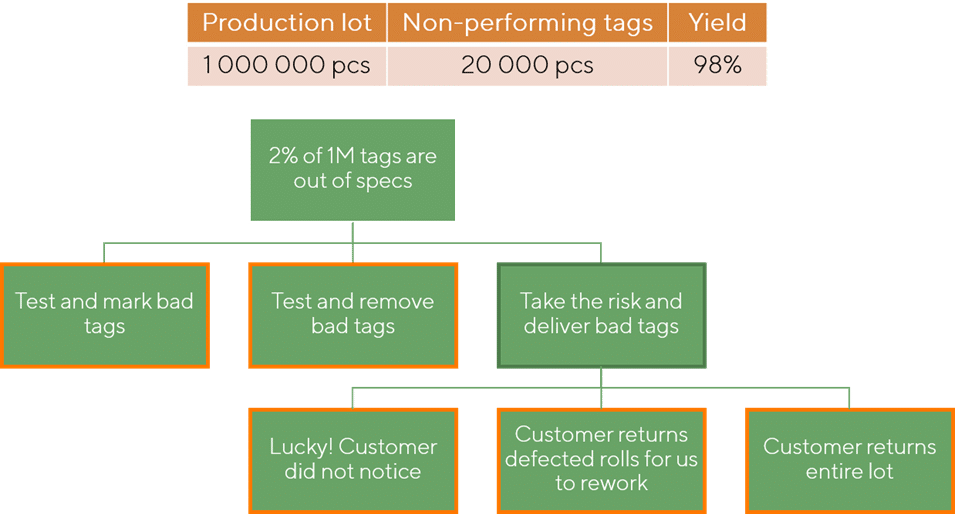
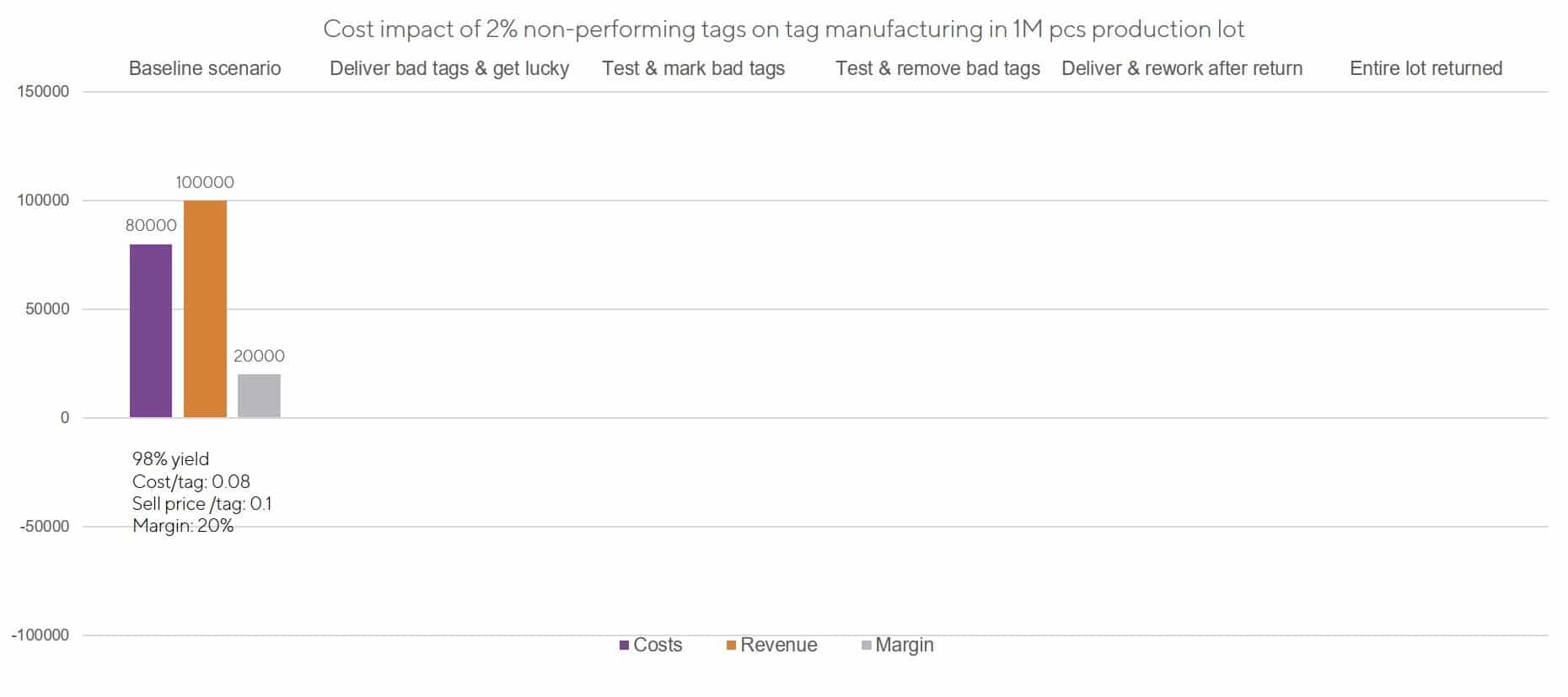
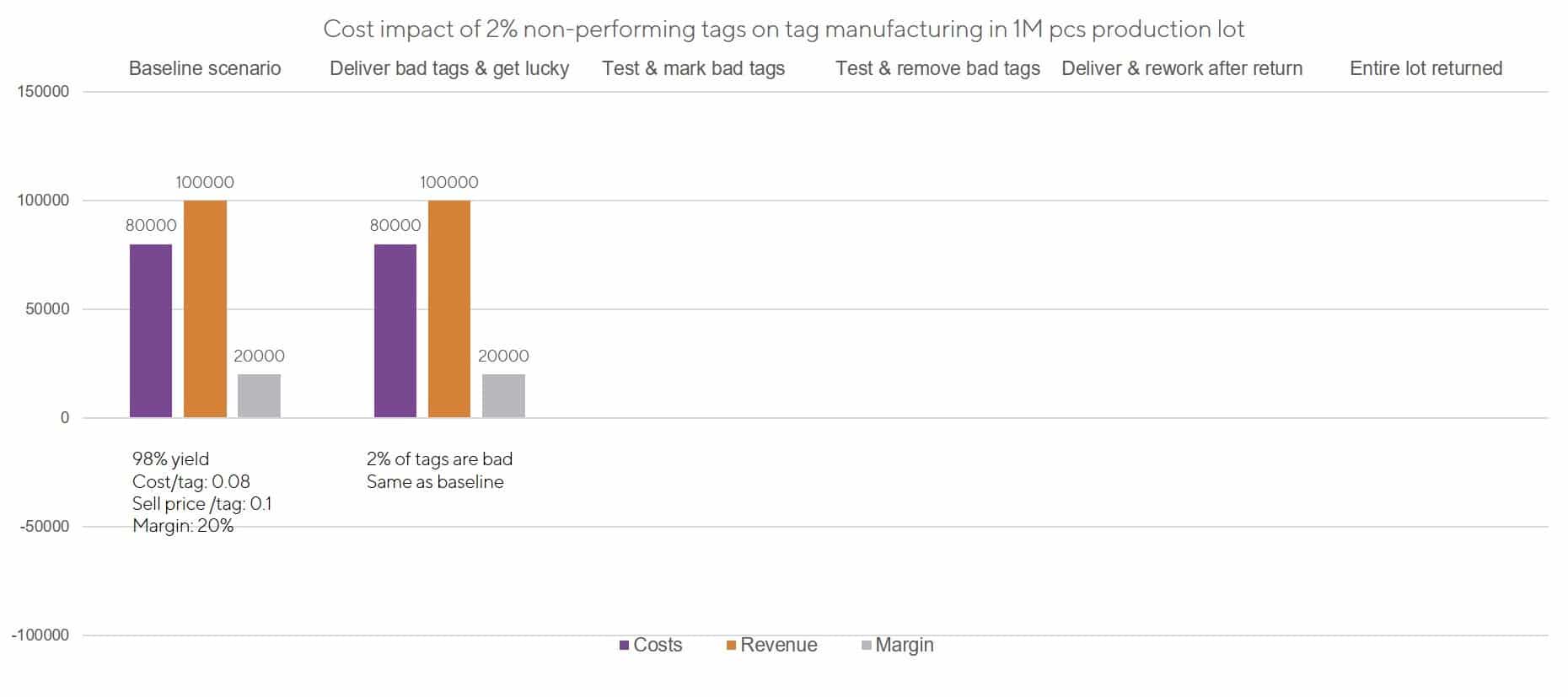
To remain in scope, our example analysis focuses on the cost impact of non-performing RFID tags in production. The case analysis is inspired by the case study presented by our customer Lab ID in our previous webinar session. In our modified case example, we are tasked with the delivery of 1 million labels to a customer. Let us assume that our manufacturing process has a yield of 98%. Out of the 1 million produced tags, 2% would be non-performing, meaning that these tags are bad quality or out of specification. Confronted with this reality, there are three possible actions to address non-performing tags which are described in the picture below.

Different scenarios that can play out based on the action taken to address quality testing and deal with bad tags

The first one is the baseline scenario for the case. We assume that cost and sell price per tag are 0.08 and 0.1, respectively. This leaves us with a margin of 20% for this production lot. In this scenario, we do not take into account any potential cost impact of 2% non-performing tags.

Base scenario – 2% of tags are non-performing

In the next scenario, we ride our luck and deliver all tags without addressing the bad ones. Thankfully, the customer does not notice any defects this time. While the 2% of non-performing tags did not have any repercussions on our margins, the last two scenarios showcase how repeating the action might bite us back the next time. We also do not consider the implications of how the bad tags will inevitably affect our customer’s business.

We get lucky – customer does not notice delivered bad tags

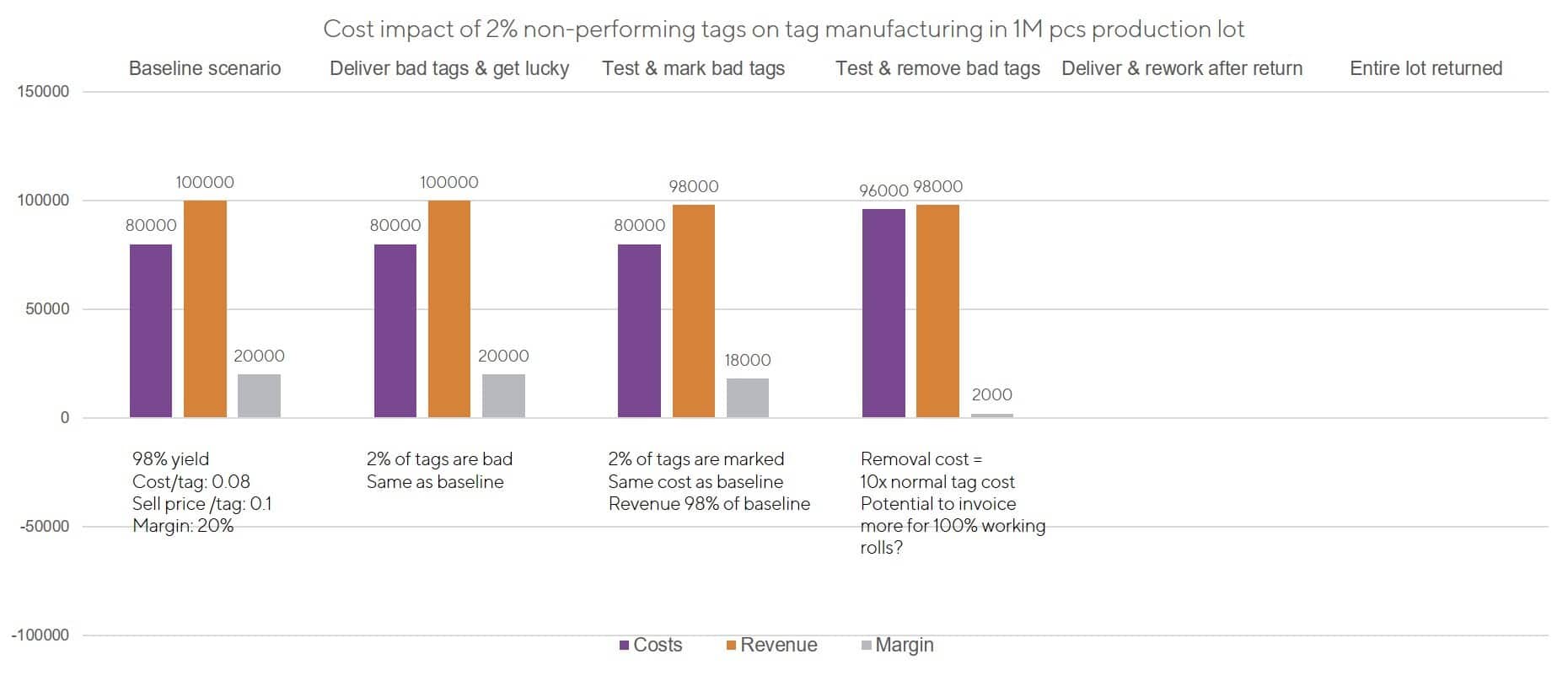
We can also do something about the bad tags. In the third scenario, we decide to test our tags and mark the bad ones during production. This would incur costs in the form of initial tester investment (a capital expenditure that is omitted from the costs of this single production lot) and marker ink (a largely negligible running cost). Marking the tags does not introduce extra production processes or require an operator to supervise the machine. With the help of the tester, we are able to mark the non-performing tags out of the 1 million. This sees our margins decrease slightly (20% to 18%) as we do not charge the customer for the bad tags.

Alternatively, we can also decide to test and then remove bad tags during production. Aside from the initial equipment investment as with the previous scenario, this also requires additional steps in the production, e.g. by handling non-performing tags with a splicing table and changing them to a normal one. This process also requires an operator overseeing the production process which induces additional costs. For our analysis, we assume this removal of a bad tag is ten times the normal cost of producing a tag. This would add a somewhat significant cost to us but our margins remain positive at 2%. Worth considering in this scenario is customers’ willingness to pay more for rolls with 100% working tags. This could help offset the extra costs associated with tag removal.

Testing tags – in both scenarios we can achieve a positive margin

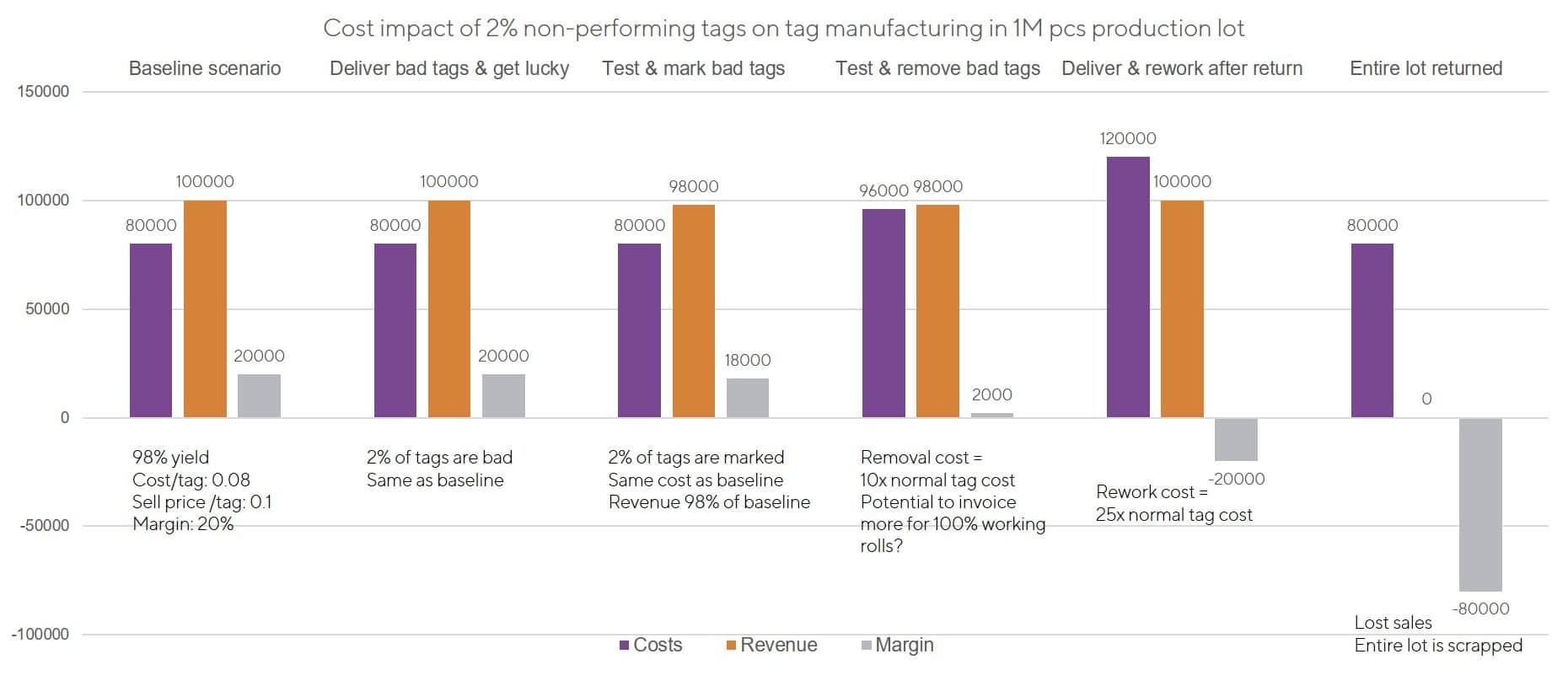
Next, we deliver all tags, 98% good and 2% bad. This time neglecting quality has consequences: the customer notices defects in our delivery, returns the lot, and demands we rework them to reach the promised quality. This requires us to find the non-performing tags from the lot and replace them with good-quality ones. For our analysis, we assume all that tag replacement hassle along with the changes to production planning costs us 25 times the normal cost of producing a tag. Not only have our margins turned negative, but we also need to deal with an annoyed customer whose plans have been disrupted.

Final two scenarios – not testing tags can have grave financial and reputational consequences

In the final “doomsday” scenario, after delivering the production lot, the customer detects the defects, simply returns the lot, and stops doing business with us. Revenue for this production lot has been lost, our customer relationship is severely damaged and our reputation as a tag manufacturer is also at risk. Not addressing quality issues and providing no quantifying proof of quality can have severe consequences. As shown, a single batch of tags mixed some with inferior quality can do much more harm than expected.

Loss of customer relationships is difficult to measure in costs

Being able to quantify quality puts tag producers in a superior position to win and establish trust with customers. Getting there requires effort but as shown in our example it is a worthwhile pursuit in the long run. We are happy to help with your needs in getting there. A good resource to start with is our webinar on managing quality in RAIN RFID and NFC manufacturing.

On-Demand Webinar

Quality Management Approaches in RAIN RFID and NFC Manufacturing

The Benefits from RFID Technology Growth in this Decade

Mar 25, 2021

I work as an engineer at Voyantic and my main fields of expertise are electronics and radio science. Last autumn I started studying business administration to get a wider perspective in general. I have been trying to tie my work and studies together as much as possible, and when I attended a course called “Future experts 2030”, I got the idea to look into the future and see what it might bring for the RFID industry. More specifically: I tried to pick some trends which would have the most impact on the growth of the RFID industry.

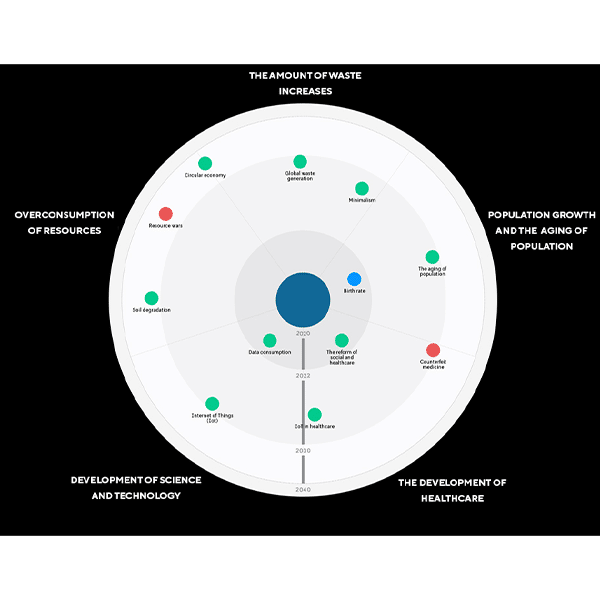
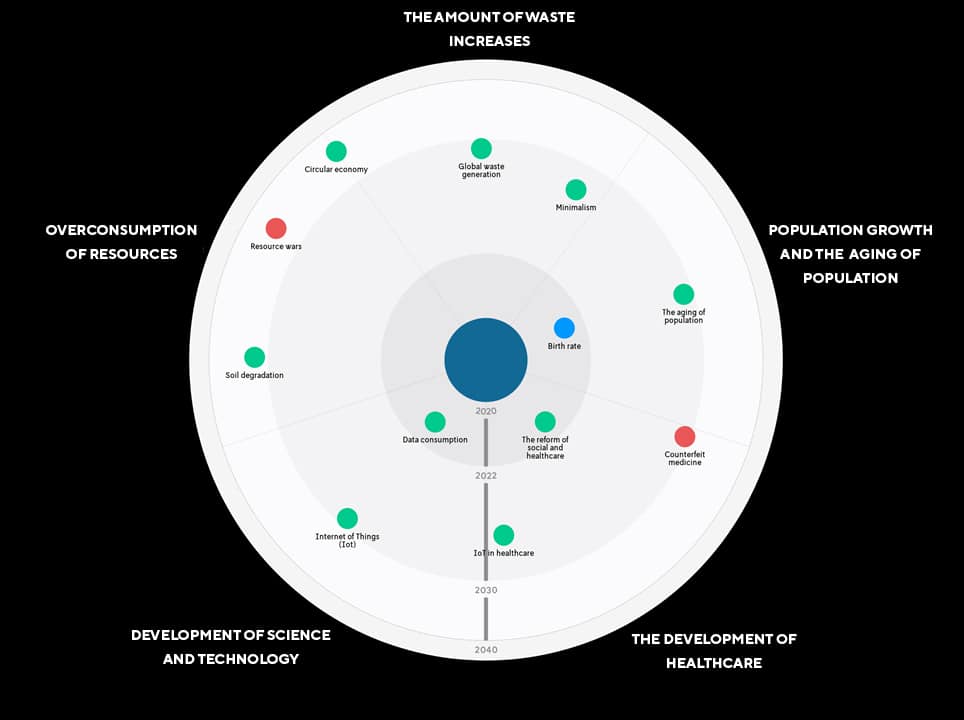
Of course, there are a lot of possibilities, but I chose to take a closer look at five megatrends:

  • The development of science and technology
  • Overconsumption of resources
  • The amount of waste increases
  • Population growth and the aging of the population
  • The development of healthcare

Those megatrends were put on a future radar and some important elements were added for each sector.

The further from the center the elements are, the weaker their effect is in the present time. The colors represent the trend of the elements:

  • Green: Strengthening
  • Blue: Weakening
  • Red: Wild card

Let’s look into these trends and see what they have to do with RFID.

The development of science and technology

RFID technology is developing rapidly all the time, no doubt about that. My colleague Teemu wrote a blog post about the recent RAIN RFID research topics a while ago and listed some interesting topics there. However, if we look at the big picture it is not surprising that other technologies are also developing, and some of those are competing with RFID.

Since RFID enables items (or “things”) to be identified by systems run by computers, it is naturally one of the technologies used by IoT. For example, retail stores can use RFID for automated and real-time inventory. But when we think about identifying an item, is it enough to just know what it is? Wouldn’t it also be nice to know where it came from?

Hospitals can trace people and equipment with RFID tags, and I believe that this kind of traceability would make RFID much more valuable in some cases. That would require that different systems would be able to communicate with each other and pass tag information from one operating environment to another. For example, responsibility is nowadays an important aspect and companies could benefit from more transparent value chains.

Looking from a different perspective, the data consumption in the world keeps increasing exponentially and the data provided by RFID is adding to that. This requires continuously more from the data transfer networks and memory storage. This also brings data management challenges for the RFID systems.


Population growth, aging, and the development of healthcare

In western countries, the population is aging and the lifetime expectancy keeps increasing. The importance of healthcare will also grow while the workforce shortage problem gets worse. Since the amount of work increases, system and service automation should be made effective. This development is fortunately already quite far, as can be seen from another one of Teemu’s blog posts.

More and more medicines are used globally, and online shopping for medicine is also growing. This could attract more counterfeit medicine to the market, and that is something RFID could be used to prevent. Medicine traceability would make it harder for counterfeit medicine to reach the market, which increases the security of the medicine market.

Overconsumption of resources and the amount of waste increases

The overconsumption of resources is a well-known problem around the globe and so is the amount of waste the human population creates. The more we spend, the worse it gets. In the future, soil degradation might prove to be a serious problem for agriculture, and a shortage of raw materials for the electronics or construction industry could be a crippling problem.

For example, in retail, physical waste is created when inventory is not up to date or there are problems in the logistic chain. This causes:

  • Items to go out of date (or fashion)
  • Too many items are ordered
  • Items are lost

RFID is a well-known answer for an automated inventory and the retail industry has adopted it quite nicely.

What is needed from the RFID industry?

To be able to offer reliable solutions for the problems, the RFID industry needs to overcome some obstacles. One well-known bottleneck is the tag manufacturing capacity; the world has not enough capacity to manufacture tags if every retailer suddenly demanded every item to be tagged. We have to pump up the tag manufacturing numbers to be able to answer the growing demand.

Putting up the infra to enable the benefits of RFID is not cheap and requires investment, but I’d like to raise an equally important aspect to overcome. It’s not easy. The end users might not be experts in RF and they do not want to buy the RFID infrastructure. What they want to buy is the automated inventory, which just happens to be enabled by RFID technology. And they need help with that. RFID is not magic and has its limitations that need to be considered. That is why I believe the help provided as a service creates quite much value for the customers and should not be overlooked.

I also believe that it is a problem that different RFID environments do not communicate with each other. It means that the traceability of a tag is cut when it moves from one environment to another. To overcome this issue, the companies could work together and create a standardized system for tracing tag data.

All in all, the RFID industry is in a good position, and seems like the demand for RFID solutions remains high in the future. Hopefully, the COVID-19 pandemic will not cause too much setback for the development of RFID technology due to companies investing less in new systems.

Wearable Sensors, Brain Stimulation and Invisible Tags: Review of RAIN RFID Research from 2018 to 2020

Feb 23, 2021

中文版 Chinese version

Three years ago I wrote a blog article about RFID research published in 2017.

Now it feels like a good time to take a look at the research front again.

  • Have the research themes changed?
  • What are the new hot topics?
  • What should be expected for commercial use in the upcoming years?

First, a disclaimer: The selection of the introduced research papers and overview is my own. Summaries of the articles are short and written from my personal perspective. The points I raise are not necessarily the same as the authors’ intentions. When you find the topic interesting, I recommend clicking the link and reading the whole article.

I started the analysis by looking at the headlines of RFID research articles found in Google scholar, published in 2018 – 2020. I did a word count analysis of the headlines. The word count analysis gave me an idea of the research themes. Here is my take on the RFID research.

Wearable tags

A lot is going on around Wearable tags. This seems to indicate that RAIN RFID tags will be embedded in clothing and apparel in increasing numbers. The RFID applications should be designed to take these “out of system” tags to account.

Wearable tags will become more common

Sensor tags

An ongoing research topic is Sensor Tags. Using RAIN RFID as a means for transmitting information, almost anything can be sensed with RAIN RFID sensors. The trick is to find applications where RAIN RFID brings some unique benefit or a better fit to the application than other data transmission methods.

RAIN RFID tag’s backscatter signal strength changes when tag tilt angle changes, or when tag is exposed to different chemicals.

RFID in health and wellness

Health and wellness is an interesting and growingly versatile research area.

Wireless might work better

Printed Antennas, miniaturization, graphene, and specialty tags

Other hot research topics include printed antennas, tag miniaturization and graphene, and specialty tags

Author’s vision of an invisible tag attached to a window

RFID has a bright future ahead

Overall the research topics indicate increasing maturity in the RAIN RFID and NFC technologies. There is no need to study the basic viability of the technology, profitability, or efficiency of the basic use cases, or common manufacturing methods. Research works at the edges of the technology – and those edges are a good distance away from the everyday RFID and NFC use cases. New research is not needed to prove the RAIN RFID usability in supply chain or asset management in retail, manufacturing, or healthcare. Research is not needed for proving NFC’s suitability to travel tickets, access cards, or as a marketing tool.

Research can focus on “wilder and wilder” sensor integrations, the use of RFID in patient treatments, and other innovative and wonderful ideas out there. Strong research on RFID indicates a strong and healthy long-term future for the technology.

The Future of RAIN RFID Tag Design

Watch this webinar to hear our panel of three industry experts identify and discuss trends and disruptions that will affect the RAIN RFID tag industry, and how tagging implementations will change in the coming five years.

Ensuring Reliable Operations of Multiple RAIN RFID Systems in Hospitals

Jan 13, 2021

中文版 Chinese version

I recently gave a presentation at the RAIN Alliance and AIM EngageAgain event about the coexistence of multiple RAIN RFID systems in hospitals. I felt that the topic is important since the use of RAIN RFID is booming in the healthcare industry – including hospitals. Hospitals are unique and challenging environments as there may be several RAIN RFID systems operating in parallel. Each system has its own tags and readers, but they are not isolated from each other.

The coexistence of these systems should be taken into account from the beginning to ensure reliable system operations. The good news is that RAIN RFID technology includes several tools and methods to help with the challenge.

RAIN RFID in hospitals

There are plenty of documented RAIN RFID use cases for hospitals. These can be grouped into several categories:

  • Medicine supply chain tracking and inventory management
  • Medicine administration tracking
  • Patient tracking
  • Asset tracking
  • Tracking staff members and activities
  • Document tracking
  • Managing consumables inventory

These applications use several different types of RAIN RFID readers and plenty of RFID tags:

  • Handheld readers
  • Ceiling mount readers
  • Gate readers
  • Other fixed readers

  • Labels on medication
  • Labels on consumables
  • Embedded tags on consumables and workwear
  • Hard tags on assets
  • Labels on documents
  • Staff ID cards
  • Patient wristbands

There are also tags from other systems such as tags embedded in patients’ clothes.

Why does designing for the coexistence of RAIN RFID systems matter?

When RAIN RFID tags are read or counted, the reader sees all tags in the reading zone by default, even if there are obstacles, such as walls, in between. If the systems are not properly designed, it is easy to read unintended labels.

Example – An application for ensuring that the right patient gets the right medication at the right time: If coexistence is not considered, the system may be overwhelmed with all the tags in the environment: ID cards, tags on consumables, documents, assets, etc. The application fails as a result of the unexpectedly high number of tags.

Methods for enabling coexistence

There are several methods and tools available for enabling coexistence. Some of them can be used together, but not all of them are useful for every application and environment. The decision on which method or tool to use should be made on a case-by-case basis.

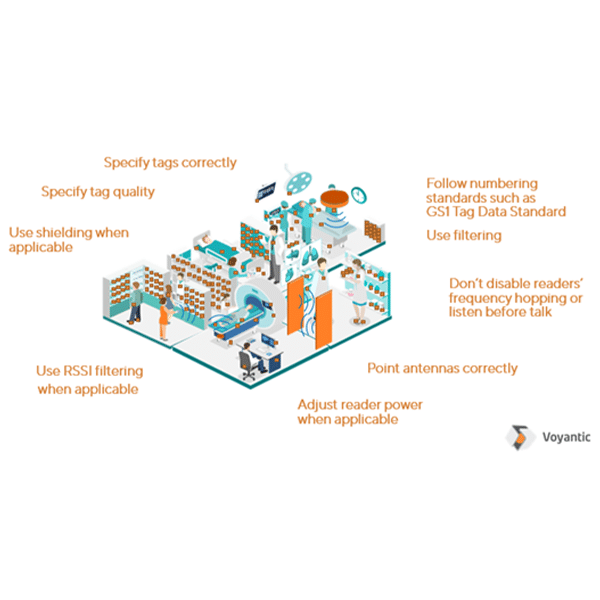
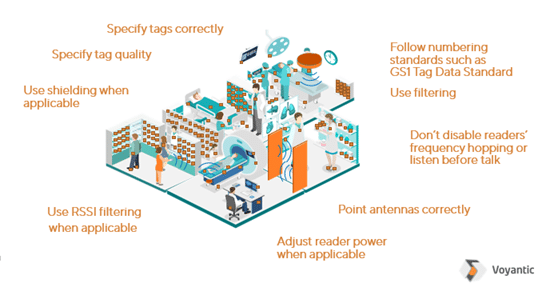
  • Frequency hopping with its interesting history is a functionality of RAIN RFID readers enabling multiple readers to operate at the same time. These reader features are on by default, just let the readers operate as they are intended.
  • Reader zoning is a method where a material blocking RF signals is used to isolate reading areas from each other. This cannot be used always but is worth considering. Read more about Reader Zoning from another blog article.
  • Power adjustment and antenna positioning can be used to adjust the readers’ reading areas. Smaller power enables reading from a closer range, and pointing antennas to different direction changes the reading area. These reader settings and antenna positions should always be optimized with fixed readers
  • Tag selection and tag quality specification should match the applications’ requirements. A short-range tag cannot be read from far, and a tag with a too long read range may create stray readings. Non-specified or low quality tags lead to inconsistent performance, which creates both missed reads and stray readings.
  • RSSI filtering is a method where the reader is set to ignore tags with a response signal that does not match the set criteria. The Response Signal Strength is only an indication of the distance between the tag and the reader, but nevertheless a useful method in some applications.
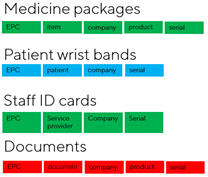
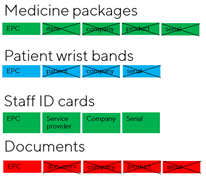
  • Code filtering and using Select is, in my opinion, the most important method and should always be used.

Code filtering and Select

RFID Tag Data Standards follow a structure where the beginning of the code defines which standard is being used, and the following parts define, in more and more detail, information about the tagged item.

For example, the EPC Tag Data Standard and ISO 15961 + ISO15962 Tag Data Standard have about 20 application areas included. The code structure allows filtering tags with codes at multiple levels, such as reading only document tags, reading only patient wristbands, or searching only for a specific tag, such as a staff ID card.

The filtering is done with the Select command in the inventory sequence.

An example – Inventory of medical packages:

  • The reader is set to use the select command as a part of the inventory cycle.
  • The select is set to consider only items with SGTIN codes and ignore everything else. SGTIN is an EPC Tag Data Standard Code that points to Trade Items – items that are sold and purchased. This would also show other trade items, consumables for example. Usually, this is not an issue, since the application is designed to handle a large number of codes, and items not in inventory are just shown unknown items and can be ignored at a software level.
  • Further filtering could be implemented by selecting only items manufactured by specific companies.

An example – Locating a person:

  • The reader is set to use the select command as a part of the inventory cycle.
  • The select is set to consider only GSRNP codes with a specific serial number, and ignore everything else. GSRNP is an EPC Tag Data Standard Code that points to Service providers, and serial number filters this down to an individual.

Filtering relevant tags with select command is a powerful method and should always be used. Use of filtering is based on using standard coding in all applications.

Watch the full presentation recording:

Sourcing ARC Certified Labels – Harder Than You Think

Oct 21, 2020

日本語版 Japanese version

This blog post has been edited after its original publishing. The edits with their justifications are listed at the end of the post.

The COVID-19 pandemic has motivated many companies, including us, to develop and improve different business areas. We started a project studying ARC certified labels, which first required us to get our hands on as many certified labels as possible. We had a plan to source 179 different labels, 50-100 pieces per label, from 16 label manufacturers.

Disclaimer: the pandemic affected the response and wait times for the labels. But even after taking this into consideration, it turned out that sourcing these RFID labels is hard, and requires a significant time investment. In this blog, we take a closer look at how the sourcing process unraveled.

Contacting Suppliers

We started the sourcing process from scratch: searched for the product online and utilized the company websites’ contact information for companies that supply ARC certified labels. This information was easily found, but we didn’t find any possibilities to purchase labels online. As we reached out to the companies, it became clear that we had encountered one of the main obstacles throughout this sourcing process.

About 50% of all the companies did not reply to our initial contact request. None of the companies with a contact form on the company website replied to the original message. In contrast, all companies that had a direct email address to a contact person on their website responded quickly. To reach the 50% that didn’t reply anything, we decided to look for familiar connections that someone at the office knew to get a response and to move forward with the project.

If the first inquiry goes unanswered, I wonder how many potential customers these days simply go with another supplier.

With no previous connections within the industry, we would probably not have been able to get more than half of the labels. Voyantic has been in the industry for over 15 years and we are well networked with tag suppliers. New companies that are interested in starting with RFID technology, however, might not start at all if it is this difficult to get relevant information and samples.

Starting Small Should Be an Option

Small order quantity seemed to be an issue for some companies and required special arrangements and more detailed information. The combination of poor communication and large sample quantities is not very inviting for new companies to start using RFID technology. Increasing awareness and lowering the bar of trying the technology without a significant investment could be crucial for spreading the use of RFID technology.

Customer Research or Interrogation?

We received a lot of questions about our purchase inquiry, e.g., could you share the purpose of your testing, and how will you use the results? Are you sourcing from other companies too? We had limited information to share about the use of the test results at this moment, and this seemed to be the other main issue in this process and, in some cases, even an insurmountable obstacle for purchasing the labels. Sharing this information shouldn’t be a requirement for buying label samples. It is good to gather information on how your customers are using your products to better meet their needs, but not to an extent where it makes the purchasing process slow and difficult or even impossible.

On a Positive Note

Despite the obstacles faced with many companies, some were straightforward to cooperate with and performed exemplary compared to the others. Some companies responded to the sample request the same day, and their samples were received within the following weeks. Some of the requested samples were obsolete, and some had been replaced with new ones, which slowed down the order process for some suppliers as it was very time consuming to agree on sufficient replacement products. However, one company was very helpful when we noticed the label we were looking for wasn’t available anymore. They suggested a comparable label that was shipped within a week.

Highs and Lows of Sample Tag Sourcing

Since we started this project at the beginning of March, we managed to obtain samples from 13 companies by July, but never got the labels from 3 other companies.

Most companies were easy to cooperate with, but in many cases, the sourcing process was extended by additional communications. A good network has been crucial to source the label samples, but also new connections were established, which is always positive.

As a recommendation to tag suppliers, we want to point out that sample orders can be the start of a new, long-lasting customer relationship, which is a good reason to process sample orders with the same importance as regular orders.

Edit on October 22nd 2020. After careful consideration and valuable feedback received from people commenting on the blog, we decided to omit references to specific companies. We feel that it is somewhat unfair to publicly praise some companies at the expense of others based on this sourcing experiment. There may be many reasons why companies have had different reactions to our requests, one of them being that they have recognized Voyantic as not a normal buyer. Finally, we still believe that the topic is important, and our sincere intention is to try to point out something that may be a problem in the industry, not specific companies.

Read more about buying tags from the buyers’s perspective. Download our free RAIN RFID tag buyer’s guide to get a more comprehensive understanding and an example request for a quotation!

Download the RFID Tag Buyer’s Guide

Learn what to ask when buying RFID tags.
Get our example request for quotation to help you get relevant quotes.

Successful RAIN RFID Use is Based on Continuous Improvement

Sep 10, 2020

日本語版 Japanese version

Voyantic is mostly working with RFID technology providers. But I still discuss regularly with RAIN RFID users about their projects and challenges they have seen.

  • missing reads
  • stray reads
  • occasional faulty tags or readers
  • after a small change something doesn’t work anymore
  • and so on

The smaller technical issues often have a root cause in approach to RAIN RFID, especially how it is treated from a continuous improvement point of view. Sometimes (often) RAIN RFID is seen as a one-off IT project. The initial implementation often is an IT project, but when the system is taken into use, the project should not just be signed as complete, but it should be transitioned to the relevant operational organization and under continuous improvement. From this point of RFID has its own particulars.

Already in the implementation project, the continuous use should be taken into account. During the project, it is important to establish the specifications:

  • specify the tags including
    • performance
    • quality
    • tagging
  • specify the readers

Create a Tag Specification for Your RAIN RFID System

When specifying, use standards such as GS1 TIPP, or other methods to specify the performance. An unfortunately common way is to specify a tag or reader model. With a rapidly developing technology such as RFID, tying systems into specific component models is not the best long term approach.

Example of a tagging specification; what elements a specification should contain

This specification is the cornerstone of continuous improvement.

Establish Continuous Improvement and Problem-solving Practices

In several discussions, I have shared a version of a below continuous improvement outline. Let’s build the model step by step to see what it means in RAIN RFID use.

Let’s start with the basic: Do, Measure, Improve cycle.

When this is translated into the world of RAIN RFID use, the elements could be described as in below picture. The specification is the cornerstone of the continuous improvement cycle.

Next, let’s add some details:

Operations refers in this case to the RFID related operations. In-house operations related to RAIN RFID are reading the tags and possibly writing the tags, And then depending on the make or buy decisions, items are tagged, and someone is manufacturing the tags. All of these actions should be based on the specification: What are the tag requirements, how the items are tagged, how the tags are read.

When any system is used long enough, something changes. These changes should be reflected as changes in the specifications.

  • The changes and problems can be noticed reactively, that is: User notices that something is wrong, for example, missing reads in inventory counting, and reports the issue through proper channels.
  • The changes can be recognized proactively: There can be various checkpoints in the process and change implementations. Tagged items can be randomly tested; tags can be tested, new tag suppliers can be evaluated, etc.

If a proactive approach is used, suitable test methods need to be applied. The right approach is to have an in-house RFID test lab.

The same RFID test lab can also be used in problem-solving.

Implementing continuous improvement processes during the RAIN RFID implementation project helps to get the most out of the technology and investment. Transferring the RAIN RFID solution with development practices from project organization to operations ensures successful long term RAIN RFID use.

If you would like to discuss your RFID implementation or learn more about possibilities to set up an RFID lab, please contact Voyantic and request an online demo.